Molecules and Bioenergetics
No description yet. This curated deck is ready for daily study.
Card preview (24)
What is the first law of thermodynamics?
Energy can be converted from one form to another, but can neither be created nor destroyed.
What is the second law of thermodynamics?
In the universe or an isolated system, the degree of disorder only increases.
What makes biological order possible?
the release of heat energy
Why is the release of heat energy necessary for cells to exist?
Cells are islands of order in a disorganized world. Biochemical processes that organize the cell simultaneously release heat, thereby increasing the universe’s level of disorder.
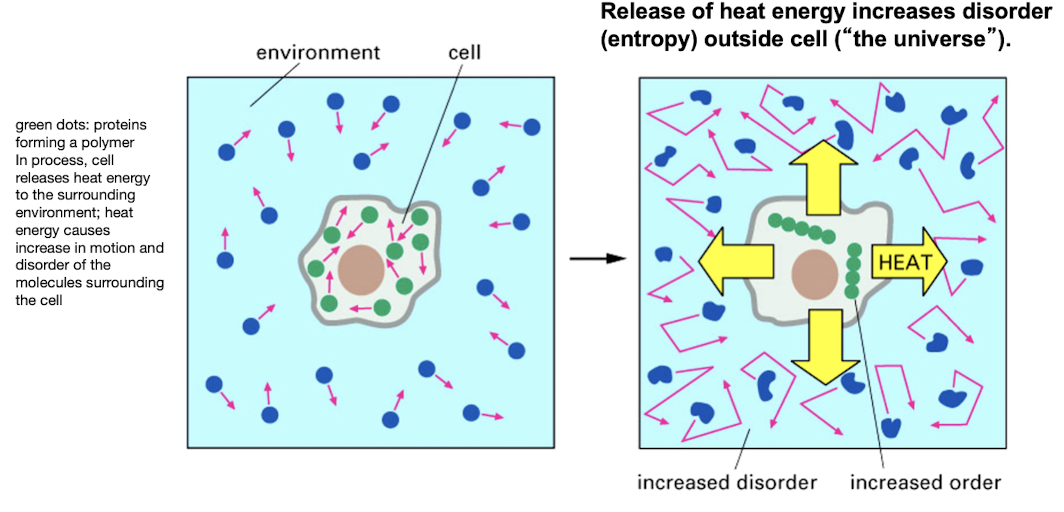
When is heat energy released from a cell?
during the interconversions of different types of energy
What is electric potential?
areas within a cell (or from inside and outside) where the charge in molecules is higher in one area and lower in the other; movement of charge across distances that allows work to be done
What is a concentration gradient?
area of a cell (or from the inside to the outside the cell) where there’s a high concentration of a molecule and somewhere else in the cell, the ion concentration is low; the movement of molecules across distances allows work to be done
Where is the potential energy for molecular work stored?
stored in chemical bonds, concentration gradients, and as electric potential
Why do chemical bonds release energy when broken?
Due to the rearrangement of the bonds and how the molecules interact with the surrounding environment, release energy
What does Gibbs Free Energy measure?
the energy of a molecule that could be used to do work in a cell
What are the four reasons molecules possess energy within their bonds?
vibration rotation translation (movement) enthalpy
What is enthalpy?
energy stored in chemical bonds
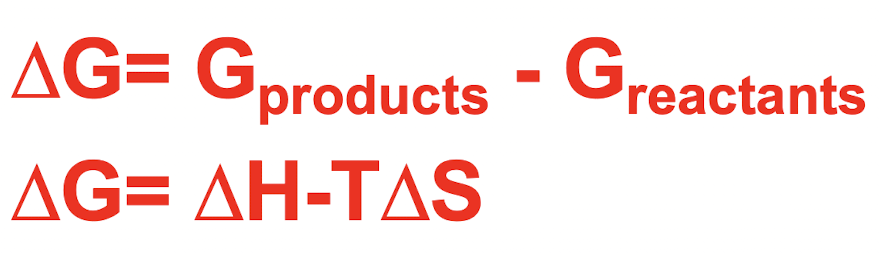
What is the Gibbs Free Energy equation?
G=H-TS where H = enthalpy; T=temperature in K; S = entropy
What is the change in Gibbs Free Energy equation?
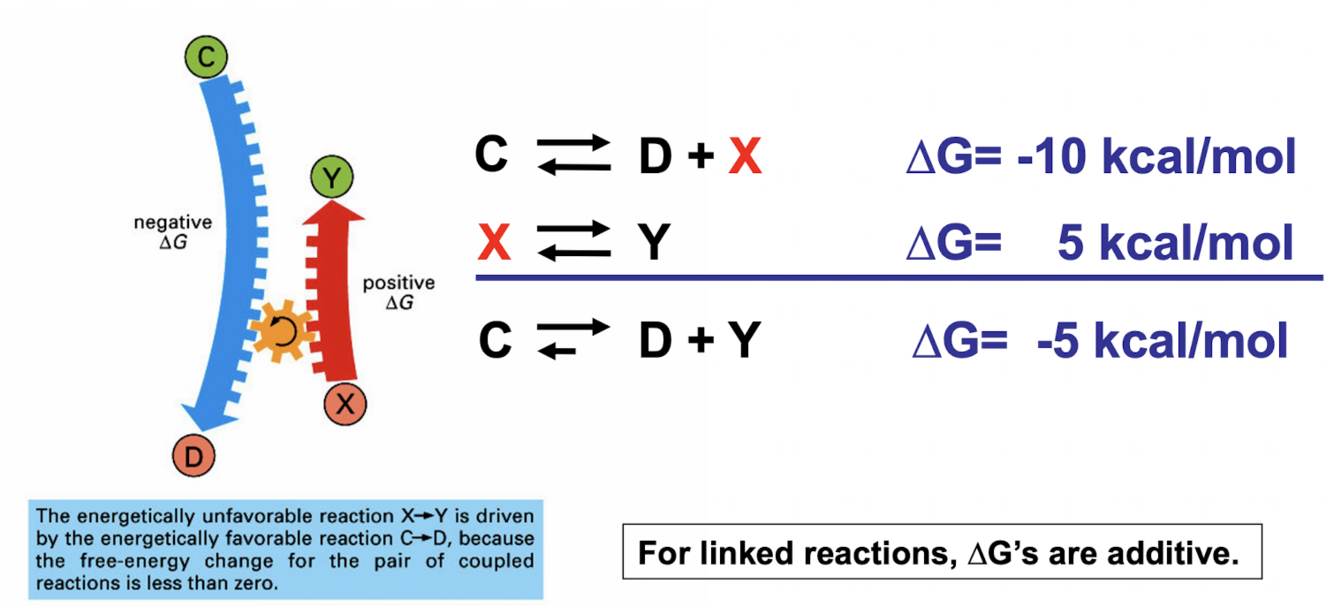
Because many biological reactions result in a decrease in entropy, how does the cell ensure they occur?
Coupling exergonic to endergonic reactions
What does a -DeltaG indicate?
The reaction is exergonic and energetically favorable.
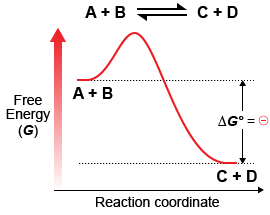
What does a +DeltaG indicate?
The reaction is endergonic and energetically unfavorable.
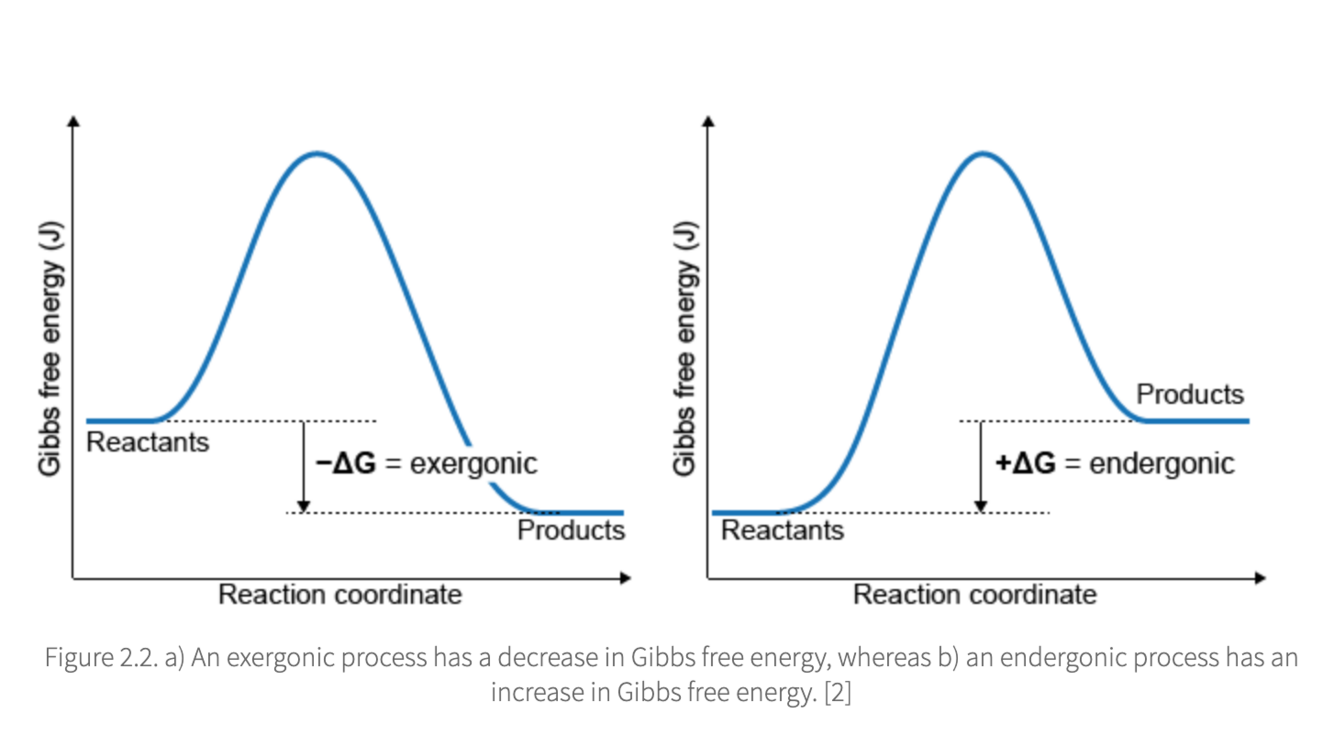
What’s the difference between an exergonic and an endergonic reaction?
In an exergonic reaction, the Gibbs free energy of the forward reaction decreases. In an endergonic reaction, the Gibbs free energy of the forward reaction increases.
If a reaction has a negative DeltaG, a decrease in enthalpy and an increase in entropy, what will happen?
The reaction will occur.
If a reaction has a positive DeltaG, an increase in enthalpy, and a decrease in entropy, what will happen?
The reaction will not occur.
How can I tell if coupling reactions will work?
If the additive DeltaG is negative.
Is ATP an activated carrier or a high energy group?
activated carrier
Is GTP an activated carrier or a high energy group?
activated carrier
Is NADH an activated carrier or a high energy group?
activated carrier