B: Stereochemistry HL
No description yet. This curated deck is ready for daily study.
Card preview (10)
Polysaccharides - Starch
• Polymer of a-glucose sugars -(condensation) • mixture of a-amylose and amylopectin • a-amylose - a-glucose with a-1,4,-glycosidic links • amylopectin - branched polymer of a-glucose with a-1,4,- and a-1,6-glycosidic links • more space between molecules –> not as strong IMF • Helical • not fibrou, not strong • soluble in hot water
Polysaccharides - Cellulose
• polymer of b-glucose sugars -(condensation) • herbivores survive on rich cellulose diets such as grass • provides structure and strength to plants • b-1,4-glycosidic links • linear chains, no branching –> strong IMF between the chains, OH groups form H bonds • insoluble • Humans cannot digest cellulose as we don’t possess the cellulase enzyme • major component of dietary fibre • prevents constipation, hemorrhoids
Hydrogenated Fats
• cis C=C are much more common naturally than trans C=C • cis C=C produce kinks reducing IMFs and are liquids at room temp C=C + H2 —Ni 150degrees–> -C-C- hydrogenated fat • hydrogenated fats have higher melting points because of a higher degree of saturation (Mr increases) • fats like margarine are produced
Advantages - Hydrogenated Fats
• cheaper than animal fats • increased hardness of products • fewer C=C –> reduction in oxidative and hydrolytic rancidity
Disadvantages - Hydrogenated Fats
• Saturated fats are more damaging to the heart and circulatory system • cis fatty acids can isomerise into the trans form - implicated in cardiovascular diseases
Vision Chemistry
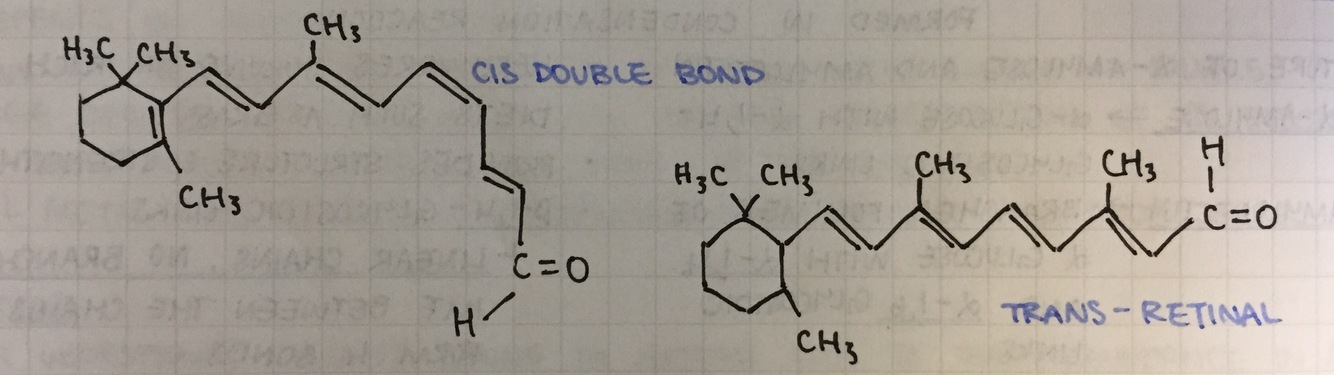
• in the retina there are rod cells (light intensity) and cone cells (color determination) • these cells have a large no. of protein rhodopsin on the surface • consists of the protein opsin bonded to a moldecule of cis-retinal
cis/trans-retinal
• conjugated system –> π electrons in Pz orbitals delocalized –> absorbs light • retinal changes to the trans form –> changes the conformation of the protein which triggers a series of events that result in a signal being sent tot he brain • once the signal has been sent, the trans-retinal molecules converted back to cis-retinal by an enzyme
a and B sugars
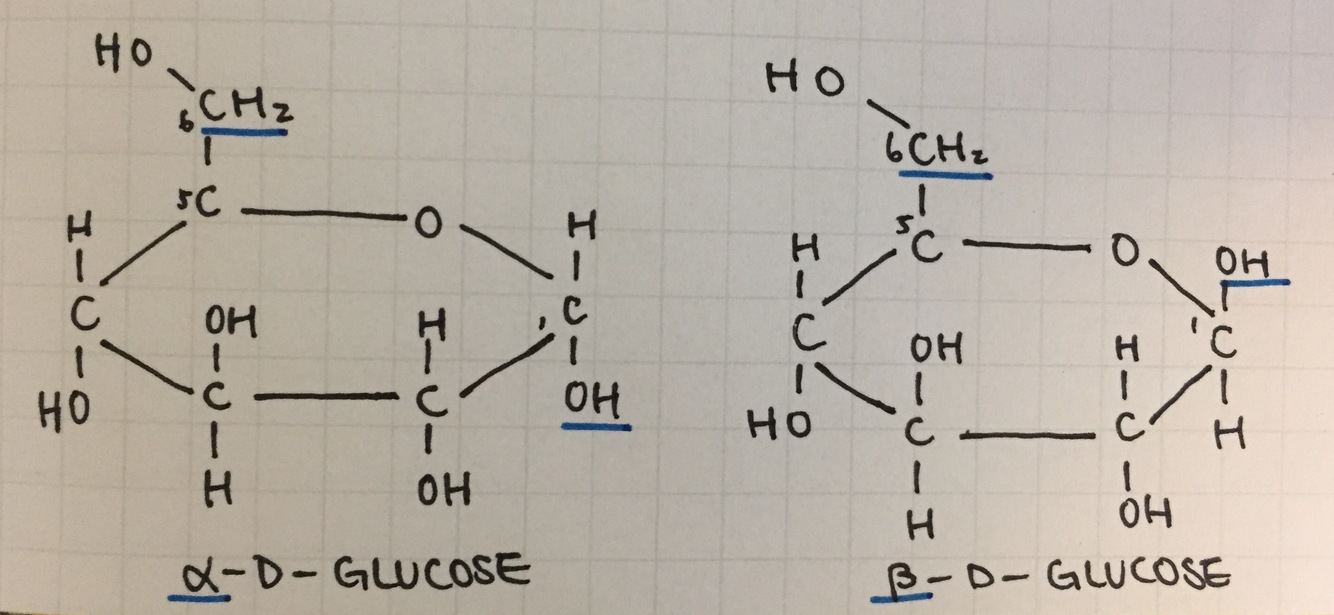
• when a sugar cyclises, an extra chiral center is formed the O on carbon 5 can either attack the C=O group from above or below the plane of the group • alpha - if the OH is on the opposite side to carbon 6/ below the ring • beta - if the OH is on the same side as carbon 6 /above the ring
D and L Optical Isomerism - Amino Acids
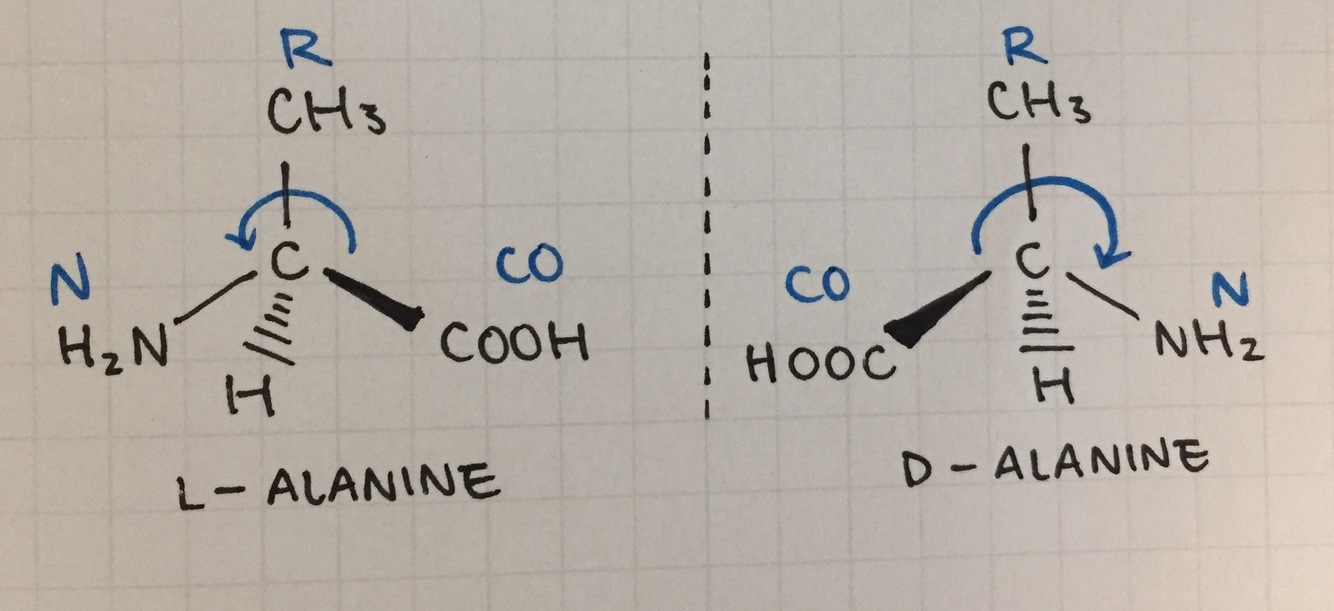
• All amino acids are chiral except glycine (only has 3 different groups) • only the L-configuration is found in proteins C.O.R.N. If moving from the COOH to R to NH2 is • clockwise it is dextrorotatory • anticlockwise it is lavorotatory
D and L Optical Isomerism - Carbohydrates
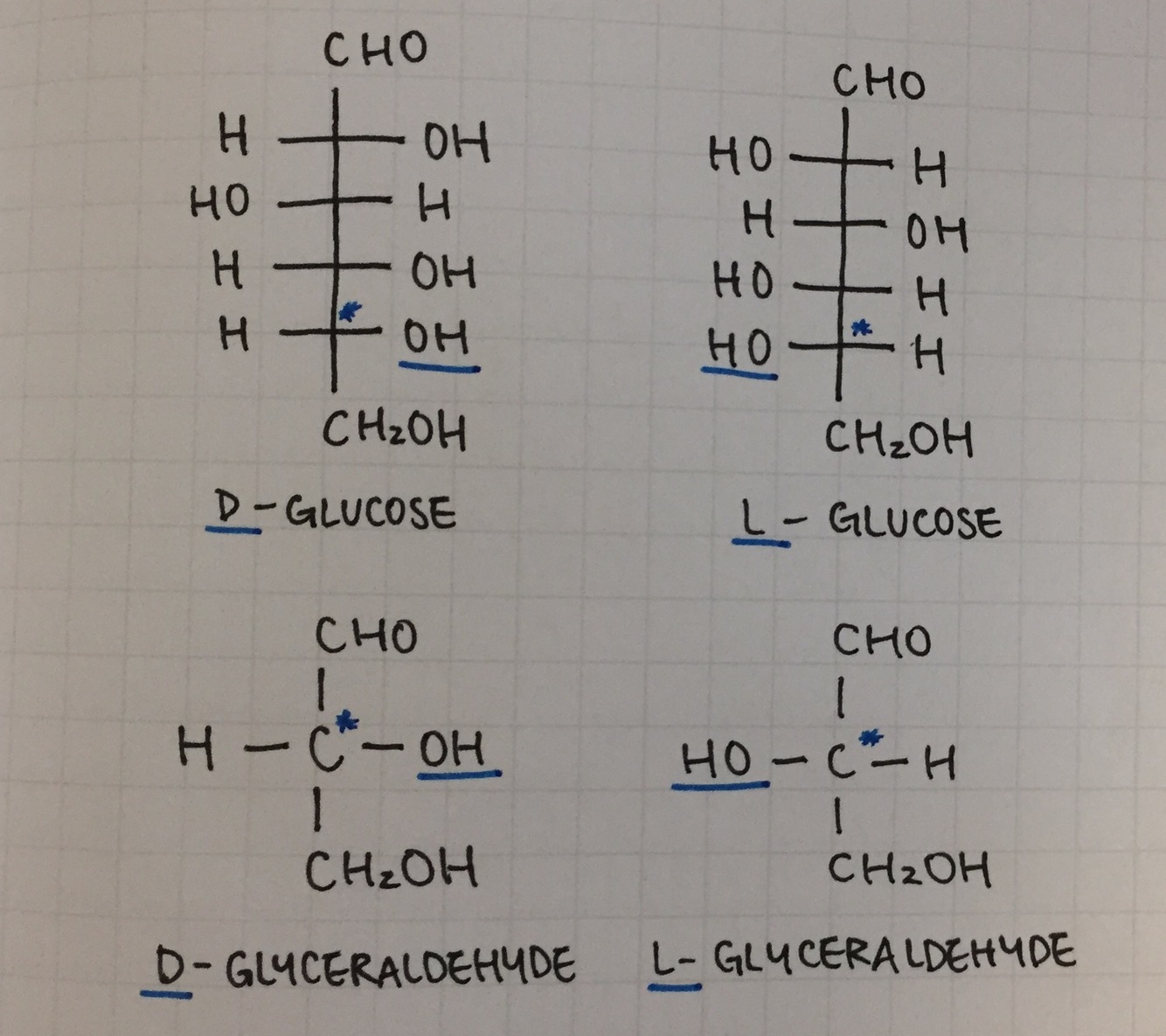
• If the OH group on the chiral carbon furthest away from the carbonyl group is on the right, the molecule is dextrarotatory • if the OH group is on the left, it is lavorotatory • D sugars are much more common htan L sugars in nature