Section 7 Chapter 43 - Vectors
No description yet. This curated deck is ready for daily study.
Card preview (10)
Vector
A quantity with both direction and magnitude
How vectors can be represented as a list
[a, b, c] where a, b, c each represent the vectors magnitude along the x, y, z axes
How vectors can be represented in terms of sets
A 4-vector over ℝ can be written as ℝ<span>4</span>
How a vector can be represented as a function
A vector can be considered as a function that maps {0, 1, 2, 3} to {x, y, z, w}
How a vector as a function can be represented in programming
With a dictionary
How a vector can be represented visually
A vector can be represented as an arrow from the origin to the point that the vector represents
Graphical result of vector addition
Translation
Graphical result of scalar-vector multiplication
Scaling
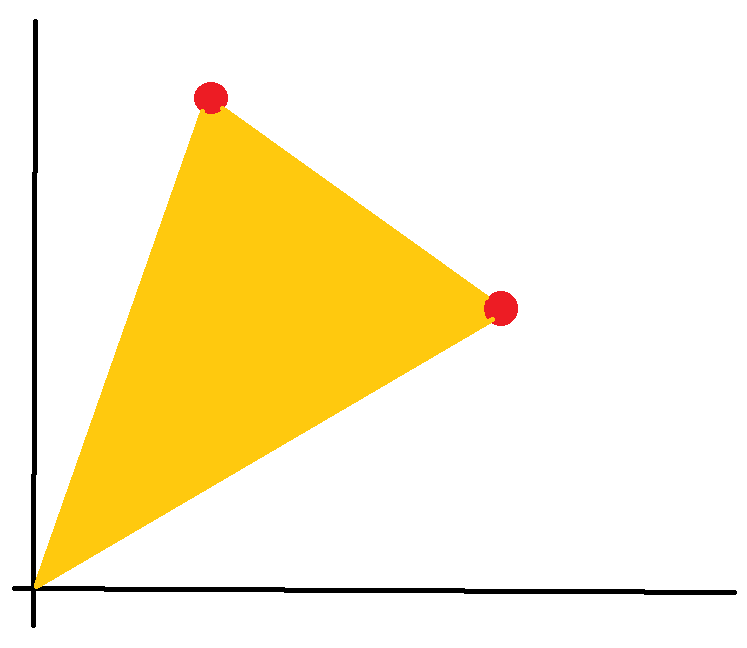
Convex combination of two vectors
If u and v are vectors then their convex combination is in the form αu + βv, where α+β
How vectors can be used as a parity bit checker
u = [1,1,1,1,1] v = [0,1,1,0,1] v dot u (where you replace + with XOR and * with AND) will give you the parity bit to achieve even parity When you sum the products you are essentially taking the last bit as if you were summing binary