Method Evaluation and Quality Control
No description yet. This curated deck is ready for daily study.
Card preview (18)
A Gaussian distribution is usually a. Bell shaped b. Rectangular c. Uniform d. Skewed
a. Bell shaped
The following chloride (mmol/L) results were obtained using a new analyzer: What is the mean? a. 108 b. 105 c. 109 d. 107
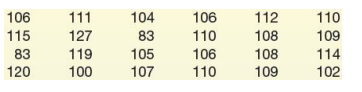
a. 108
. The following chloride (mmol/L) results were obtained using a new analyzer: What is the median? a. 108.5 b. 105 c. 112 d. 107
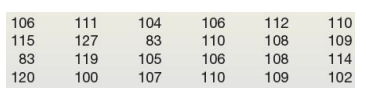
a. 108.5
For a data value set that is Gaussian distributed, what is the likelihood (%) that a data point will be within ±1 SD from the mean? a. 68% b. 99% c. 95% d. 100%
a. 68%
The correlation coefficient a. Indicates the strength of relationship in a linear regression b. Determines the regression type used to derive the slope and y-intercept c. Is always expressed as “b” d. Expresses method imprecision
a. Indicates the strength of relationship in a linear regression
If two methods agree perfectly in a method comparison study, the slope equals and the y-intercept equals. a. 1.0, 0.0 b. 0.0, 1.0 c. 1.0, 1.0 d. 0.0, 0.0 e. 0.5, 0.5
a. 1.0, 0.0
Systematic error can best be described as consisting of a. Constant and proportional error b. Constant error c. Proportional error d. Random error e. Syntax error
a. Constant and proportional error
Examples of typical reference interval data distribution plots include all of the following except a. ROC b. Nonparametric c. Parametric d. Bimodal
a. ROC
A reference range can be verified by a. Testing as few as 20 normal donor specimens b. Literature and vendor material review c. Using samples from previously tested hospital patients d. Using pharmacy-provided Plasmanate spiked with target analyte concentrations
a. Testing as few as 20 normal donor specimens
Reference interval transference studies a. Are used to verify a reference interval b. Are used to establish a reference interval c. Require as many as 120 normal donors d. Use a 68% reference limit for acceptability
a. Are used to verify a reference interval
Diagnostic specificity is the a. Ability of a test to correctly identify the absence of a given disease or condition b. Chance an individual does not have a given disease or condition if the test is within the reference interval c. Chance of an individual having a given disease or condition if the test is abnormal d. Ability of a test to detect a given disease or condition
a. Ability of a test to correctly identify the absence of a given disease or condition
To evaluate a moderately complex laboratory test, all of the following must be done except: a. Analytical sensitivity and specificity b. Verification of the reference interval c. Accuracy and precision d. Reportable range
a. Analytical sensitivity and specificity
An ROC includes all of the following except: a. Perfect test = an area under the curve <1.0 b. Equals receiver operator characteristic c. Plots sensitivity and 1 – specificity d. Can be used to compare two different tests
a. Perfect test = an area under the curve <1.0
For method development studies, which analytical performance test should be done first? a. Imprecision studies b. Comparison of methods (COM) c. Recovery d. Interference studies e. Does not matter, they all need to be done
a. Imprecision studies
For the following series of laboratory values, the vendor has indicated that a true value is 6.0. Series = 5, 4, 5, 6, 7, 5, 3, 8, 5, 9, 5, 4, 5, 6. The SDI (standard deviation index) is: a. –0.3 b. +0.3 c. +1.0 d. –0.7
a. –0.3
Comparison of method studies: a. Estimate systematic error. b. Use primary QC material and standards that span the reportable range. c. Are usually completed within 4 working days. d. Are not required for nonwaived tests
a. Estimate systematic error.
Interference studies typically use as an interferent. a. All of these b. Hemolyzed red cells c. Highly icteric samples d. Highly lipemic samples
a. All of these
• Allowable analytical error is a. A combination of random and systematic error b. Best if it is greater than the total error c. Used only for research and initial evaluation studies
a. A combination of random and systematic error