Unit 2: Molecules
No description yet. This curated deck is ready for daily study.
Card preview (24)
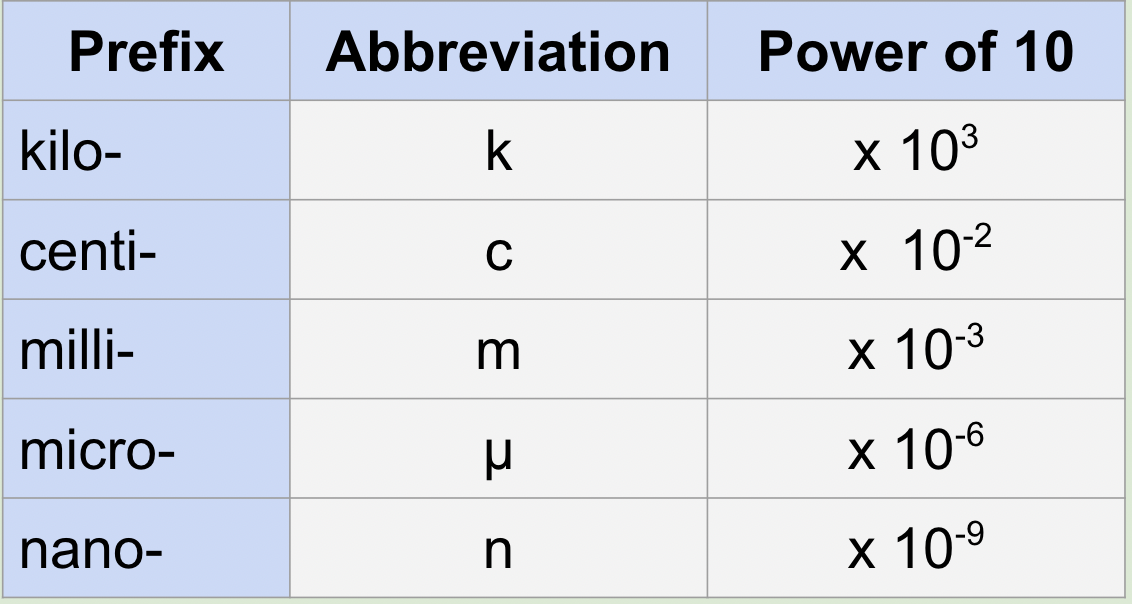
What are the SI Units Prefixes?
View Image
Explain why carbon is the most suited for being the backbone of everything
Carbon: - Since it has 4 valence electrons, It can form 4 single bonds and is thus suited for being the backbone due to its stability - It allows carbs, lipids, proteins, and nucleic acids to form
What is a monomer and polymer + in the context of carbohydrates?
Monomer: - Molecules that join to other similar molecules to form a polymer OR one unit of something EX: DNA’s monomers are nucleotides + Polymer = DNA Carbohydrates: - Their monomers are monosaccharides + polymer = carbs
How are polypeptides formed?
Process: - Polypeptides are made via condensation reactions which release a water molecule - The OH/hydroxyl group is from both of the monosaccharide leaves. Leaving the molecule w one oxygen between them - Bonds are usually formed between 1 and 4 prime carbon of diff. monosaccharides
What is a monosaccharide
Monosaccharides: - Defined as a single sugar molecule - Atoms C,H,O are always in a 1:2:1 ratio EX: C6H12O6 - hydrogen to oxygen ratio is 2:1
Carbohydrates are also broken down in digestion. What is the process?
Carbs: - are broken via hydrolysis reactions - Are defined by an addition of water to split apart the bond of a large molecule
How are carbohydrates classified?
Classification: - is classified based on the # of sugar molecules - one sugar are called monosaccharide, two are disaccharides, and many are polysaccharides + poly are the energy for organisms
Define hexose sugars and pentose sugars
Hexose: - are monosaccharides with 6 carbon EX: Glucose, galactose, fructose Pentose: - monosaccharide w 5 carbons EX: deoxyribose and ribose
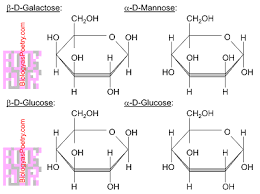
What are alpha and beta glucose and its differences
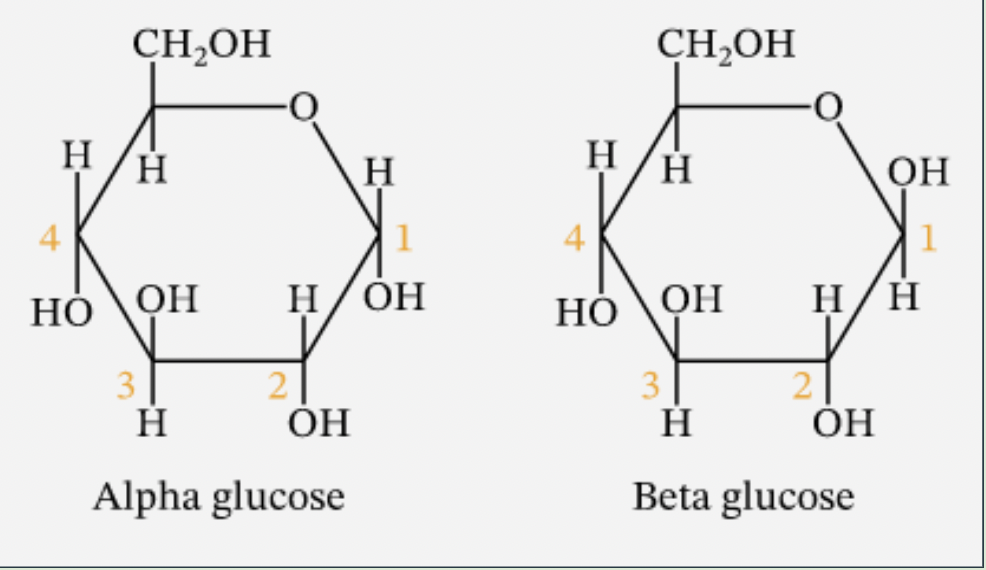
Glucose: - are types of glucose and hexose sugars - alpha: at the one prime carbon, the hydroxyl group is pointed up -Beta: at the one prime carbon, the hydroxyl group is going down
Outline 3 properties of glucosej
Glucose: 1. is Soluble in water because it’s polar and can be dissolved in a polar solvent such as water 2. can be easily transported EX: in the bloodstream 3. relatively stable compound and doesn’t degrade as its being transported cause strong cov bonds 4. Yields a great amount of energy when the covalent bonds break
What are the energy sources in plants and it’s structure
Starch: - Starch is made of amylose amylopectin - Amylose: long chains of alpha glucose molecules - Amylopectin: long chains of alpha glucose + branching of alpha glucose - Starch is not soluble in water due to the size which allows for compact storage of starch grains w out affecting osmotic pressure - After 20 glucose units, amylopectin has a branch - They are bonded w glycosidic bonds - are compact due to branching and coiling Note: Starch is made of glucose molecules
What is the energy source for animals:?
Glycogen: - is defined as a polysaccharide for short-term energy - has cov bonds between 1 + 4 carbon and has branches of alpha glucose bonding to 6 prime carbon - Its insoluble, and compact due to branches and coiling Note: Glycogen is made of glucose molecules
What is the polysaccharide found in the cell wall of plants?
Cell wall: - cellulose has long chains of beta glucose molecules which are unbranched - molecules bonded between 1 + 4 carbon - every second beta glucose molecule is flipped resulting in a straight chain - Cellulose forms groups called microfibrils held together by hydrogen bonds - Microfibrils have high tensile strength to maintain the structural integrity of cell wall
What are the different types of fatty acids and their composition?
Fatty acids: - Contain a carboxyl group (-COOH) and a methyl group (-CH3) - can be saturated: only contains single bonds between hydrocarbon chain - can be unsaturated which means they have double bonds that are bent and are called kinks - Amongst unsaturated, it can be monounsaturated or polyunsaturated meaning one or many double bonds
How does carbohydrate assist with membrane proteins ?
Mem proteins: - glycoproteins have a carbohydrate chain - the carb has a specific shape that can act as an antigen: the molecule that binds to a receptor on a cell surface for cell to cell communication (ID card)
Outline the roles of glycoproteins
Glycoproteins: - cell to cell adhesion: interact with other glycoproteins to form tissue - receptors: when hormones bind = changes metabolism in cell - cell-cell communication: neurotransmitters bind to glycoproteins - immune response: act as markers on cells allowing the immune system to distinguish outside cells - act as an antigen which simulates an immune response = production of antibodies to remove pathogens
Outline the differences in fats and oils
Fats: - fats are triglycerides which are solid at room temperature - they have a higher MP and are usually saturated - used by animals Oils: - oils are triglycerides that are liquid at room temperature w a lower MP - fatty acids are unsaturated because the kinks mean they are more spread out so they turn liquid - Oils are used by plants and fish
Outline the composition of triglycerides and phospholipids
Triglycerides: - made of one glycerol molecule (a sugar) and 3 fatty acids Phospholipids: - made of one glycerol molecule + 2 fatty acids + one phosphate • both are formed via condensation reactions
Explain how triglycerides are good insulators
• triglycerides are good insulators cause they have a low thermal conductivity
Outline the composition of steroids + whether they can diffuse across cell mem + examples
Steroids: - they are lipids with 4 carbon rings +. a hydrocarbon chain - They can diffuse through the cell mem cause they dissolve in fatty acid tail EX: Oestradiol and testosterone
Outline the properties of water + give some examples of whr water can be found
Water: - is polar, covalent, w weak charges at poles - is dense as a liquid than a solid EX: ice floats in water - can bond with 4 other water molecules Examples: - water makes up the cyto and is also found between cells as interstitail fluid because metabolic processes work best in an aqueous environment
What is electronegativity + explain why water is polar
Electronegativity: - the strength of attraction between an atom and its valence electrons Water: - oxygen has a more positive nucleus than hydrogen atoms and has greater attraction for the elctrons - So electrons are shared unequally - the hydrogen bonds of water are weak
Explain why water is a good solvent
Water: - it dissolves stuff well EX: anyt polar will dissolve - water forms hydrogen bonds with anything polar and pulls it apart
What is the xylem in plants
Xylem: - a thin narrow tube that transports water and the nutrients in the water from the roots of the plant to the leaves - This is due to capillary action: the ability of water to flow against gravity in a narrow space + the co/adhesion of water - water sticks to the plant and also to other water molecules