AQA A Level Chemistry - Kinetics
No description yet. This curated deck is ready for daily study.
Card preview (23)
• What is collision theory?
• Particles are constantly moving in random directions • Consider this reaction (pictured) • Molecule A must collide with molecule B in order for them to react • Most of the time, their collisions are unsuccessful • This means they do not end up forming a product. Instead, they bounce off each other and go their separate ways • A successful collision means the particles react • Particles must have enough energy when they collide for the collisions to be successful

• What is the activation energy?
• The minimum energy needed for a reaction to occur/start
• What must happen for a reaction to occur?
• Particles must collide • With E ≥ Ea • This symbol ≥ means greater than or equal to
• Why might a reaction occur very slowly?
• A small number of particles have E ≥ Ea
• Why do most collisions not cause a reaction?
• A small number of particles have E ≥ Ea
• If a reaction occurs very slowly because only a small number of particles have E>Ea, why will all of the reactants eventually gain enough energy to react?
• Molecules gain energy • Due to collisions
• Why do some particles only have a very small amount of energy?
• Collisions cause some molecules to slow down or lose energy
• What is the rate of reaction?
• The rate of change in concentration • per unit of time • Units: mol dm-3 s-1
• What is the rate of reaction only influence by?
• Temperature • Concentration • Pressure (for gas based reactions) • Catalysts • Surface area (for solid reactants, as surface area increases, rate of reaction increases)
• What is the explanation for the increase in rate due to an increase in temperature?
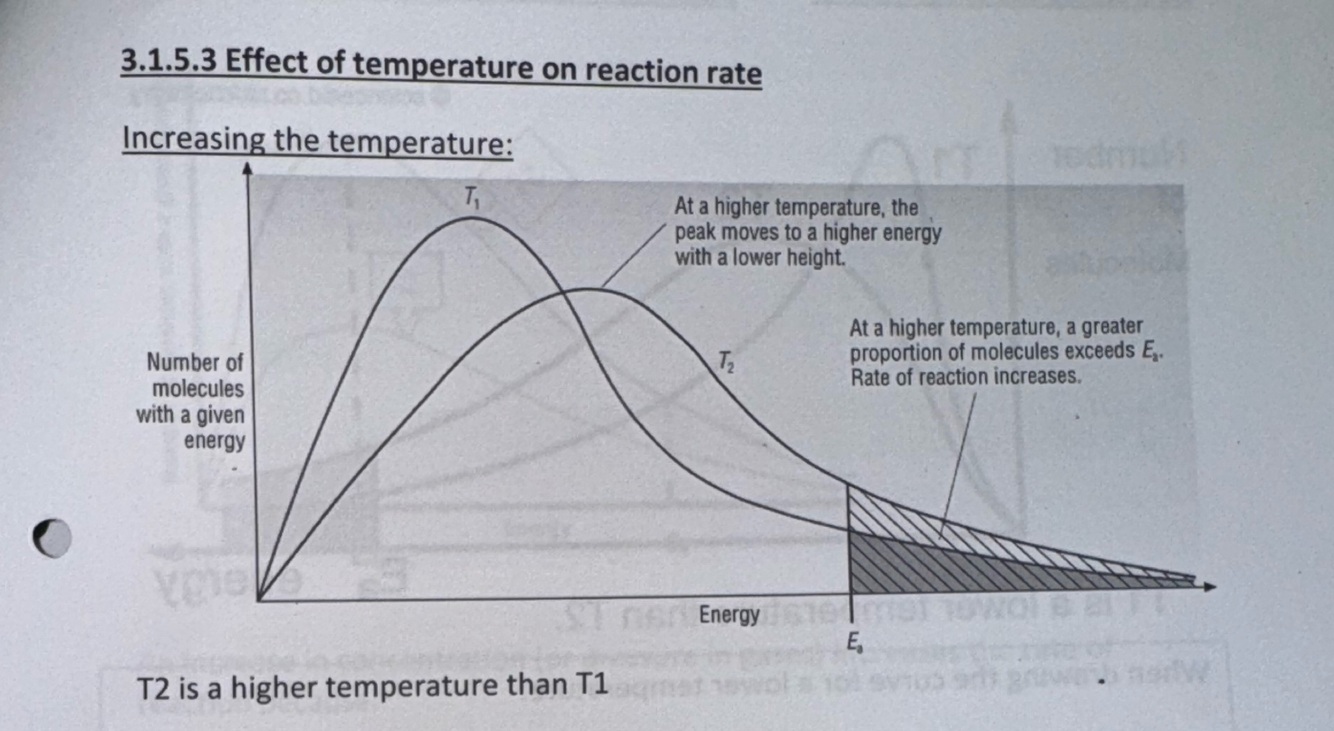
• More particles have E ≥ Ea • Increases frequency of successful collisions
• What is the explanation for the increase in rate when the concentration increases?
• Increase in number of particles per unit volume • Increases frequency of successful collisions
• What is the explanation for the increase in rate due to the increase in pressure?
• Increase in number of particles per unit volume • Increases frequency of successful collisions
• What is the explanation for the increase in rate due to the addition of a catalyst?
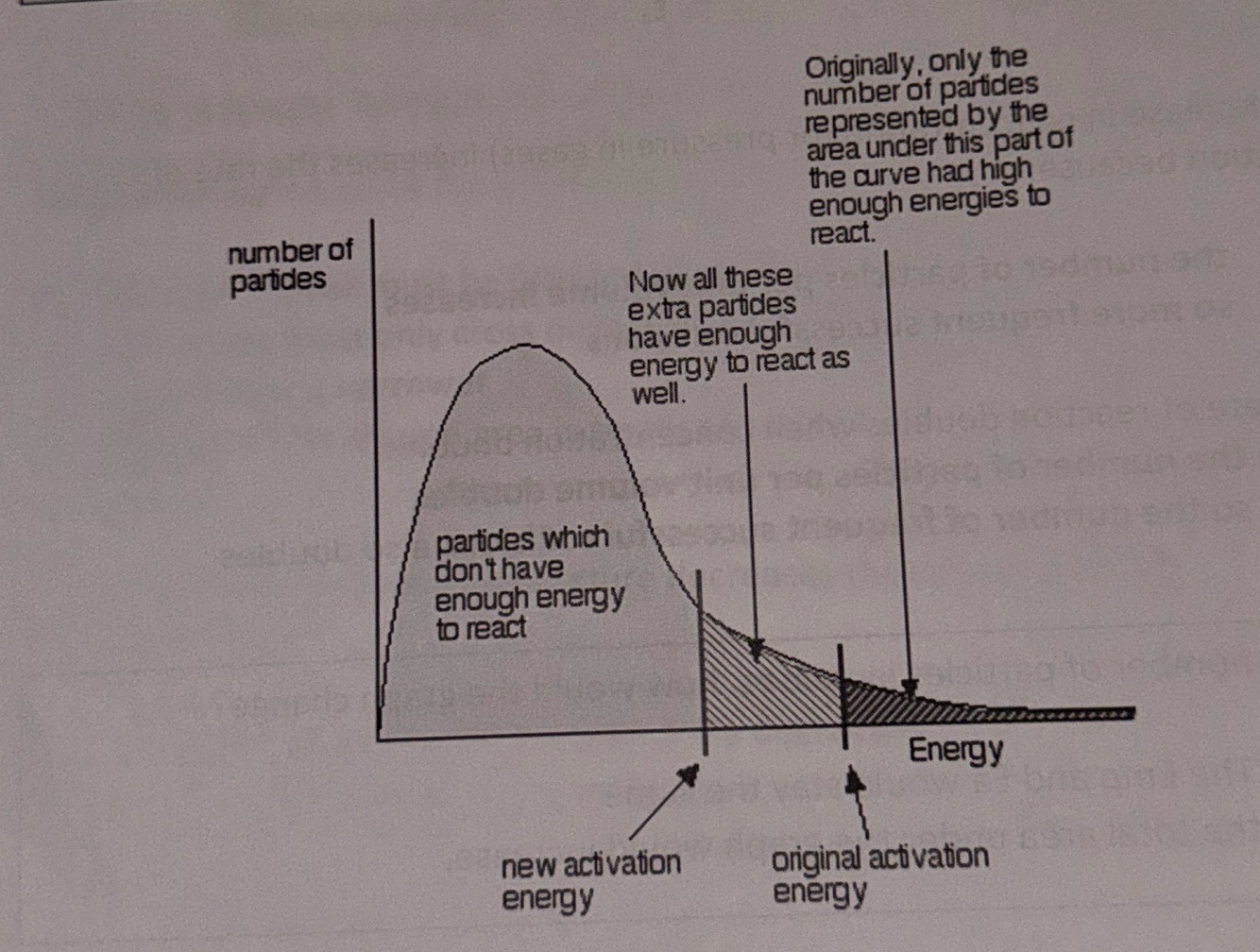
• Lowers Ea • So there are more particles with E ≥ Ea • Increases frequency of successful collisions
• What is the explanation for the increase in rate due to the increase in surface area?
• Increased number of reactant particles made available • Increases frequency of successful collisions
• Maxwell-Boltzmann distribution of molecular energies
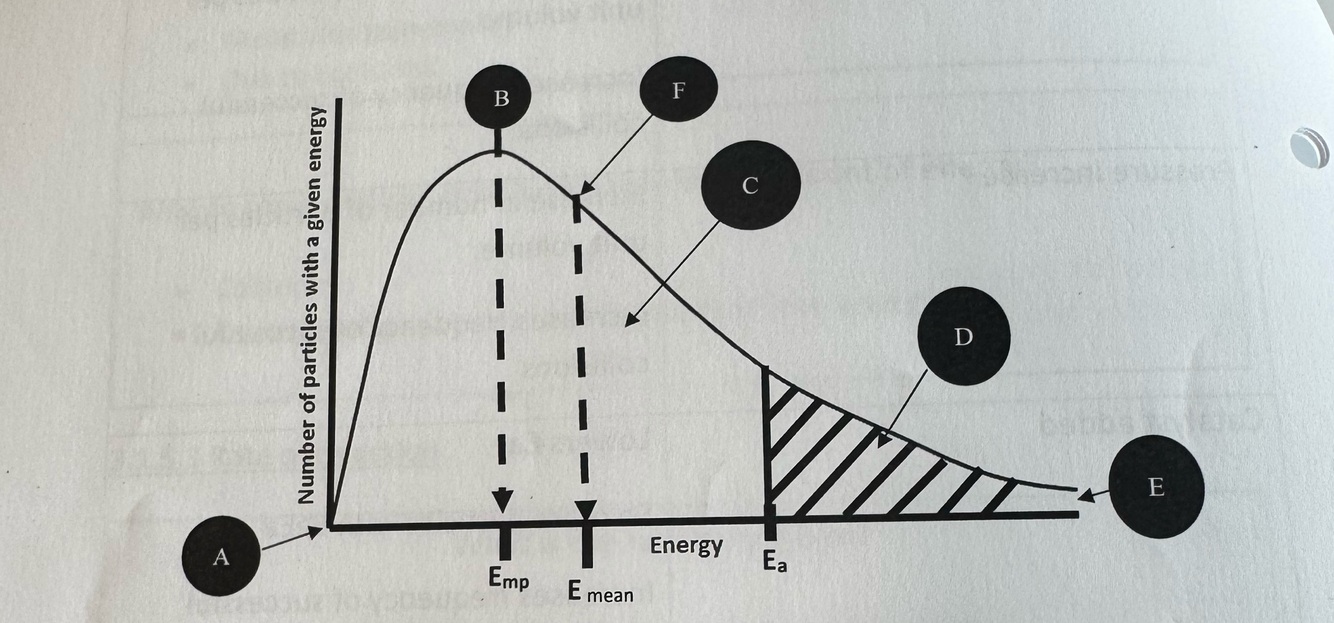
• Particles in a liquid/solution/gas have a range of kinetic energies • The range of energies of particles in a gas is represented by the Maxwell-Boltzmann distribution (see graph below) A - Line must start at the origin as no particles can have zero energy B - The peak of the curve shows the most probable value for the energy of the particles (Emp) C - The area under the curve shows the total number of particles D - The area under the curve, but to the right hand side of Ea represents the particles with enough energy to react E - The line levels out towards the x axis, but never touches it F - The mean energy of particles is a line where the area under the curve on either side of the line is equal • The distribution shows that only a small fraction of particles can collide with enough (E ≥ Ea) to start a reaction/break bonds (ie to allow the reactants to overcome the activation energy and form products)
• The effect of temperature on reaction rate
• When drawing the curve for a higher temperature: • The High T peak must be further to the right • The curves must only cross once • The High T curve is wider/broader • The size of the shaded area is larger for High T peak • At high temperature/when temperature increases the rate of reaction increases because: • The proportion of particles with E ≥ Ea increases, so more frequent successful collisions • The rate of reaction approximately doubled when temperature rises by 10 degrees C
• Why does a small increase in temperature affect the rate of reaction?
• A small increase in temperature leads to a significantly large number of particles with the activation energy
• Decreasing the temperature
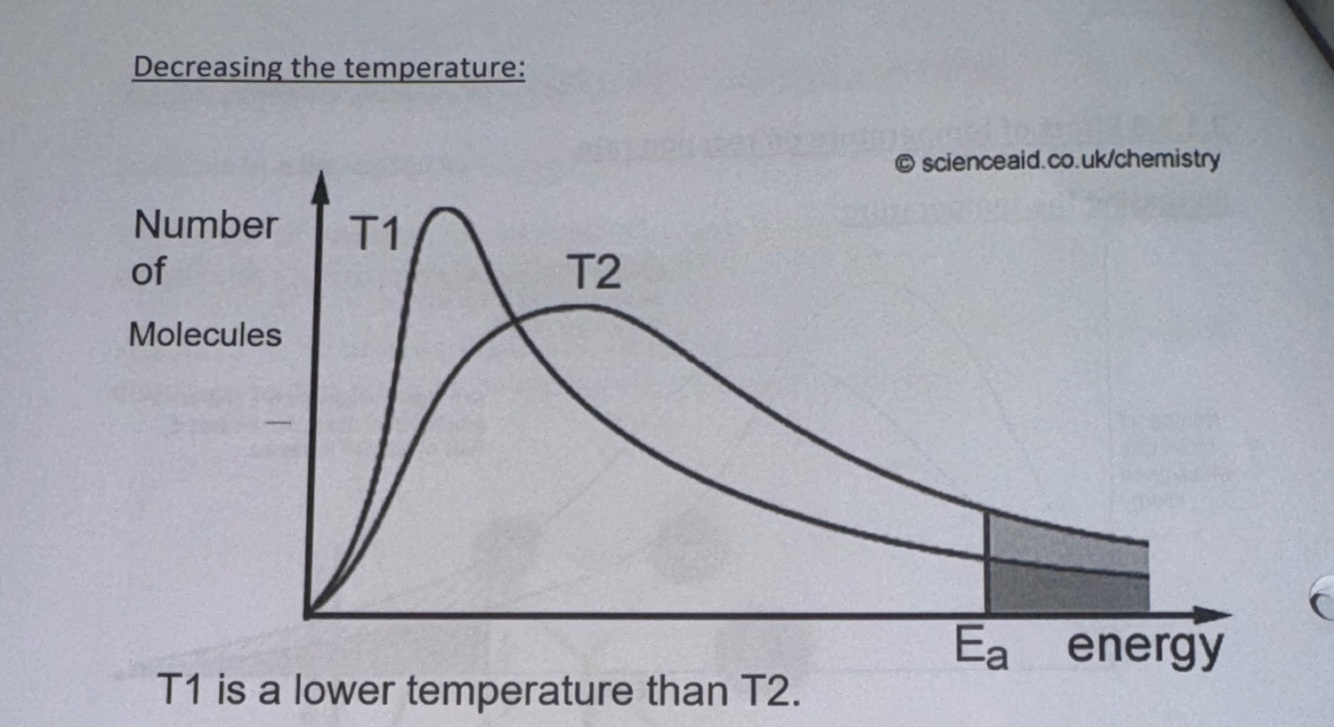
• When drawing the curve for a lower temperature: • The low T peak must be further to the left • The curves must only cross once • Low T curve is narrower • The size of the shaded area is smaller for Low T curve Increasing • At low temperature/when temperature decreases the rate of reaction decreases because: • The proportion of particles with E ≥ Ea decreases • So less frequent successful collisions
• Effect of concentration and pressure
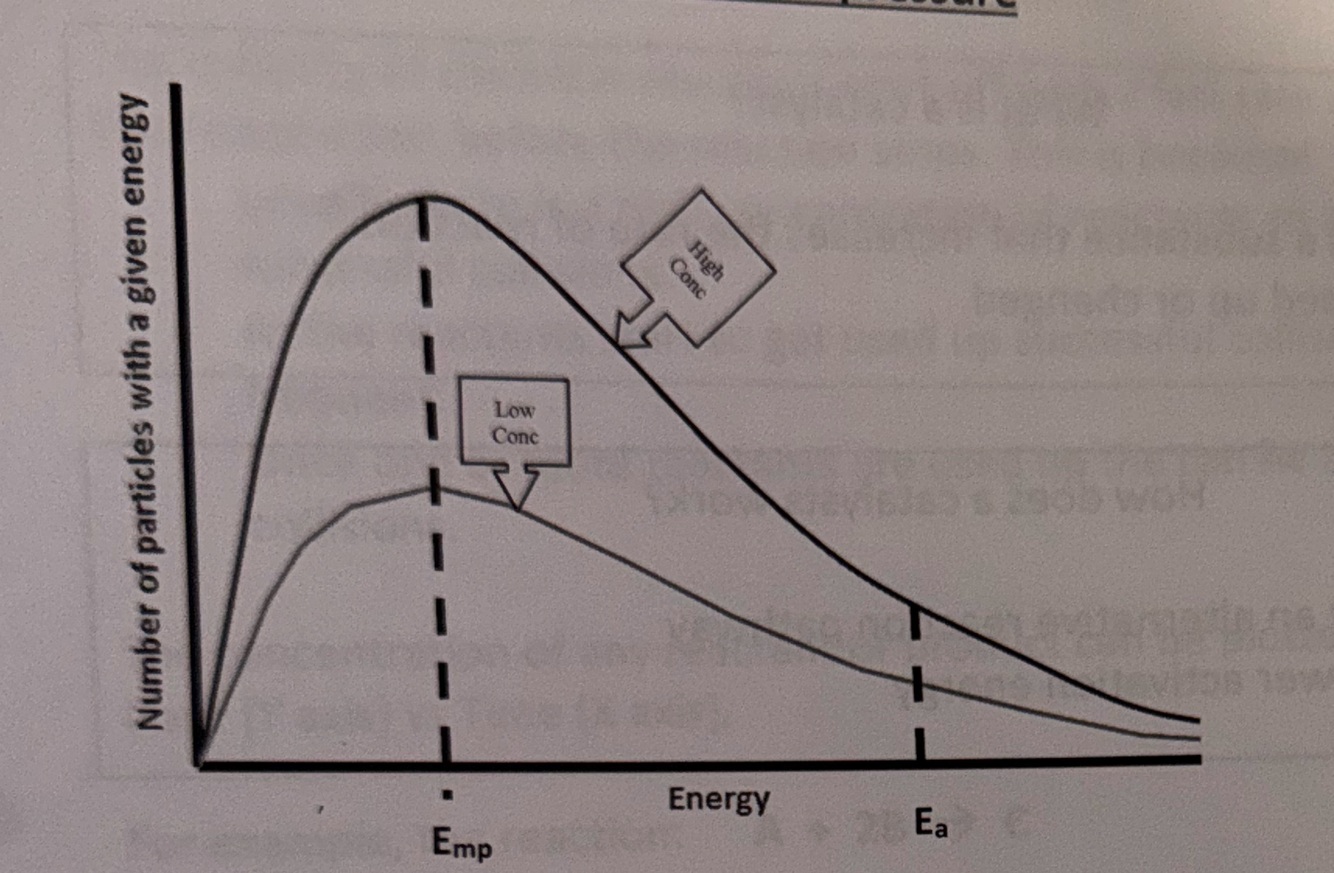
• An increase in concentration (or pressure in gases) increases the rate of reaction because: • Increase in number of particles per unit volume • So more frequent successful collisions • The rate of reaction doubles when concentration doubles: • The number of particles per unit volume doubles • So the number of frequent successful collisions also doubles
• If the number of particles increases, how would the graph change?
• The Emp and Ea would stay the same • The total area under the graph would increase
• What is a catalyst?
• A catalyst is a substances that increases the rate of reaction • but is not used up or changed • speeds up a reaction but is chemically unchanged at the end of the
• How does a catalyst work?
• By providing an alternative reaction pathway • that has a lower activation energy
• A catalyst increases the rate of reaction because:
• The activation energy decreases • So more of the particles have a collision energy greater than the activation energy (E ≥ Ea) • So there are more frequent successful collisions