Unit 2 Safety, Body Mechanics, Patient Transfer
No description yet. This curated deck is ready for daily study.
Card preview (24)
Most hospital fires are caused by:
➢Spontaneous combustion ➢Open flames ➢Cigarette smokers ➢Electricity
Be Prepared of Fires
• Know the fire plan of your facility. • Know evacuation route and alternative route. • Locate fire alarms, extinguishers, and fire doors.
In Case of Fire: RACE and PASS
• RACE ➢Rescue ➢Alarm ➢Contain ➢Extinguish • PASS ➢Pull ➢Aim ➢Squeeze ➢Sweep
Fire Extinguisher Mechanism
• Pull the pin, breaking seal • Aim nozzle • Squeeze handle • Sweep at base of fire
Electrical Safety Rules
• All electrical equipment and appliances must be approved for hospital use. • Follow equipment manufacturers’ instructions. • Equipment used on or near patients or near water must have grounded plugs. • Inspect equipment regularly, paying attention to cords and plugs. Arrange for repairs as needed. • Do not overload circuits by connecting too many devices to a single outlet or outlet group. • Unplug or turn off electrical equipment before exposing internal parts. • Do not attempt to repair equipment unless you are trained to do so. • Use only extension cords approved for the intended purpose. • In case of electrical fire, use a class C or carbon dioxide fire extinguisher.
Falls and Collisions
• Precautions taken increase safety for patients and personnel. • Do not park equipment near corners. • Do not store heavy items on upper shelves. • Stack stored items neatly and carefully. • Do not string electrical cords across doorways or other traffic patterns.
Chemicals and Spills
• Limit access to the area of a spill and evaluate. • Healthcare facilities have written policies and procedures to follow in determining appropriate action in the event of a chemical spill. • OSHA requires that all chemicals be properly labeled and that Material Safety Data Sheets (MSDSs) for all hazardous materials be on file and easily accessible to personnel.
MSDS stands for
Material Safety Data Sheets • For all hazardous material • Must be on file • Easily accessible • Indicates proper equipment & procedure for managing a chemical spill
Eye Splashes
• Require prompt treatment • Eyewash station—a first aid station for chemical eye splashes that sprays water into the eye from a convenient height
Ergonomics
• The study of the human body in relation to the working environment • Ergonomic awareness and education in the workplace have reduced job injuries in recent years.
Body Mechanics
The principles of proper body alignment, movement, and balance
Rules of Body Mechanics
• Provide a broad base of support. • Work at a comfortable height. • When lifting, bend your knees and keep your back straight. • Keep your load well balanced and close to your body. • Roll or push a heavy object. Avoid pulling or lifting.
Patient-Transfer
➢Only method to ensure patient safety • Wheelchairs used for those who can sit upright • Stretchers used for those too weak to sit • Small children may be transported in cribs. • Infants may be transported in incubators.
Preparation for Transfer
• Check with nursing service. • Check patient identification. • Plan what you are going to do and prepare your work area. • Obtain equipment and check it for safety and function. • Enlist the patient’s help and cooperation. ➢Communicate with the patient what you are doing. • Obtain additional help when necessary. ➢Communicate role of assistants in the transfer plan.
Bed-to-Wheelchair Transfers
• Lower the bed to wheelchair level, and elevate the head of the bed. • Position the wheelchair parallel to the bed with wheels locked and footrests out of the way. • With the patient in the supine position, place one arm under the patient’s shoulders and one under the knees, and in a single, smooth motion, raise and turn the patient to a sitting position with his or her feet dangling over the side. ➢Patients with back pain may find it easier to sit up from a lateral recumbent position. ➢Take a moment to assist the patient with slippers and a robe • A gait belt, or transfer belt, which provides a secure hold, should be used with weak, unsteady patients. ➢Grasp the gait belt or reach around the patient and place your hands firmly over the scapulae; the patient’s hands may rest on your shoulders. ➢On your signal, lift upward to help the patient stand. ➢Use a broad base of support and keep your back straight. ➢Now instruct and assist the patient to pivot a quarter turn so that the edge of the wheelchair is touching the back of the patient’s knees; then ease the patient into a sitting position in the chair. ➢Position the footrests and leg rests, and cover the patient’s lap and legs with a sheet or bath blanket to provide warmth and comfort and to protect the patient’s modesty. • Falls most commonly occur when the patient sits in the wheelchair. ➢May miss the edge of the seat or tip the chair by sitting too near the edge • To avoid such an accident, be sure to lock the wheels of the chair and assist the patient until seated securely.
Wheelchair-to-X-Ray Table Transfers
▪ Lower bed ▪ Get wheelchair ready ✓ BE SURE IT IS LOCKED ▪ Get patient to sitting position ▪ Orthostatic hypotension ▪ Face to face: assist patient to standing ▪ Pivot ▪ Lower patient to wheelchair ▪ Footrests & Blanket ▪ May need help of a Gait Belt CAUTIONS: ▪ Stroke ▪ Paralysis ▪ Lower extremity fractures ▪ Hip replacement ▪ Knee replacement
Special Considerations for Wheelchair Transfers
• Stroke victims: usually have weakness on one side of body, determine weak side and position yourself on that side. Brace patients weak leg with your knee as patient stands. When moving wheelchair to bed, position patients strong side adjacent to bed or table and instruct them to lead with stronger leg • Fractures of the lower extremity • Joint replacement -Hip Replacement: Patients who have undergone hip replacement by means of the anterior surgical approach are able to sit upright in a chair at a 90-degree angle. Do not permit the patient to adduct, abduct, or rotate the affected leg, and avoid any hyperextension, especially when walking. Patients who have undergone hip replacement by means of the posterior approach, which is the most common, are able to tolerate abduction, but must not be allowed to cross the affected leg over the midline; both adduction and internal rotation must be avoided. Furthermore, these patients must not flex at the hip beyond 90 degrees. -Knee Replacement: Weight bearing is usually tolerated, but a walker is needed when taking more than one or two steps. Move the patient toward the strong side. When sitting and when lying down, provide support under the calf and knee of the affected leg for comfort and safety. • Spinal trauma or surgery: Use a stretcher. Moving from a supine position to a sitting position, or from sitting to a supine position, places considerable stress on the spine. Instead, the patient should sit from a lateral recumbent position. When lying down, the patient should lie first on one side and then turn to the supine position with the knees flexed. Provide support and assistance to the patient while extending the legs, and place a bolster or pillow under the knees for support when he or she is supine. • Patients who cannot stand safely: Require a hydraulic lift for transfers, Do not use until proper instruction and training are obtained.
Precautions for Patients with Hip Replacements
-Surgery via the Anterior: Approach May sit upright Weight bearing is usually tolerated (check chart) Avoid abduction Avoid adduction Avoid internal or external rotation Avoid hyperextension -Surgery via the Posterior: Approach Must not flex hip beyond 90 degrees Weight bearing is usually tolerated (check chart) Abduction is permitted Avoid adduction Avoid internal rotation
Stretcher Transfers Three methods:
➢Draw sheet ➢Slider board ➢Sliding mat
Safety Side Rails
Required to be in up and locked position: ➢For patients who are impaired or unconscious ➢During transport ➢When patients are left unattended on a stretcher
Base of support
where body meets the floor broad base provides stability for body position & movement, a line between the points of contact with a horizontal surface
Center of gravity
point at which body weight is balanced mid-portion of pelvis/ lower abdomen
Line of gravity
Imaginary vertical line passing through center of gravity
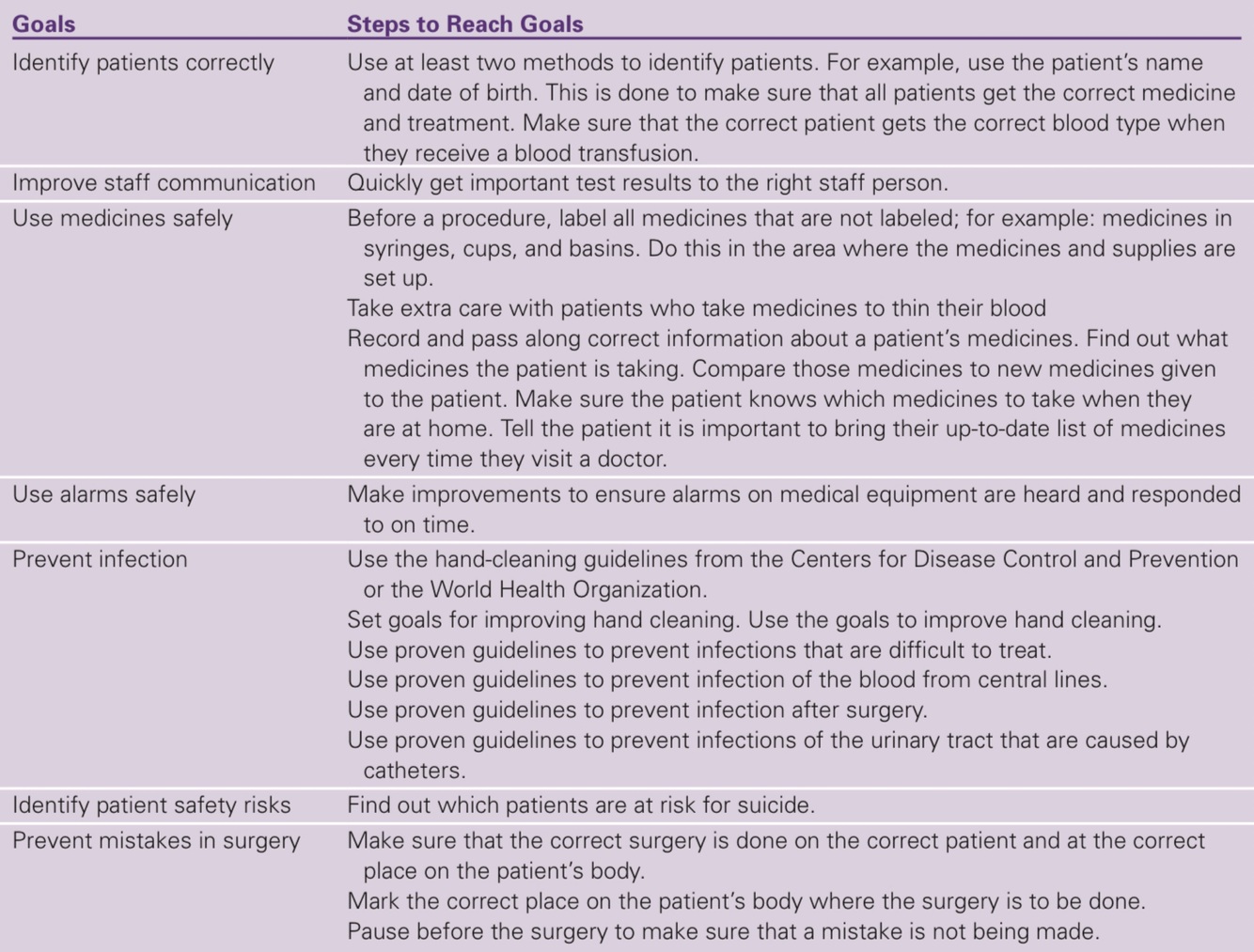
National Patient Safety Goals