Unit 1: Computer Components
No description yet. This curated deck is ready for daily study.
Card preview (24)
Describe the role of the Control Unit.
• Coordinates the activity of all other processor components • Manages the phases of the Fetch-Execute cycle • Decodes instructions received into the processor
Name five registers used in the Fetch-Execute cycle.
• Program Counter (PC) • Memory address register (MAR) • Memory data register (MDR) • Current instruction register (CIR) • Accumulator (ACC)
How is the Program Counter (PC) used in the Fetch-Execute cycle?
• Holds the address if the next instruction • Incremented by one when the instruction is read, ready for the next cycle.
How is the Memory address register (MAR) used in the Fetch-Execute cycle?
• Contains the address of the memory location from which data or an instruction is to be fetched.
How is the Memory data register (MDR) used in the Fetch-Execute cycle?
• Temporarily stores the data being transferred to and from memory. • It acts as a buffer, allowing the processor and memory units to act independently without being affected by minor differences in operation.
How is the Current instruction register (CIR) used in the Fetch-Execute cycle?
Holds the instruction currently being decoded or executed.
How is the Accumulator (ACC) used in the Fetch-Execute cycle?
Holds the result of an instruction.
What is the purpose of the Arithmetic-Logic Unit (ALU) in the processor?
Used to carry out instructions received by the processor and produce the processed output.
What is the System clock in the processor?
A continuously cycling signal that is used as a timing pulse for all processor components.
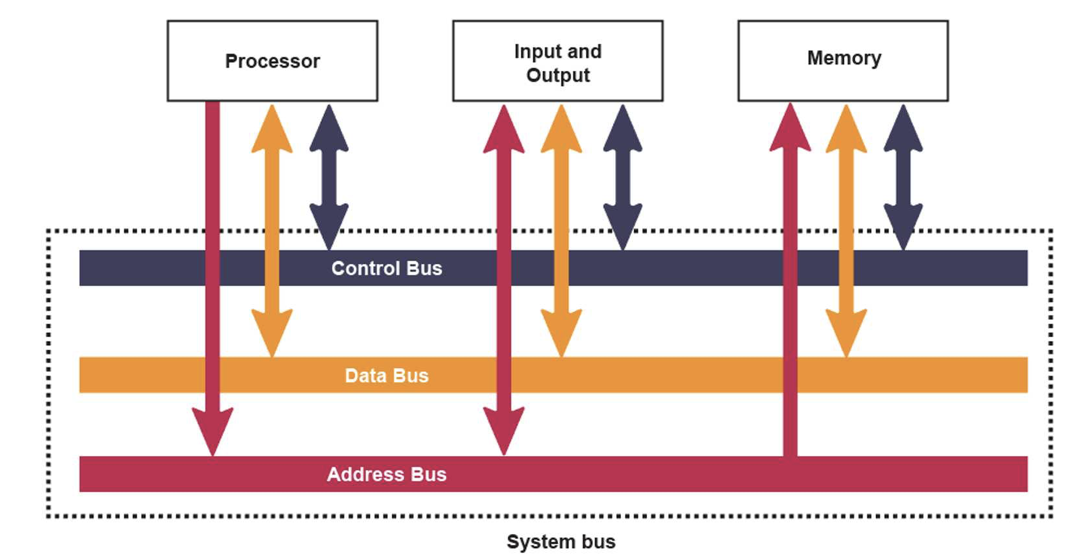
What is a bus?
Buses are a set of parallel wires which connect two or more components inside the CPU.
What does the system bus consist of?
The system bus consists of three separate buses carrying control signals, addresses and data
What are registers?
Registers are small memory cells that operate at a very high speed. They are used to temporarily store data and all arithmetic, logical and shift operations occur in these registers.
Describe the purpose of the Data Bus.
This is a bi-directional bus used for transporting data and instructions between components.
Describe the purpose of the Address Bus.
Used to transmit the memory addresses specifying where data is to be sent to or retrieved from. The width of the address bus is proportional to the number of addressable memory locations.
Describe the purpose of the Control Bus.
This is a bi-directional bus used to transmit control signals between internal and external components. The control bus coordinates the use of the address and data buses and provides status information between system components.
Name 7 control signals.
• Bus requests • Bus grant • Memory write • Memory read • Interrupt request • Clock
How is Assembly language processed by the CPU.
Assembly code uses mnemonics to represent instructions; the instruction is divided into operand and opcode in the Current Instruction Register. The operand contains the data or the address of the data upon which the operation is to be performed. The opcode specifies the type of instruction to be executed.
What is Pipelining?
Pipelining is the process of completing the fetch, decode, and execute cycles of three separate instructions simultaneously, holding appropriate data in a buffer in close proximity to the CPU until it’s required. While one instruction is being executed, another can be decoded and another fetched.
What is the purpose of Pipelining?
Pipelining is aimed to reduce the amount of the CPU which is kept idle. It is separated into instruction pipelining and arithmetic pipelining.
What is instruction pipelining?
Instruction pipelining is separating out the instruction into fetching, decoding, and executing.
What is Arithmetic pipelining?
Arithmetic pipelining is breaking down the arithmetic operations and overlapping them as they are performed.
Describe the sequence of operations in the Fetch-Decode-Execute Cycle.
Fetch phase: - Address from the PC is copied to the MAR - Instruction held at that address is copied to MDR by the data bus - Simultaneously, the contents of the PC are increased by 1 - The value held in the MDR is copied to the CIR Decode phase: - The contents of CIR are split into operand and opcode Execute phase: - The decoded instruction is executed
What three factors affect CPU performance?
Clock speed, number of cores and the amount and type of cache memory.
How does Clock speed affect CPU performance?
All processor activities begin on a clock pulse, and the clock speed is the time taken for one clock cycle to complete. Consequently, the higher a system’s clock speed, the more instructions it can process over a given time.