protein synthesis and chromosomes
暂无描述。系统推荐的高质量记忆内容,适合每天坚持背诵学习。
卡片预览 (21 张)
What is a gene?
a base sequence (a section) of DNA, which occupies a locus (a fixed position), that codes for: • the amino acid sequence of a polypeptide (therefore determining the proteins of an organism) • a functional RNA (including ribosomal RNA and tRNAs )
Which two organelles contain DNA like that of prokaryotes?
mitochondria and ribosomes
What is the definition of a genome and a proteome?
genome - the complete set of genes in the cell proteome= the full range of proteins that the cell is able to produce -
Draw and label a chromosome
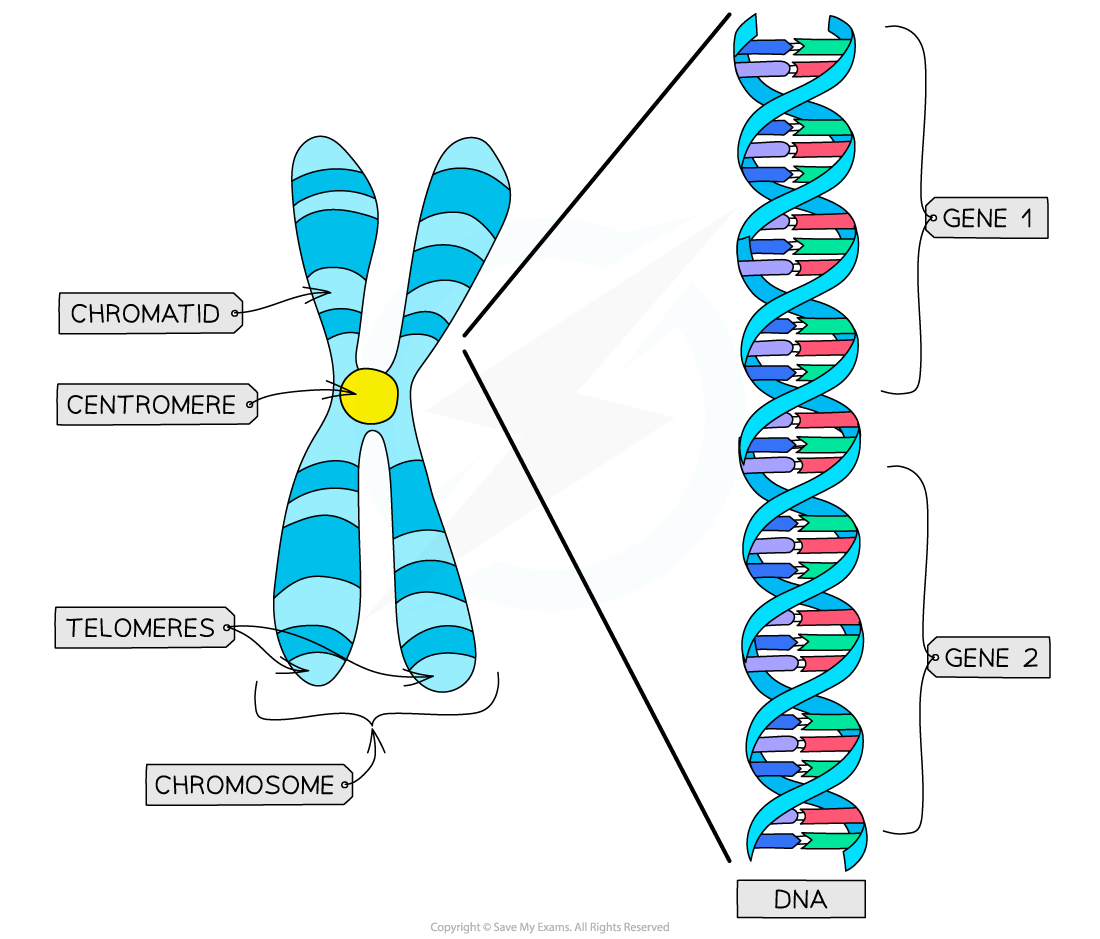
What are homologous chromosomes?
carry the same genes which code for the same characteristics at the same locus, half from mum, other half from dad can be different alleles
What is the difference between sister chromatids and a homologous pair of chromosomes?
sister chromatids are identical copies of chromosomes formed during DNA replication homologous chromosomes could be different alleles
What is an allele?
an alternative form of a gene
What is a codon?
three bases on mRNA that codes for a single amino acid
What are the three types of RNA?
messenger RNA ,transfer RNA, ribosomal RNA
Describe the structure of mRNA? (2)
• single polynucleotide strand • the groups of three bases in mRNA is called a codon
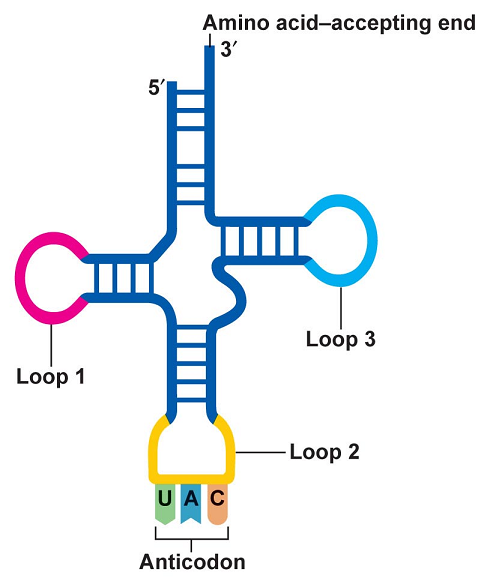
Describe the structure of tRNA? (4) Draw it
• single polynucleotide folded into a cloverleaf shape • held by hydrogen bonds which occur between complementary base pairs within the polynucleotide • a sequence of three bases = anticodons • it has an amino acid binding site on the opposite end of where the anticodons are
What is the role of mRNA?
carries genetic code from the DNA in the nucleus to the cytoplasm
What is the role of tRNA?
carries amino acids to the ribosome during protein synthesis
What is transcription?
the process of making an RNA copy of a gene sequence
Describe the process of transcription? (exam-based)
occurs in the nucleolus of the nucleus hydrogen bonds between complementry base pairs break and the DNA helix unwinds to expose the bases to act as a template only one chain of the DNA acts as a template free RNA nucleotides align by complementary base pairing in RNA uracil base pairs with adenine RNA polymerase joins adjacent nucleotide by phosphodiester bonds between adjacent nucleotides RNA polymerase reaches a stop codon and then detaches, resulting in the formation of pre-MRNA. pre-mRNA is spliced to form mRNA mRNA then leaves the nucleus through the nuclear envelope pores -
What happens during the splicing of pre-mRNA? What type of cells does this only occur in?
ONLY HAPPENS IN EUKARYOTES In the nucleus: introns are removed from the pre-mRNA and exons are joined together through splicesome.
What is translation?
the process in which the mRNA is ‘read’ and translated into a protein.
Describe the process of translation?
A molecule of mRNA leaves the nucleus via a nuclear pore mRNA is attached to a ribosome in the cytoplasm the ribosome attaches at the start codon the tRNA molecule brings a specific amino acid and then the complementary anti codon binds to complementary mRNA codons the ribosome will move along the mRNA molecule to enable another complementary tRNA to attach to the next codon on the mRNA the two amino acids that have been delivered by the tRNA molecules are joined by a peptide bond. this is catalyzed by an enzyme and requires ATP trna is released after amino acid joined to polypeptide the ribosome moves along the mRNA to form polypeptide until it reaches a stop codon the polypeptide chain is now created and will enter the Golgi body for folding and modification
define degenerate code and state its advantage
each amino acid has more than one triplet code if a point of mutation occurs, even though the triplet bases will be different, it may still code for the same amino acid and therefore have no effect
define non-overlapping code and state its advantages
each base is part of only one triplet code if a point of mutation occurs, it will only affect one codon and therefore one amino acid
define universal code
each triplet codes for the same amino acid in all organisms (indirect evidence for evolution) his is an advantage as it means genetic engineering is possible