acid base
No description yet. This curated deck is ready for daily study.
Card preview (24)
Bronsted-Lowry acid
Substance that can donate a proton
A Bronsted-Lowry base
Substance that can accept a proton.
Conjugate acid is always
positive ion
Calculating pH
pH = - log [H+]
Calculating the pH of strong acids
Strong acids completely dissociate The concentration of hydrogen ions in a monoprotic strong acid will be the same as the concentration of the acid. Always give pH values to 2d.p. in the exam
Finding [H+] from pH
10-pH
Ionic Product for water
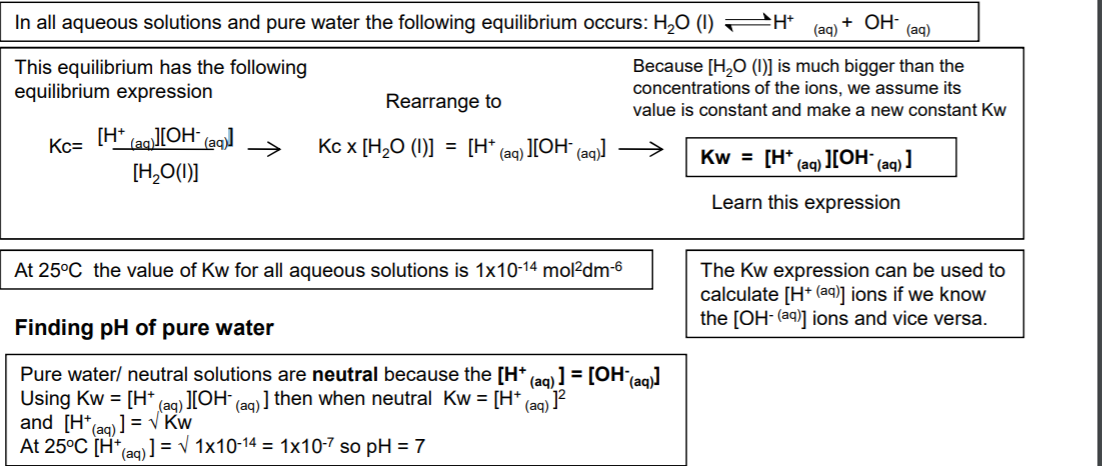
Example 2 : Calculate the pH of water at 50ºC given that Kw = 5.476 x 10⁻¹⁴ mol2 dm-6 at 50ºC
[H+ (aq)] = √ Kw = √ 5.476 x 10-14 =2.34 x 10⁻⁷ mol dm-3 pH = - log 2.34 x 10-7 = 6.6 It is still neutral though as [H+ (aq)] = [OH-)
At different temperatures to 25oC the pH of pure water changes
Le Chatelier’s principle can predict the change. The dissociation of water is endothermic so increasing the temperature would push the equilibrium to the right giving a bigger concentration of H+ ions and a lower pH.
Calculating the pH of a Strong Base
For bases, we are normally given the concentration of the hydroxide ion. To work out the pH we need to work out [H+ (aq)] using the Kw expression Strong bases completely dissociate into their ions. NaOH —– Na+ + OH-
Example 3: Calculate the pH of the strong base 0.1 mol dm-3 NaOH Assume complete dissociation
Kw = [H+ (aq)][OH- (aq)] = 1x10-14 [H+ (aq)] = Kw/ [OH- (aq)] = 1x10-14 / 0.1 = 1x10-13 M pH = - log[1x10-13] =13.00
Weak Acids
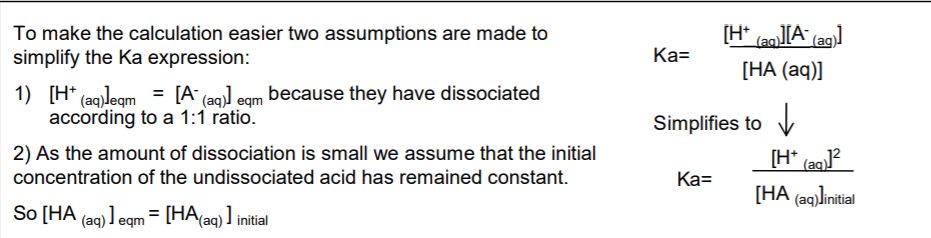
Weak acids only slightly dissociate when dissolved in water, giving an equilibrium mixture Ka=[H+ (aq)][A- (aq)] over [HA (aq)] The larger ka the stronger the acid.
pKa
pKa = -log (Ka) so Ka = 10-pKa
Calculating pH of a Weak Acid
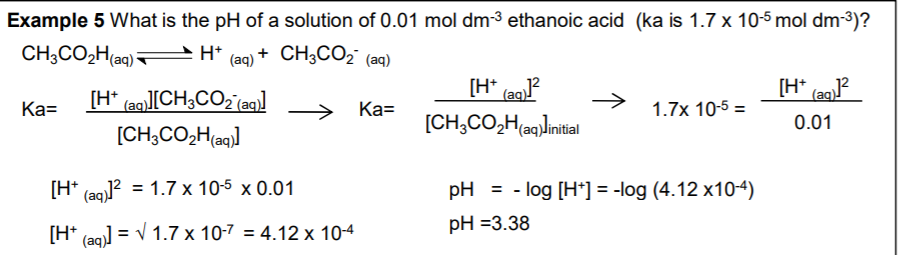
Example 5 What is the pH of a solution of 0.01 mol dm-3 ethanoic acid (ka is 1.7 x 10⁻⁵ mol dm-3 )?
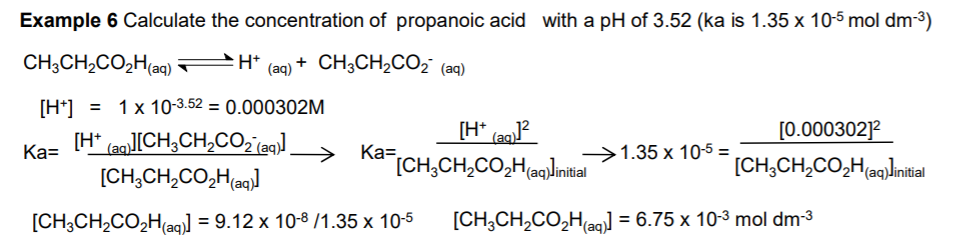
Calculate the concentration of propanoic acid with a pH of 3.52 (ka is 1.35 x 10⁻⁵ mol dm-3 )
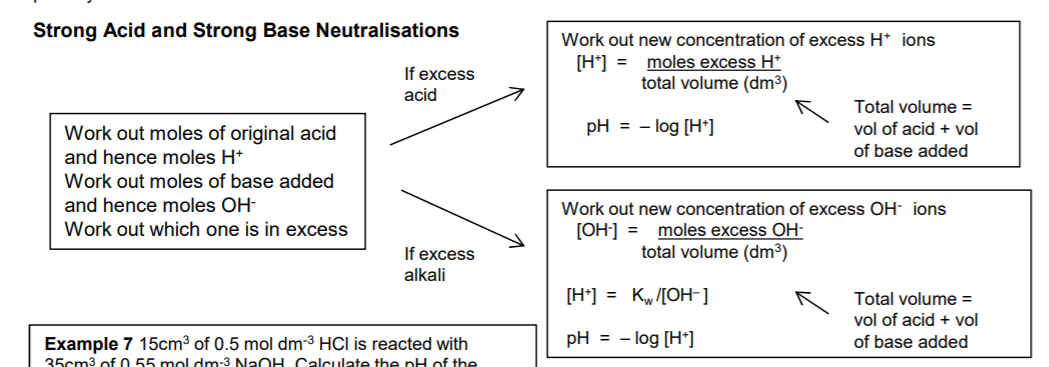
Strong Acid and Strong Base Neutralisations
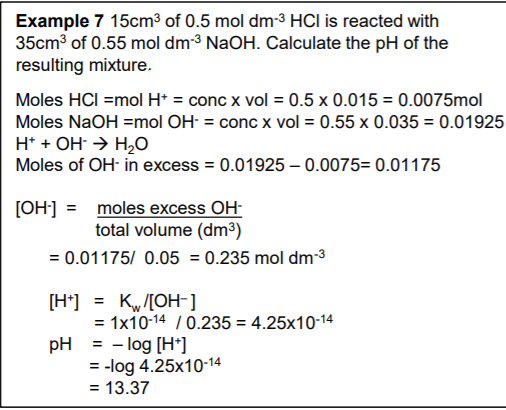
Example 7 15cm3 of 0.5 mol dm-3 HCl is reacted with 35cm3 of 0.55 mol dm-3 NaOH. Calculate the pH of the resulting mixture
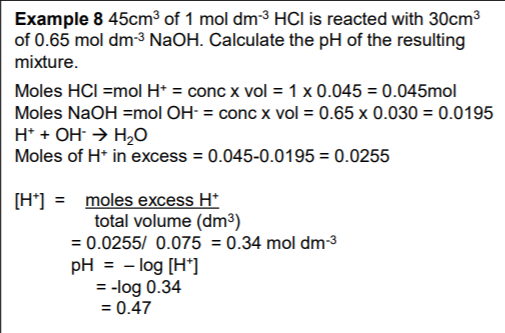
Example 8 45cm3 of 1 mol dm-3 HCl is reacted with 30cm3 of 0.65 mol dm-3 NaOH. Calculate the pH of the resulting mixture
Example 9 35cm3 of 0.5 mol dm-3 H2SO4 is reacted with 30cm3 of 0.55 mol dm-3 NaOH. Calculate the pH of the resulting mixture
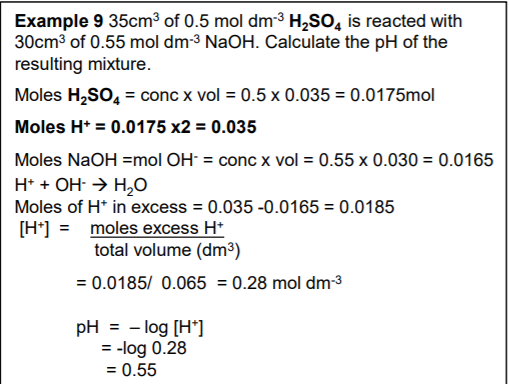
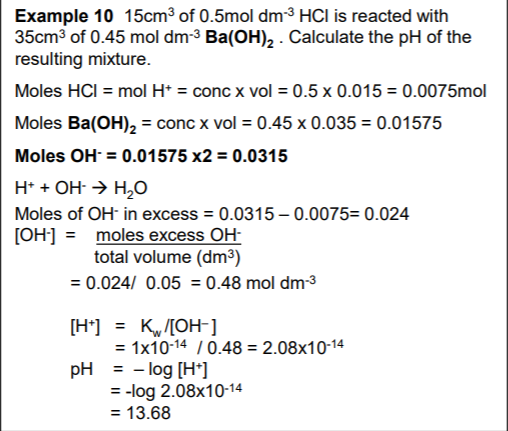
Example 10 15cm3 of 0.5mol dm-3 HCl is reacted with 35cm3 of 0.45 mol dm-3 Ba(OH)2 . Calculate the pH of the resulting mixture
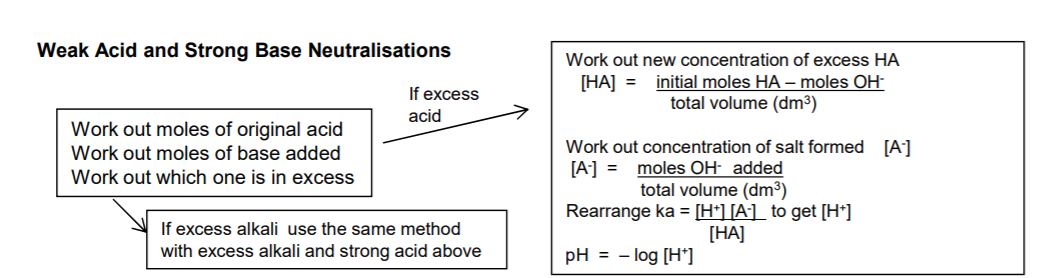
Weak Acid and Strong Base Neutralisations calculation pattern
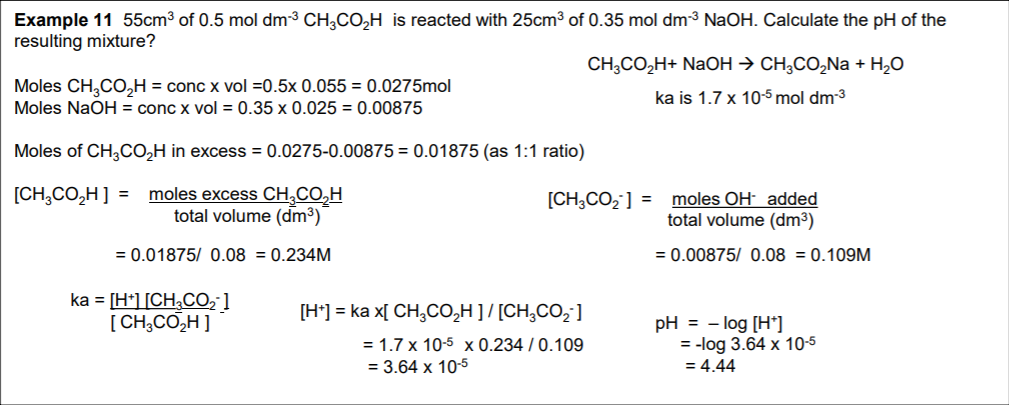
Example 11 55cm3 of 0.5 mol dm-3 CH3CO2H is reacted with 25cm3 of 0.35 mol dm-3 NaOH. Calculate the pH of the resulting mixture?
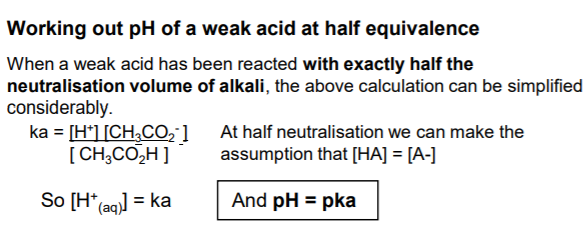
Working out pH of a weak acid at half equivalence assumptions