Chapter 7: Alkenes
No description yet. This curated deck is ready for daily study.
Card preview (24)
What is an Alkene?
Groups with c-c pi bonds.
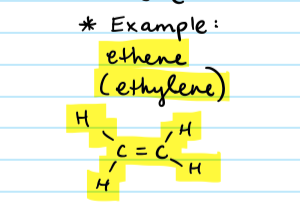
What is the basic formula of an alkene?
CNH2N 2 less hydrogens than alkanes CNH2N + 2 which makes alkenes unsaturated because they do not have the max amount of H on the molecule
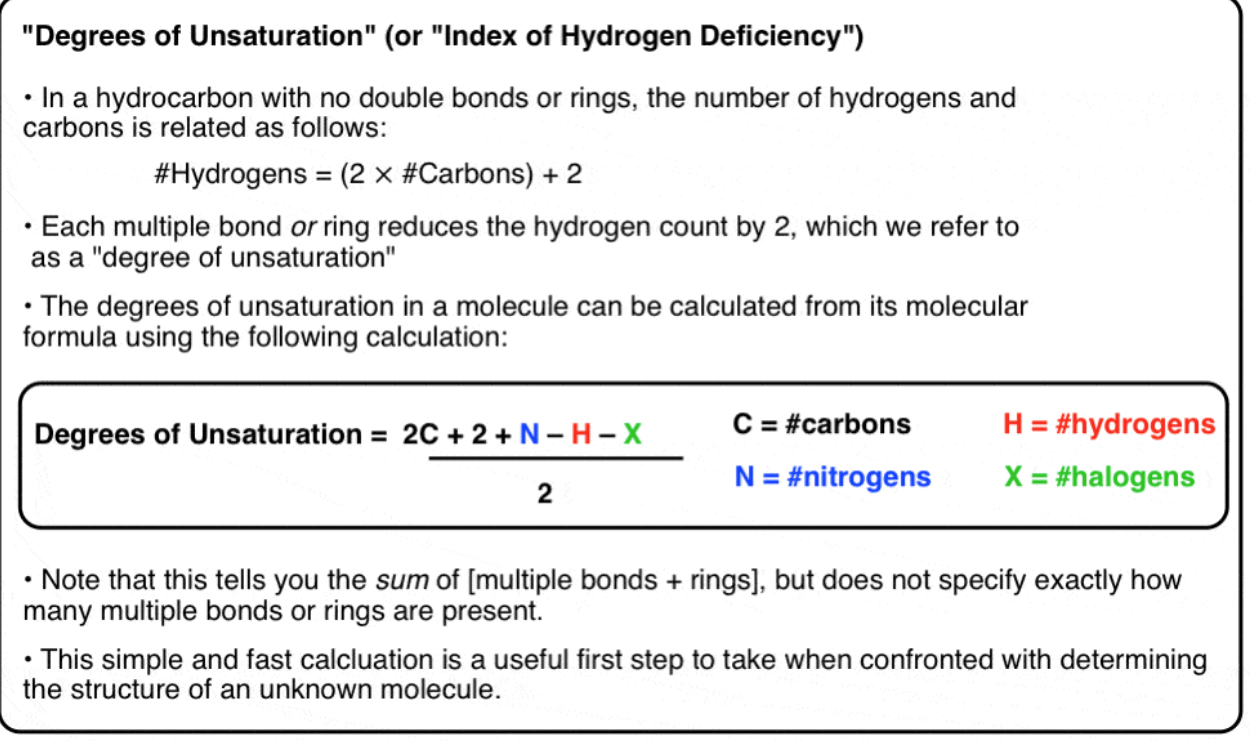
What is the unsaturation or double bond equivalent (DBE) formula and what does it help us calculate?
DBE= 2C + 2 - H - x + N/2 Helps calculate the number of pi bonds or rings in a molecule which helps solve for structure (will be important in spectroscopy)
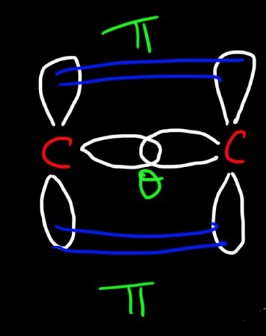
What are double bonds?
Double bonds are 2 carbons that share a sigma and pi bond.
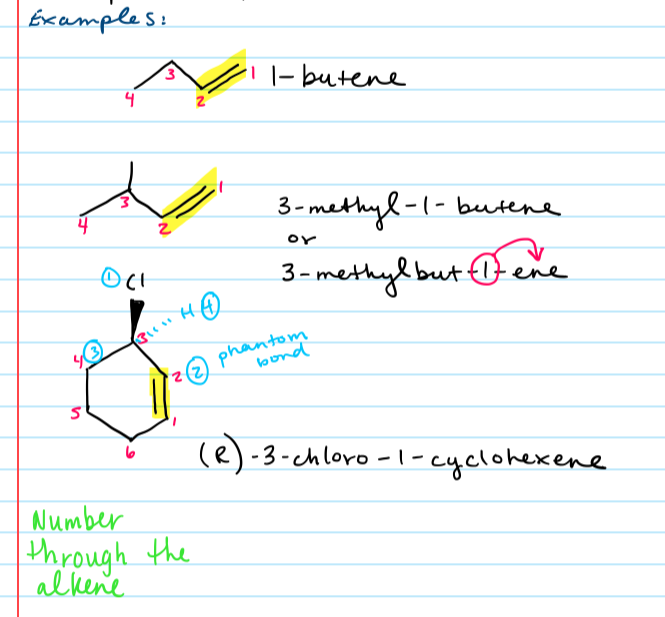
IUPAC rules for Alkenes
• Alkene demands priority so it has to be on the lowest number of carbons regardless of substituents • Find the largest continuous carbon chain that has the alkene (ring or chain) • Drop the -ane and add -ene
Diastereomers of Alkenes
• cis/trans disubstituted alkenes • E/Z designation for alkenes
How to designate E/Z for alkenes
• Use Cahn-Ingold-Prelog rules of priority • # 1 falls on the same side then (Z) • # 1 falls on the opposite side then (E)
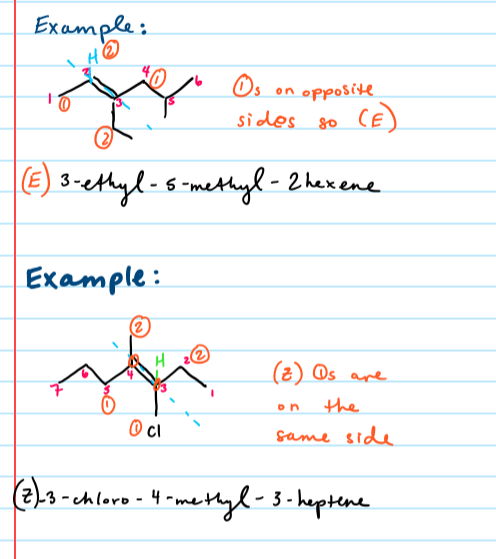
True or False: An alkene will not have E or Z if each carbon in c-c pi bond is attached to 2 different things.
False.
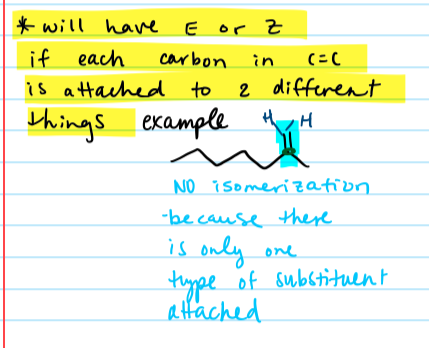
What is the vinylic position on an alkene?
An atom or substituent is in the vinylic position when they are directly attached to an alkene.
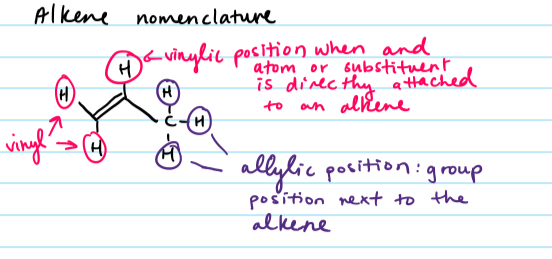
What is the allylic position on an alkene?
A group is in the allylic position on an alkene when it is next to the alkene.
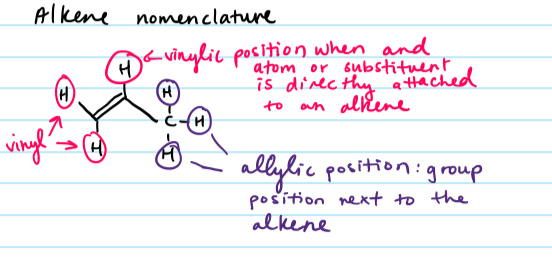
How to determine how much energy is in an alkene
Use bond energies to calculate delta Horxn
How to calculate delta Horxn of an alkene H-X addition mechanism
delta Horxn = (sum Hobonds broken) - (sum Hobonds formed)
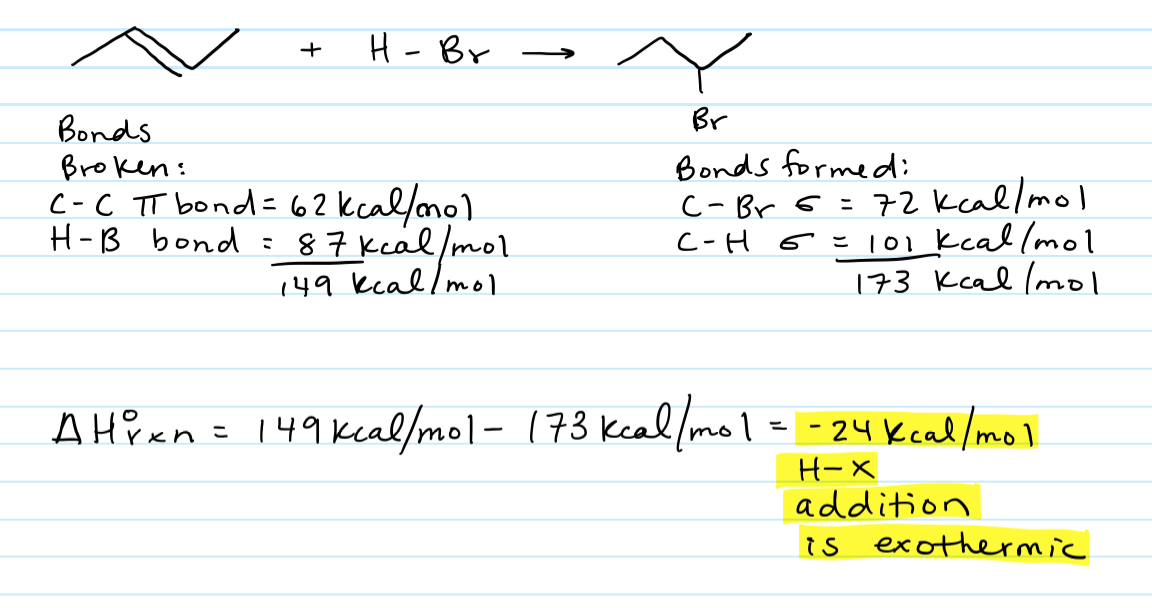
What is the sign of delta Ho of alkene mechanisms?
(-) exothermic. Energy occurs on the product side of rxn because alkenes will give off energy if you reduce or hydrogenate it.
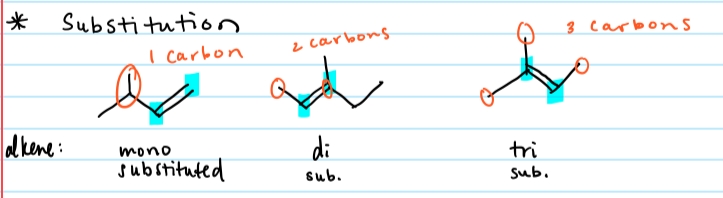
What are the three types of alkenes?
Mono substituted, disubstituted, and trisubstituted. Substitution matters
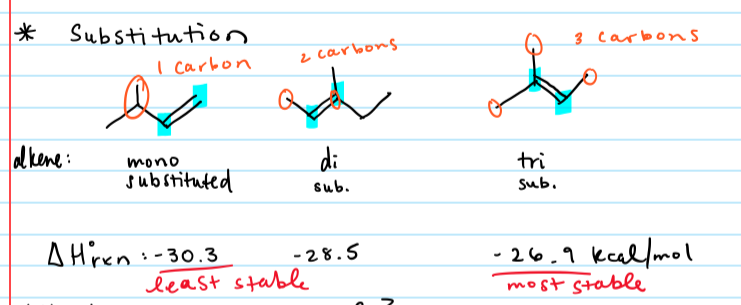
Which type of alkene is the most stable? Monosubstituted, disubstituted, and trisubstituted.
trisub > disub > monosub Trisubstituted is the most stable, Monosubstituted is the least stable
Why is a trisub alkene the most stable compared to disub (middle) and monosub (least)?
More substituted alkenes are more thermodynamically stable. Giving off less heat (less energy) creates more stability. Giving off more heat (more energy) creates less stability.
Are cis or trans alkenes more stable?
Trans are more stable because it gives off less heat and is lower in energy than cis due to avoidance of steric strain.
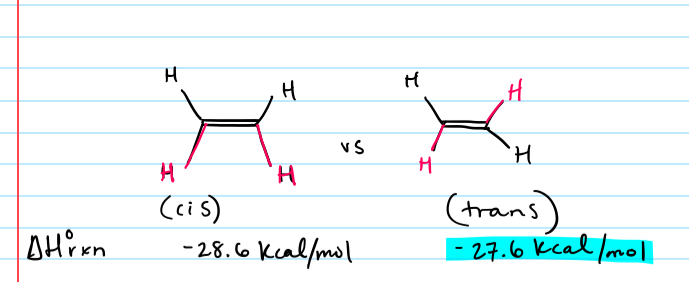
What is steric strain?
Cis alkenes create very close electron clouds called steric strain (electrons bumping into each other). Steric strain adds energy to a system making it less stable.
What is a carbocation?
A carbon that only has 6 electrons in its valence shell and is covalently bonded to 3 atoms. Carbon can have 6 electrons because it is not super electronegative.
What are the classes of carbocations?
+CH3 - methyl (C+ nothing attached) 1o primary (1 Carbon attached) 2o secondary (2 Carbons attached) 3o tertiary (3 Carbons attached)
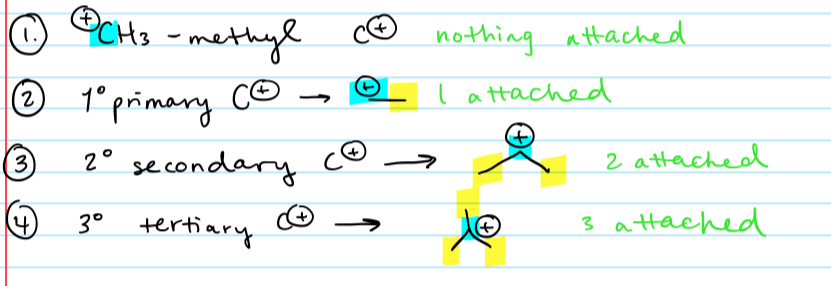
What is the trend for the stability of carbocations?
3 >> 2 > 1 more substitution=more stable or lower in energy
What is the origin of carbocation stability?
Hyperconjugation. Electron delocalization called hyperconjugation which is an overlap of a pair of electrons between a filled and empty orbital that can’t be described by resonance.
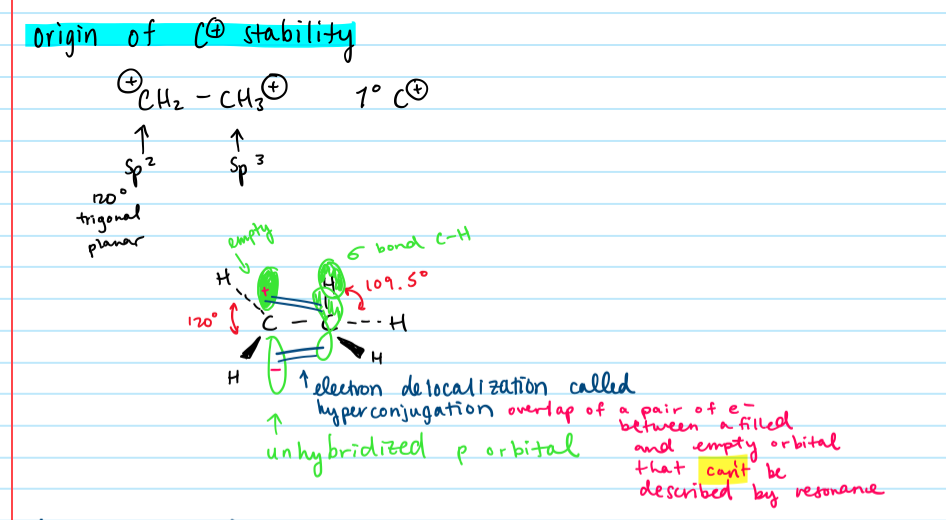
What is the trend between hyperconjugation and stability?
More hyperconjugation=more stable The more bonds that you have next to a carbocation the more hyperconjugation. The more occurrences of hyperconjugation, the more stable the carbocation.
What is the name of the Alkene reaction mechanism?
H-X Addition