Networks
No description yet. This curated deck is ready for daily study.
Card preview (24)
What is a network?
An arrangement of two or more computing devices (nodes) connected together in order to communicate with each other and share resources
Give some reasons for connecting computers in a network.
• To share data and software / share hardware peripherals (printers, hard drives, etc.) / share internet connections and services • To support collaborative working / provide centralised support and backup services • To enable rapid employment of new software and updates / enable people to communicate with each other using services (e.g. email)
Give 3 different types of networks.
• PAN - personal area network • LAN - local area network • WAN - wide area network
Describe what is meant by a PAN.
A network within the range of an individual person
Describe what is meant by a LAN.
• A network in a small area (e.g. a home, school, office building) or group of buildings on a site, existing within a small geographical area • Usually managed by local manager or team at site
Describe what is meant by a WAN.
• A network that connects separate LANs over a large geographical area • Large companies connect LANs at different sites to share data and resources • Managed by several different people or parts of an organisation working together / each LAN could be managed independently
Give 2 network usage models.
• Client-server • Peer-to-peer
Describe what is meant by a client-server network.
• A network containing a server that can back up and store data centrally • All other devices each considered a ‘client’, may be more than one server
Describe what is meant by a peer-to-peer network.
• A network configuration containing no central server • Each device equal in responsibility, each with the ability to work as a client and a server
Name the two network structures that describe the way in which data within the network is transmitted.
• Wired (e.g. via cables) • Wireless
State what is meant by ‘range’ in terms of data transmission.
The distance over which data can be transferred
State what is meant by ‘bandwidth’ in terms of data transmission.
The capacity at which a network can transmit data
State what is meant by ‘latency’ in terms of data transmission.
The delay in time between data being transferred and the instruction which caused the transfer
Two types of cables most commonly used for networks are copper wire and fibre-optic cables. Give some characteristics of copper wire cabling.
• Made of thin copper strands, transmits data as electrical signals • High noise contamination • Prone to external interference • Low bandwidth • Easy installation / fairly cheap installation
Two types of cables most commonly used for networks are copper wire and fibre-optic cables. Give some characteristics of fibre-optic cabling.
• Very low noise contamination • Not affected by magnetic interference - data carried using beams of light • Secure/reliable data transmission • Much higher bandwidth over a longer distance • Difficult installation/maintenance • Expensive due to cost of electrical components - although does not corrode • Made of glass so more fragile
Give some forms of wireless transmission media.
• Wi-Fi • Bluetooth • Zigbee • RFID • NFC
Describe the aspects of using wired transmission media to create a LAN.
• Difficult installation - Each device needs own dedicated cable • Limited flexibility - Number and location of cable connections is fixed, making changes once set up is likely to disrupt LAN • Long range • High bandwidth • Low latency - Cables have protective coverings, less susceptible to interference • Good security - Impossible to tap into physical cables without being in same location as cable
Describe the aspects of using wireless transmission media to create a LAN.
• Easy installation - Adding new devices easy, only WAPs to be connected by cable • Versatile - Devices can be moved around without losing connection, new users added easily • Short range - Walls and other physical obstacles may obstruct signal • Low bandwidth - All active devices must share available bandwidth • High latency - Susceptible to interference from other wireless networks or devices • Poor security - Anyone within range can intercept transmissions
What is meant by ‘network speed’?
The rate at which data is transferred within a network
What are network speeds measured in?
Bits per second, bps (e.g. Mbps, Gbps)
What is the equation to calculate the rate at which data is transferred?
Data transfer rate (bps) = File size (bits) ÷ Time (s)
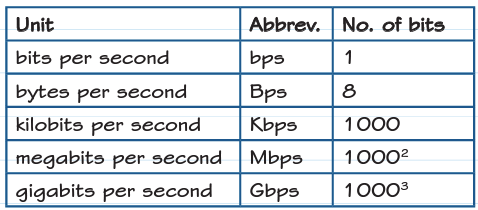
Data transfer rate is measured in base-10 units. Recall the values corresponding to each of the correct units.
What is a network topology?
The way in which devices on a network are physically arranged and connected together
Give four examples of network topologies.
• Bus • Star • Ring • Mesh