Back to marketplace

chap 7

No description yet. This curated deck is ready for daily study.

Total cards: 15•Content version: v4•Public deck•Updated: 8/1/2026

Card preview (15)

#1
Front (Question)

when explaining electron shielding what would be better sentence than “xenon atom is bigger”

Back (Answer)

larger atomic radius

#2
Front (Question)

Card front image
Back (Answer)

Mg

#3
Front (Question)

Card front image
Back (Answer)

Card back image
#4
Front (Question)

Card front image
Back (Answer)

Card back image
#5
Front (Question)

Card front image
Back (Answer)

Card back image
#6
Front (Question)

Card front image
Back (Answer)

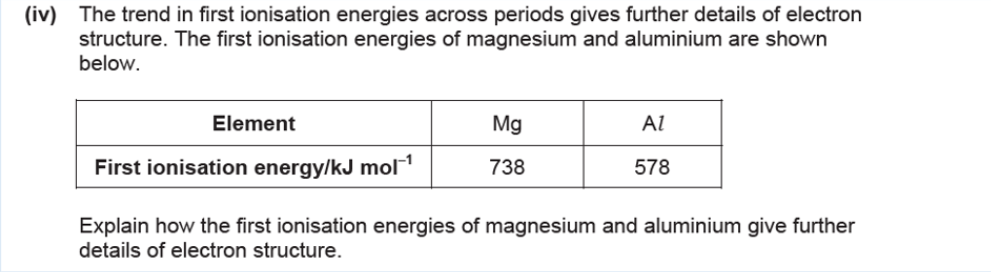
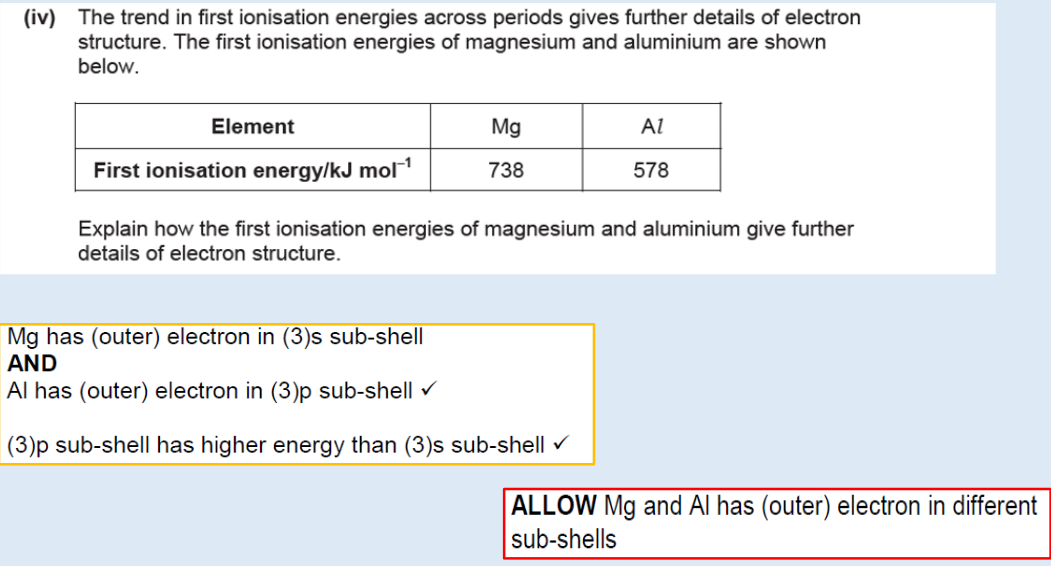
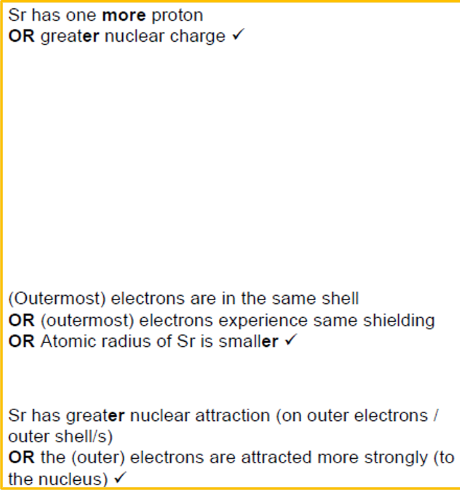
.1 more (not more) .Atomic radius of Sr is smaller even though they are in the same outermost shell .greater nuclear attraction

Card back image
#7
Front (Question)

Card front image
Back (Answer)

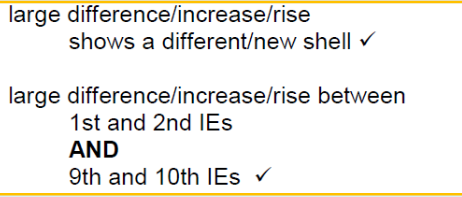
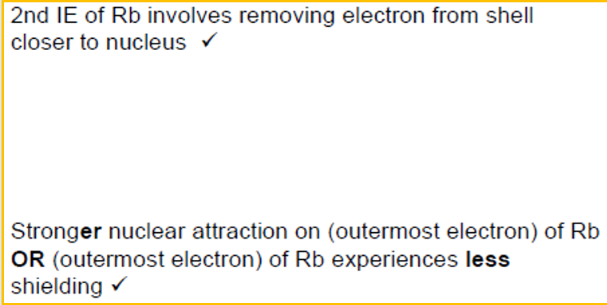
losing the 2nd e^- from the next shell closer to the nucleus —-> so stronger nuclear attraction
Card back image
#8
Front (Question)

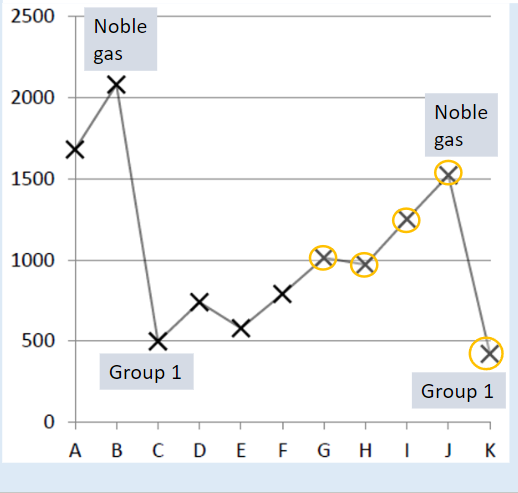
draw, start with group 7 going right, period 3, going down the table?

Card front image
Back (Answer)

Card back image
#9
Front (Question)

Card front image
Back (Answer)

Card back image
#10
Front (Question)

Card front image
Back (Answer)

Card back image
#11
Front (Question)

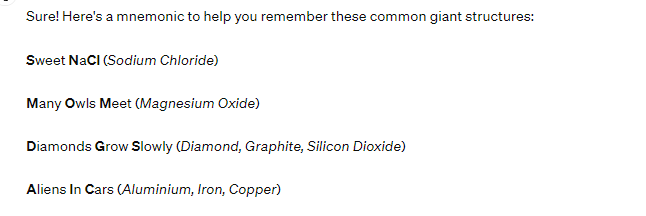
Common Giant Structures to Remember:

Back (Answer)

Giant Ionic Structures: Sodium Chloride (NaCl) Magnesium Oxide (MgO) Giant Covalent Structures: Diamond (Carbon) Graphite (Carbon) Silicon Dioxide (SiO2) Giant Metallic Structures: Aluminium (Al) Iron (Fe) Copper (Cu)
Card back image
#12
Front (Question)

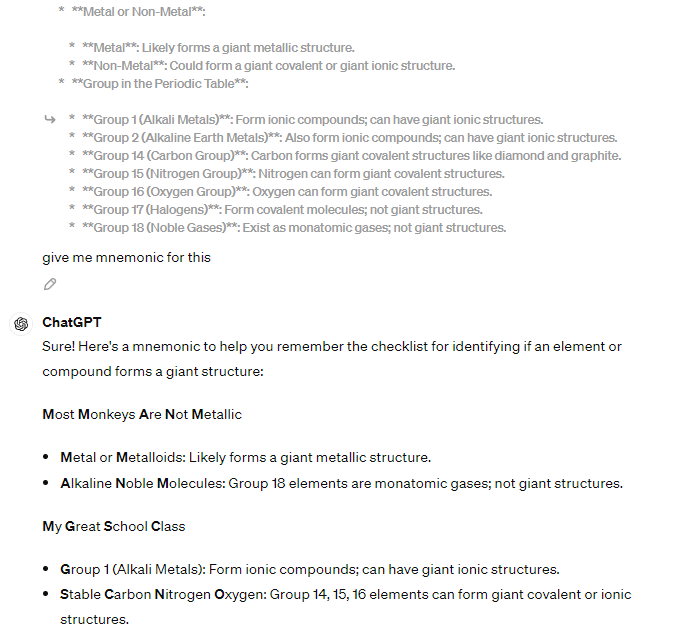
Simple Checklist for Giant Structures:
Back (Answer)

Card back image
#13
Front (Question)

Card front image
Back (Answer)

Card back image
#14
Front (Question)

give the 3rd ionization energy equation

Back (Answer)

X^2+(g) ——-> X^3+(g) + e^-

#15
Front (Question)

What 3 elements don’t form simple molecular lattices

Back (Answer)

Boron Carbon and Silicon