Organic 13: Biochemistry
No description yet. This curated deck is ready for daily study.
Card preview (24)
What is a zwitterion?
A species that has both a positive and negative charge on different parts of the molecule
Why are amino acids usually solids at room temperature?
Due to the strong ionic attraction between opposite charges on zwitterions
Describe the general structure of an amino acid.
Central chiral carbon surrounded by hydrogen, carboxylic acid group, variable group, and amine group
What is the only amino acid that isn’t optically active and why?
Glycine Because glycine’s variable group is hydrogen, which means there are only three different groups around the central carbon All other amino acids are optically active but only one enantiomer is present in nature
How many naturally occurring amino acids are there?
20
What ion is produced at low pH on an amino acid?
In strongly acidic conditions, the lone pair on NH2 accepts a proton to form an NH3+ ion (is protonated)
What ion is produced at high pH on an amino acid?
In strongly alkaline conditions, the -OH group loses a hydrogen ion (is deprotonated) to form an OH- ion
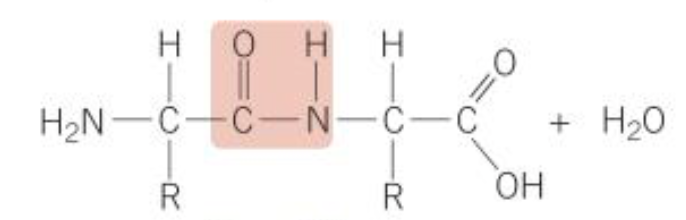
What is an amide linkage?
The bond formed after condensation reaction between two amino acids
What is the primary structure of a protein?
The fixed sequence of amino acids in the polypeptide chain It is relatively stable due to covalent bonding
What is the secondary structure of a protein?
The initial folding of a polypeptide chain into either an alpha helix or a beta-pleated sheet due to hydrogen bonding Hydrogen bonds are much weaker than covalent bonds so the secondary structure is more easily disrupted
What is the tertiary structure of a protein?
Further folding into a three-dimensional shape held in place by hydrogen bonding, ionic bonding, and disulfide bridges
How is a protein hydrolysed?
With hydrochloric acid of concentration 6moldm-3 for about 24 hours This hydrolyses all peptide linkages
How would you find the structure of proteins?
By refluxing the protein in 6moldm-3 hydrochloric acid to break the amide linkages (hydrolysis) resulting in a mixture of all the individual amino acids
Describe how you would use Thin Layer Chromatography to determine which amino acids make up a protein.
• Add a small spot containing the mixture of amino acids about 1cm up the plate • Place the plate in a tank containing a suitable solvent, and put a lid on it (this allows the solvent vapours to carry the amino acids up the stationary phase) • The affinity for the mobile and stationary phase depends on the intermolecular forces that act between the amino acid and each phase • Mark the solvent front (how far the solvent was carried up the stationary phase) • Spray the plate with ninhydrin, which reacts with amino acids to form a purple compound, OR shine ultra-violet light onto the plate to see how far the amino acids were carried • Calculate the Rf value (distance moved by spot/distance moved by solvent)
What are enzymes?
Protein-based catalysts that speed up the rate of reactions Usually globular proteins with active sites where the reaction occurs
What is the lock and key hypothesis?
The reacting molecule fits precisely into the active site and is held in the precise orientation necessary to react
What is the reality of enzyme-substrate interactions?
The reacting molecule must bond to the active site temporarily by intermolecular forces (i.e. van Der Waals) These forces allow electrons to move within the substrate to lower the activation energy for the reaction
How is the stereospecificity of enzymes important?
The active site of an enzyme is selective to individual enantiomers Because the substrate molecule must have a 3D structure that can bind precisely to the active site
How can enzymes be denatured?
Changes in pH Changes in temperature (Too much deviation from optimum)
What is enzyme inhibition?
Where a molecule with a similar shape/tertiary structure to the substrate can be used to block the active site to prevent enzyme-substrate complexes from forming
Name one drug that works by enzyme inhibition.
Penicillin Inhibits the enzymes responsible for controlling the building of cell walls in bacteria
How is computer modelling useful in drug design?
Computer modelling techniques can be used to predict the shape of proteins before they have been synthesised So can therefore predict their properties
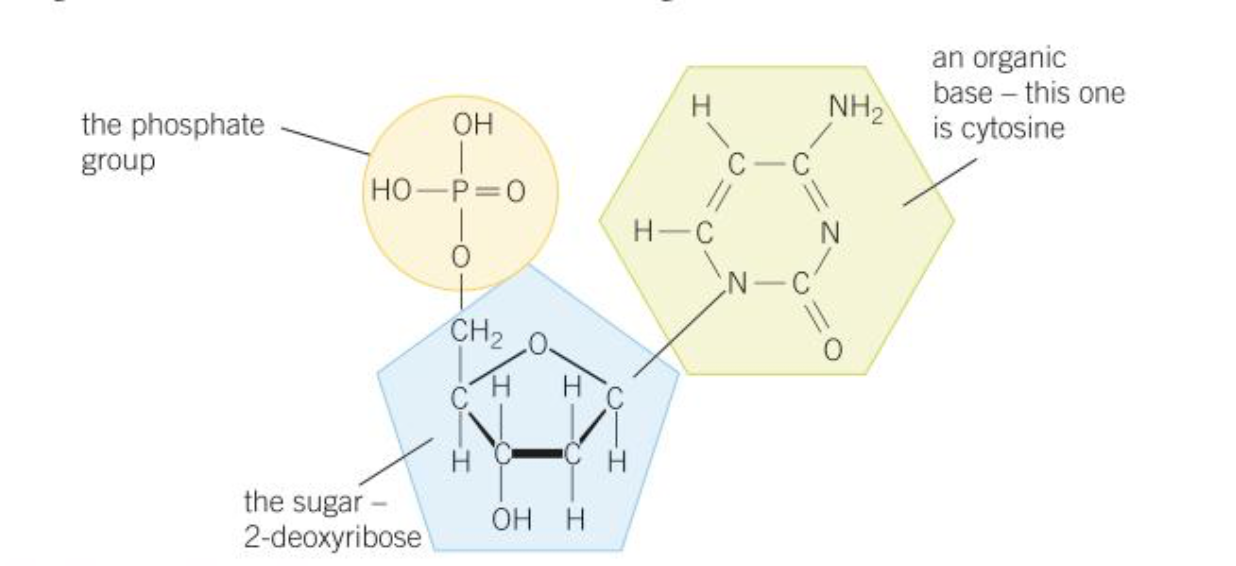
Describe the structure of a DNA nucleotide.
Phosphate 2-Deoxyribose Organic base
What are the four organic bases?
Adenine, Thymine, Cytosine, Guanine