3 Properties of waves
No description yet. This curated deck is ready for daily study.
Card preview (20)
What is the wavelength of a wave?
The distance between two consecutive crests or troughs.
True or false: Longitudinal waves have particles that move perpendicular to wave direction.
FALSE Longitudinal waves have particles that move parallel to the wave direction.
Fill in the blank: Frequency is measured in _______.
Hertz (Hz)
Define transverse wave.
A wave where particle movement is perpendicular to wave direction.
What is the period of a wave?
The time taken for one complete cycle of the wave.
True or false: Sound waves are an example of transverse waves.
FALSE Sound waves are longitudinal waves.
What is refraction?
Waves changing direction as they pass from one medium to another.
Define reflection in wave terms.
The bouncing back of a wave when it hits a barrier.
Fill in the blank: Amplitude affects the _______ of a wave.
Loudness or intensity.
What is the Doppler effect?
The change in frequency or wavelength of a wave in relation to an observer. As an ambulance moves towards you the frequency of the sound is different to as it moves away from you
What is the difference between longitudinal and transverse waves?
Longitudinal waves: particles move parallel to wave direction Transverse waves: particles move perpendicular to wave direction Longitudinal waves include sound waves, while transverse waves include light waves.
Define amplitude.
The maximum displacement of a wave from its rest position Amplitude is a measure of the energy carried by the wave.
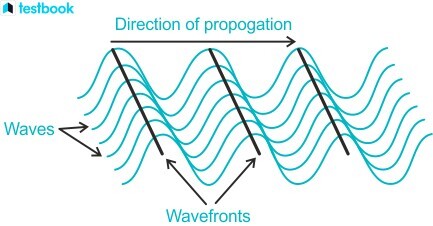
Define wavefront.
An imaginary surface representing points of a wave that are at the same point in their cycle like looking at a water wave from above
Define frequency.
The number of waves passing a point per second Measured in Hertz (Hz).
Define wavelength.
The distance between successive crests or troughs of a wave Wavelength is usually denoted by the Greek letter lambda (λ).
Define period.
The time taken for one complete wave cycle to pass a point Period is the inverse of frequency.
What do waves transfer without transferring matter?
Energy and information Waves propagate through a medium but do not carry the medium itself.
What is the relationship between frequency and time period?
frequency = 1 / time period f = 1 / T This shows how frequency and time period are inversely related.
What is the Doppler effect?
The change in observed frequency and wavelength of a wave when its source is moving relative to an observer Commonly experienced with sound waves from moving vehicles.
True or false: All waves can be reflected and refracted.
TRUE Reflection and refraction are fundamental properties of waves.