6. Chemical Kinetics
No description yet. This curated deck is ready for daily study.
Card preview (17)
Collision Theory
• Particles must collide • Particles must have enough kinetic energy to overcome electron cloud repulsion to react - activation energy • particles must collide in the correct orientation - steric factor
Factors Affecting Rates of Reaction
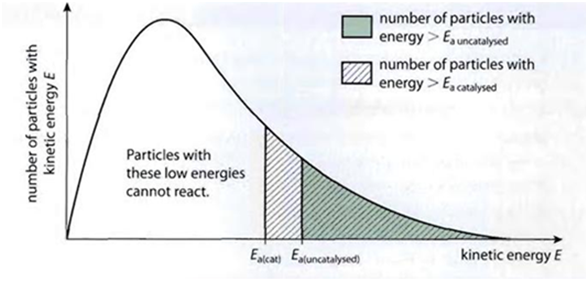
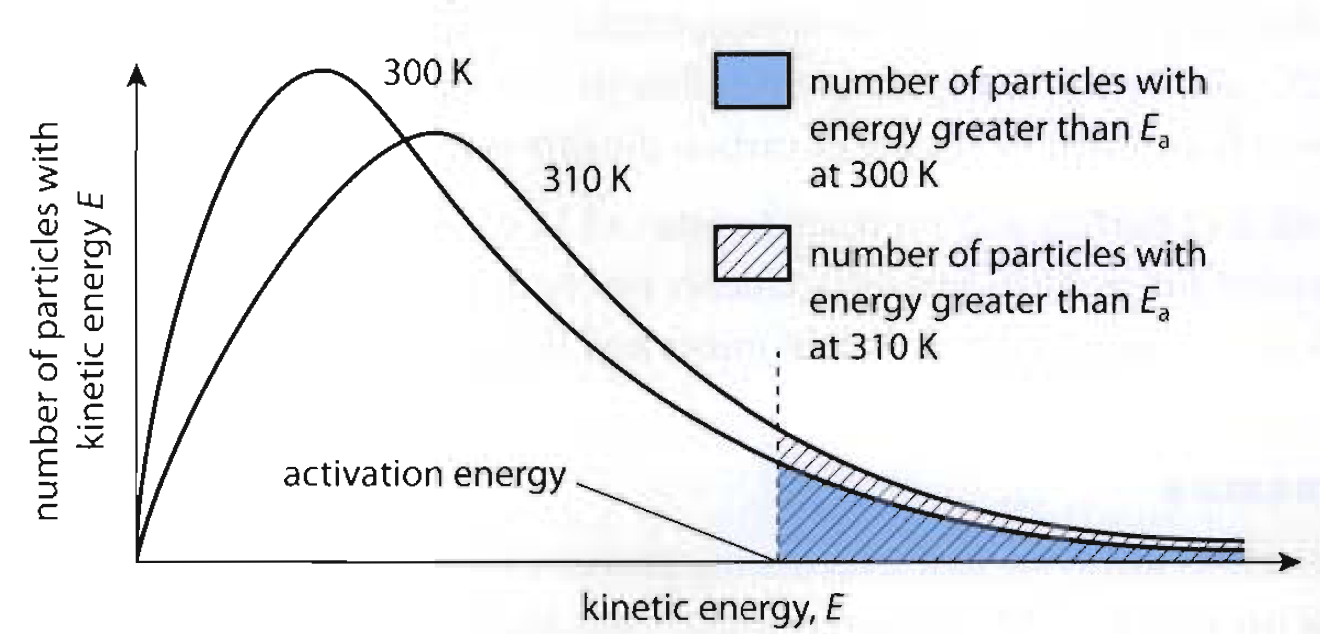
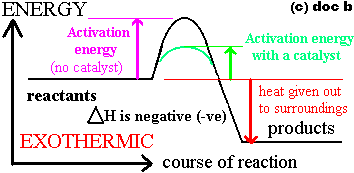
• Concentration • increase the rate at which particles collide • Surface area • increase area of contact, increased collisions • Temperature • increases the number of particles that will have sufficient active energy • Catalysts • decrease the Activation energy required
Maxwell-Boltzmann Curve - catalyst
Maxwell-Boltzmann Curve - temperature
Enthalpy level diagram
Rate of Reaction equation
-d[R] / dt = d[P] / dt mol dm-3 s-1
Ways to measure reaction rate
• Gas collection syringe • Gas collection over water • Change in mass • Change in color • Change in pH / conductivity • Chang to a point (clock reactions)
The Rate Equation
• Links to the rate of reactions to the concentration of reactants • can only be found by doing actual experiments • catalysts must be included A + B –> C + D r = k[A][B]2 k=constant If [A] is doubled, the rate is doubled If [B] is doubled, the rate is quadrupled
Order reaction (Individual / overall)
Individual order - the power to which a concentration is raised in the rate equation Overall order - the sum of all the individual orders in the rate equation r = k[A][B]2 overall order = 3 The value is 0 if the rate is unaffected by how much substance is present
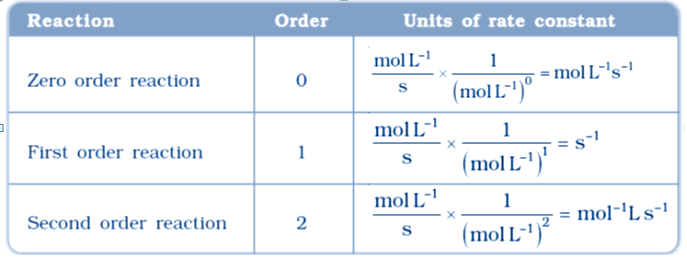
Units for the rate constant (k)
The units of k depend on the order of reaction • divide the rate by as many concentrations in the equation
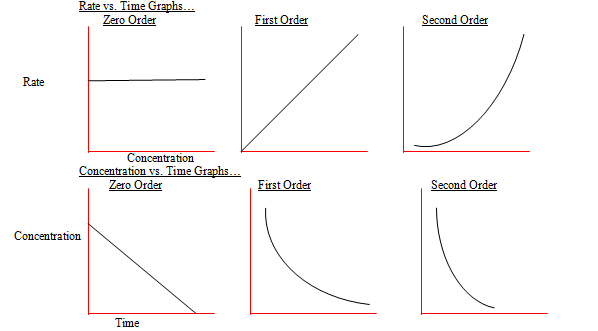
Graphical determination of rate - Conc. and Rate
Reaction Mechanism
• In a multistep process, one of the steps will be slower than all others • the overall reaction cannot occur faster than this slowest, rate-determining step • the order of the reaction for this step will be the same as the order of reaction for the entire reaction
Molecularity of the Reaction Mechanism
Unimolecular steps - involve a single species as a reactant • A –> Products Bimolecular steps - involve collisions of 2 species • A + B –> products
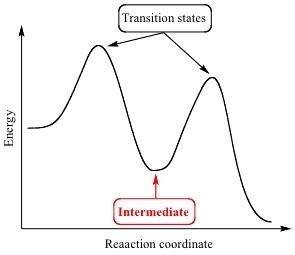
Intermdiate vs Transition States
Intermediates • Exists for a finite time • occur at P.E. minimum • Formed in one step of a reaction and consumed in a subsequent step Transition States • Have only a transient existance • occur at P.E. maximum • Exist part way through every step of a reaction
Arrhenius Equation
k = Ae - Ea/RT A = arrhenius constant, a number that represents the likelihood that collisions would occur with the proper orientation Ea = activation energy T = temp in K R = universal thermodynamics constant
Arrhenius Plot
ln(k) = -Ea/RT + lnA when K is determined experimentally at several temperatures, Ea can be calculated from the slope of a plot of ln(k) vs 1/T
Determining Ea
• convert the rate constants (k) to natural logs ln(k) • convert temperatures to kelvin and then to 1/T • draw an arrhenius plot of ln(k) vs 1/T • measure the gradient of the line • gradient = -Ea/R, solve for Ea * for most equations, an increase of 10c will double the rate of reaction