Unit 1-Atomic Structure
No description yet. This curated deck is ready for daily study.
Card preview (16)
What three particles make up an atom?
Protons, neutrons and electrons
Describe the charge, mass and position of a proton.
Positive charge, mass of 1 amu, found in the nucleus
Describe the charge, mass and position of a neutron.
No charge (neutral), mass of 1 amu, found in the nucleus
Describe the charge, mass and position of an electron.
Negative charge, almost zero mass, found in energy levels around the nucleus
What is the atomic number?
The number of protons in an atom
What is the mass number?
The total number of protons and neutrons
How do you calculate the number of neutrons?
Mass number − atomic number
Explain how an atom can contain charged particles but still be neutral.
It has the same number of protons and electrons, so the charges cancel out.
How many electrons can fit in each shell?
1st: 2 2nd: 8 3rd: 8
What are the electron arrangements of: Carbon Lithium Calcium
2,4 2,1 2,8,8,2
What is an element?
A substance made of only one type of atom
What is an isotope?
Atoms of the same element with the same atomic number but different mass number or Atoms of the same element with the same number of protons but different numbers of neutrons
What is meant by relative atomic mass (RAM)?
The average mass of an element’s isotopes, taking into account their relative proportions
What is an ion and how is it formed?
A charged atom formed when electrons are gained or lost.
What name is given to this way of representing an atom?
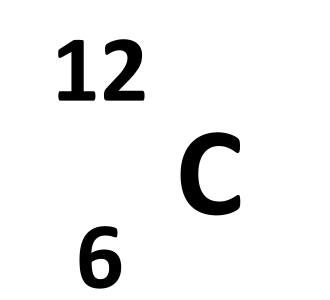
Nuclide Notation
What do the numbers in nuclide notation represent?
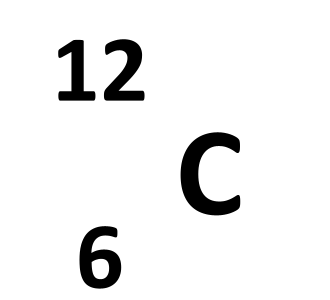
Top number = mass number Bottom number = atomic number From these you can work out protons, neutrons and electrons