chapter 18 rates
No description yet. This curated deck is ready for daily study.
Card preview (16)
what does collision theory state ?
for a successful reaction: 1. reactants must possess at least a minimum ammouunt of energy - activation energy 2. particles must approach eachother in a certain relative way - steric effect
what are the ways you can increase ROR ?
• increase surface area of solids • increase temperature • add a catalyst • increase the pressure of any gases • increase the concentration of reactants
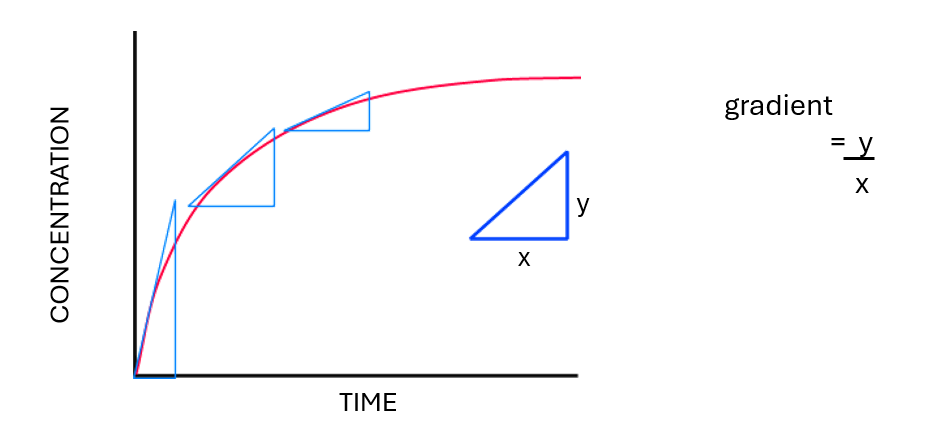
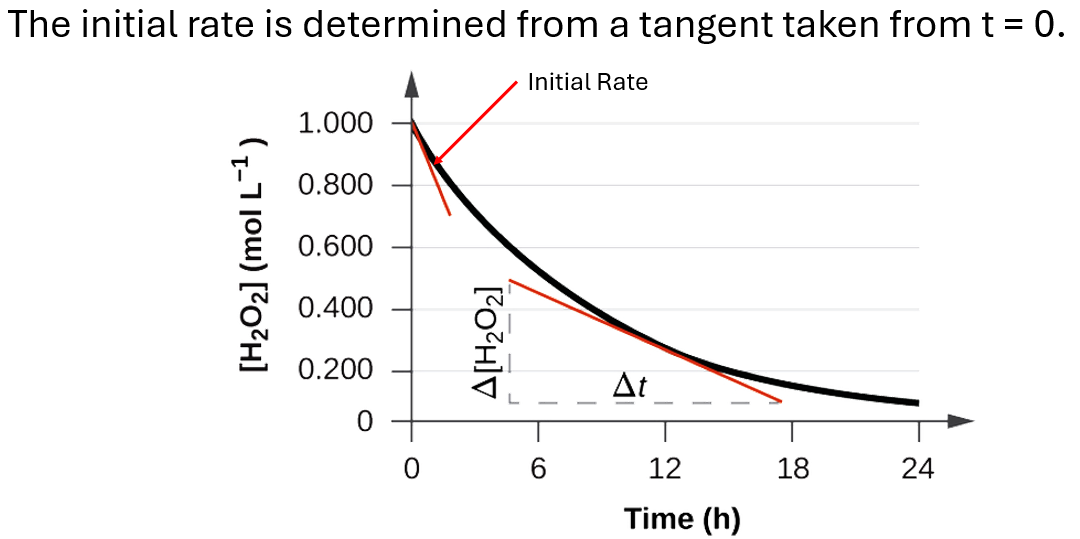
How do you measure the rate of reaction from concentration time graph
• the rate of change of concentration is found from the gradient • the gradient at the start will give the initial rate and the gradient decreases as the reaction proceeds
what is the order of a reactant ?
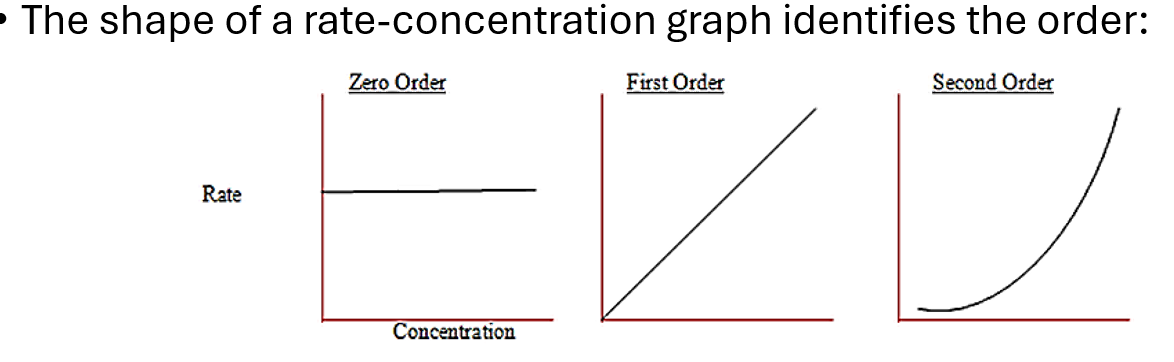
• the order attribuuted to a reagent identifies the effect changing its concentration has on the rate of reaction
what is the rate equation ?
• rate = k[A]a[B]b where: • rate = mol dm-3s-1 • k = rate constant • [A] = cocncentration of A • a = the order of reagent • the overall order of a reaction is the sum of individual orders
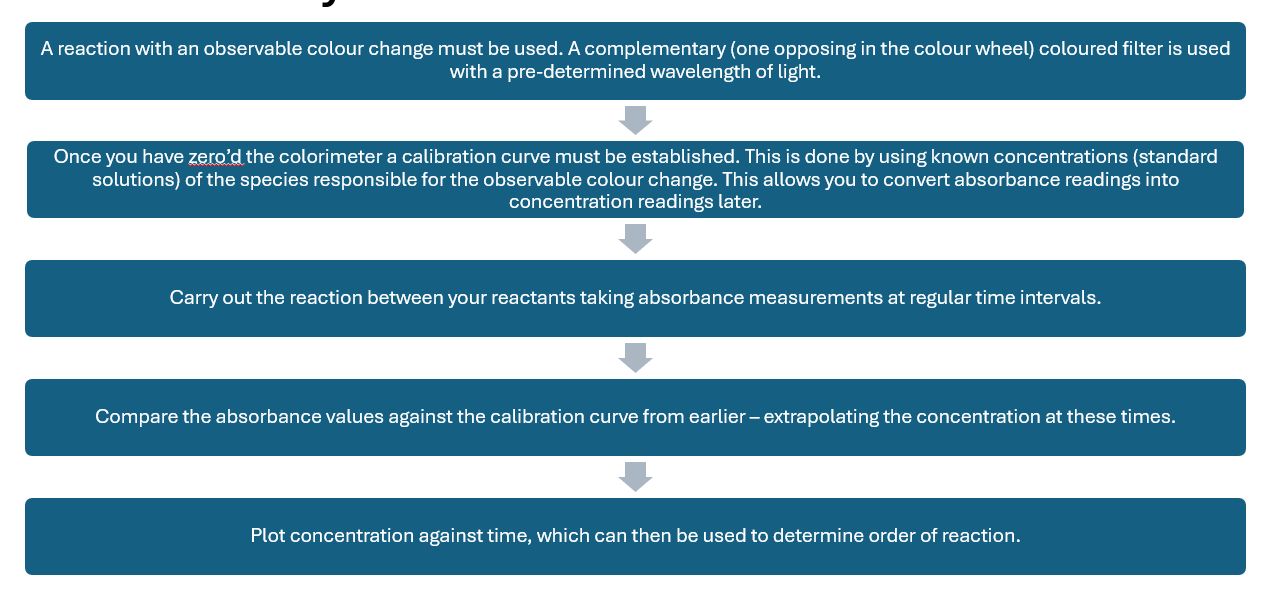
How to determine order from colorimetry ?
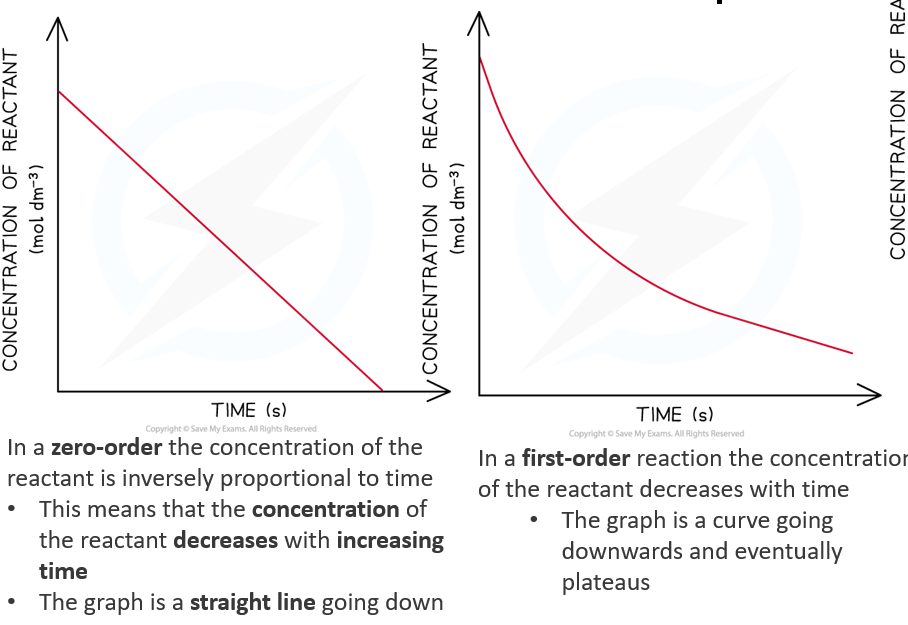
vHow to determine order from concentration time graph ?
How to determine initial rate from concentration time graph ?
how to determine the rate constant k ?
• k can be determined for a first order reaction by using: 1. Rate (tangent) - k = rate / [A] 2. Half-life as first oders have exponential relationships) - k = ln2 / t1/2
how to determine order from rate-concentration graph ?
how to calculate the initial rate methods ?
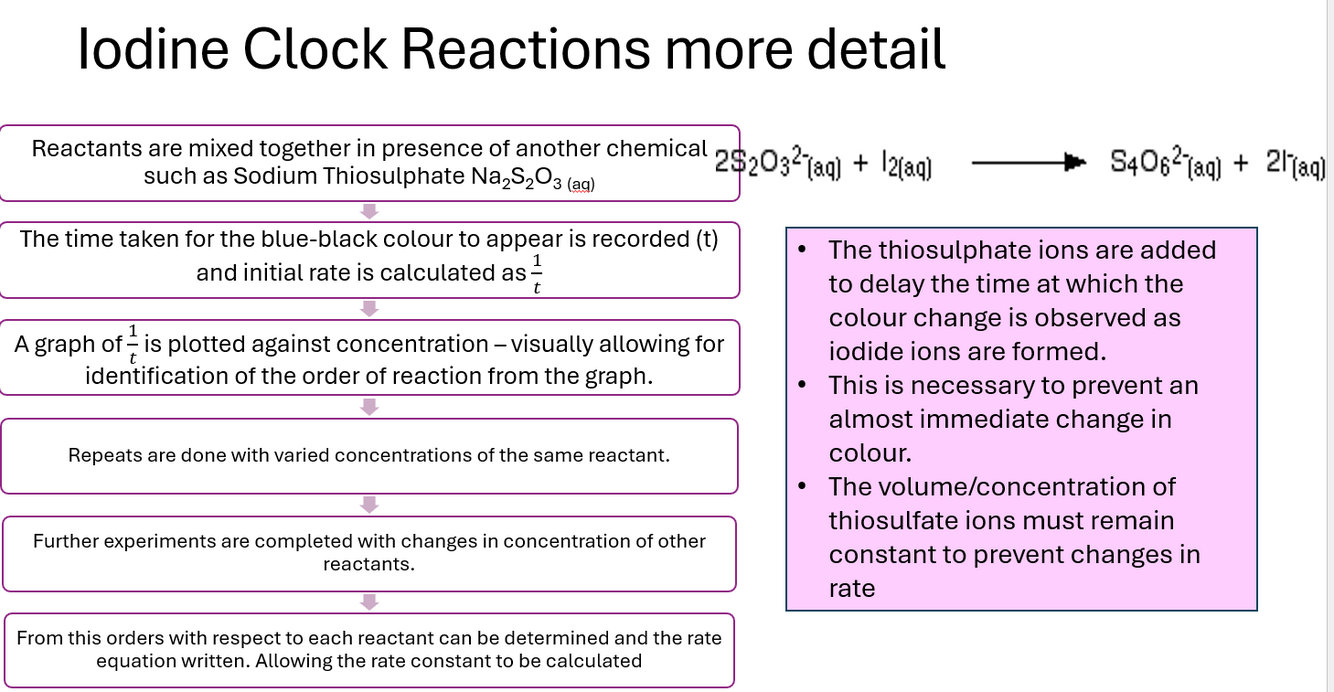
• usually record the time it takes for an easily recognisable change to occur ealry in the reaction e.g colour change, formation of precipitate • these are often refered to as clock reactions where the concentration of one reagent is altered • the intital rate = 1/t , where t is the time taken for change to occur
how does the iodine clock reaction work ?
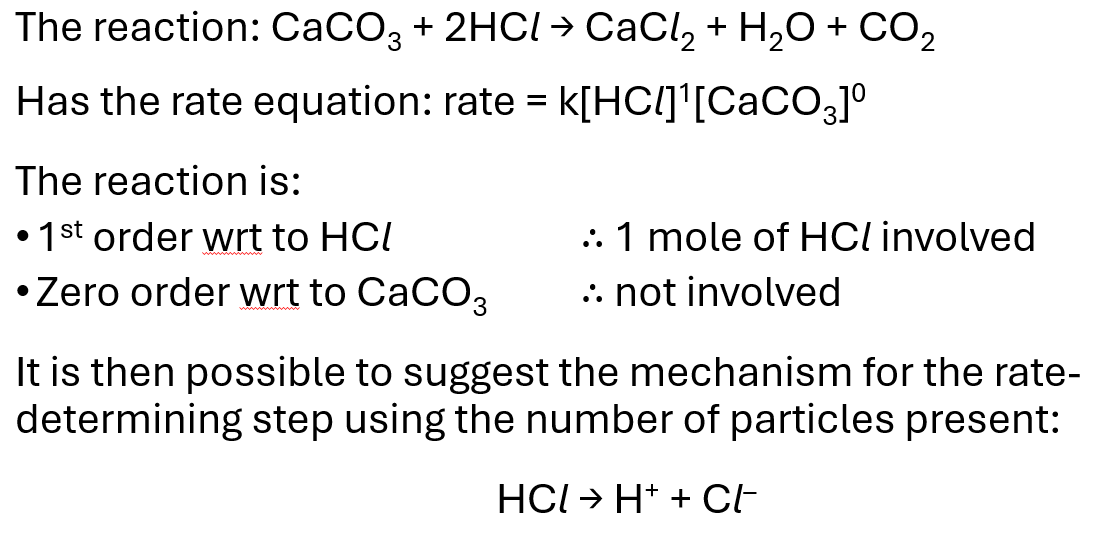
what is the rate determining step ?
• the rate determining step is the slowest step in a reaction mechanism - it determines the overall rate of reaction • there is a direct relationship between the order and the rate determining step: 1. zero order - not involved 2. first order - 1 mole of reactant 3. second order - 2 moles of reactant
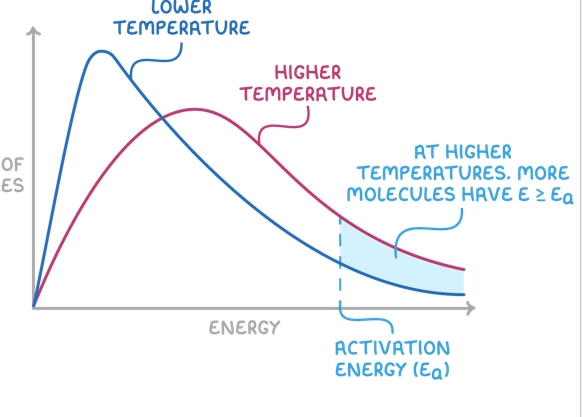
how does temperature affect the rate of reaction ?
• increase ROR: 1. boltzman distribution shifts to the right so more particles have the required activation energy 2. increased kinetic energy more frequent collisions • aprox every 10 degree increase results in doubling the rate constant k, so rate doubles
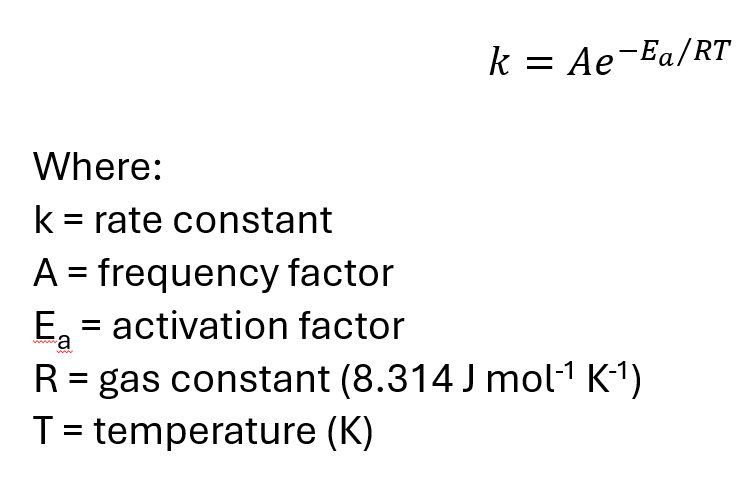
what is the arrhenius equation ?
• the effect of temperature on rate can be explained by using arrhenius equation
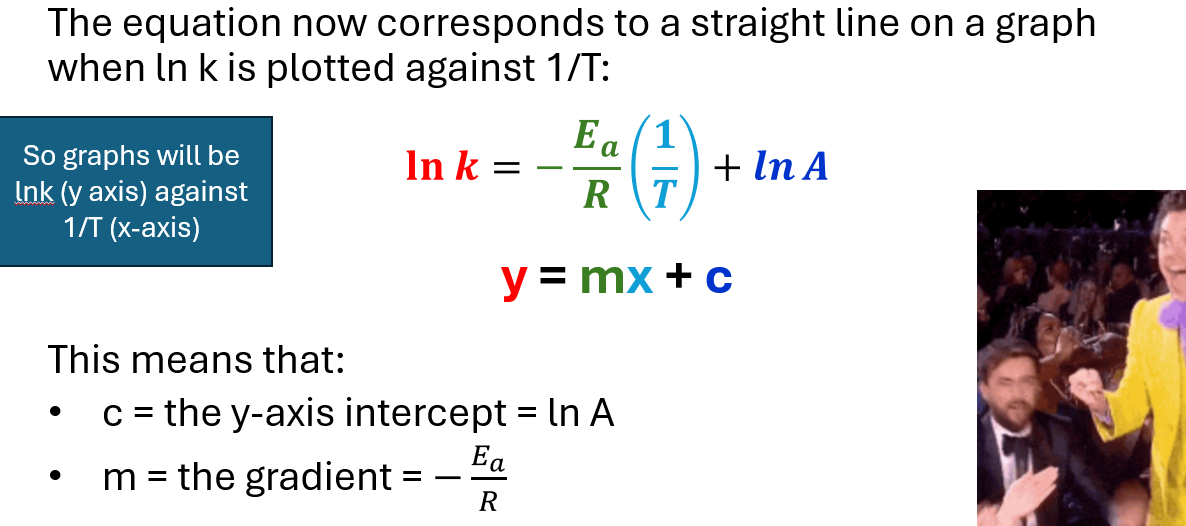
what is the linear arrhenius equation ?