5.2 ENERGY
No description yet. This curated deck is ready for daily study.
Card preview (24)
Standard lattice enthalpy Δ(le)H°
The enthalpy change that occurs when one mole of an ionic lattice is formed from its gaseous ions under standard conditions
Explain what a more exothermic (negative) lattice enthalpy Δ(LE)H° says about the ionic bonds and MP/BP
• Stronger ionic bonds, higher melting/boiling point
Standard enthalpy of formation Δ(f)H°
The enthalpy change that occurs when one mole of a compound is formed from its elements under standard conditions
Standard enthalpy of atomisation Δ(at)H°
The enthalpy change that occurs when one mole of gaseous atoms is formed from its element under standard conditions
First ionisation energy Δ(ie1)H°
The enthalpy change that occurs when one mole of gaseous 1+ ions are formed from one mole of gaseous atoms under standard conditions
Second ionisation energy Δ(ie2)H°
The enthalpy change that occurs when one mole of gaseous 2+ ions is formed from one mole of gaseous 1+ ions under standard conditions
First electron affinity Δ(ea1)H°
The enthalpy change that occurs when one mole of gaseous 1- ions are formed from one mole of gaseous atoms under standard conditions
Second electron affinity Δ(ea2)H°
The enthalpy change that occurs when one mole of gaseous 2- ions are formed from one mole of gaseous 1- ions under standard conditions
Standard enthalpy of solution Δ(sol)H°
The enthalpy change that occurs when one mole of an ionic lattice is completely dissolved in water under standard conditions
Standard enthalpy of hydration Δ(hyd)H°
The enthalpy change that occurs when one mole of gaseous ions dissolve to form one mole of aqueous ions under standard conditions
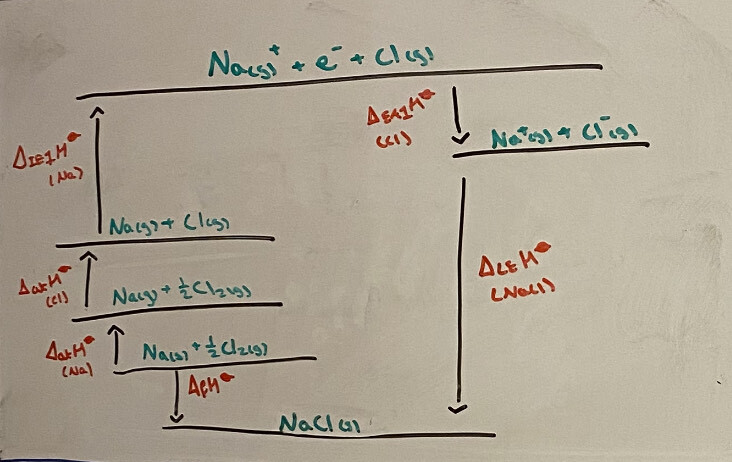
Born-Haber cycle for NaCl
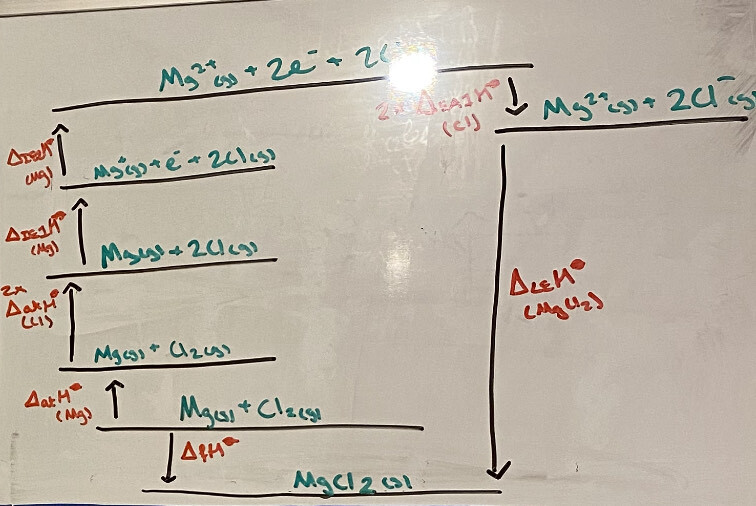
Born-Haber cycle for MgCl2
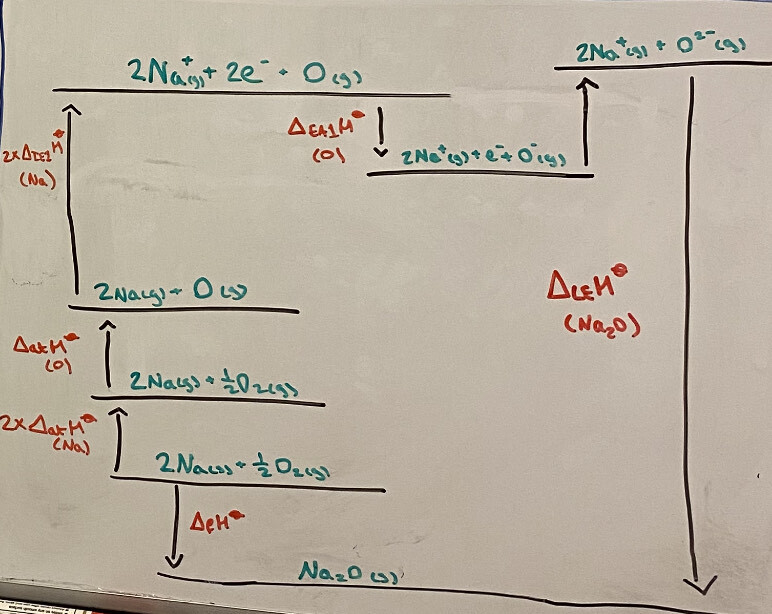
Born-Haber cycle for Na2O
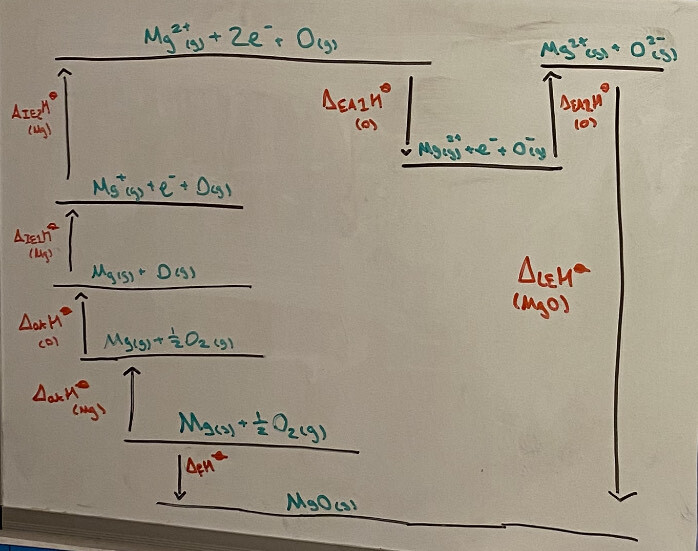
Born-Haber cycle for MgO
Enthalpy cycle for KCl
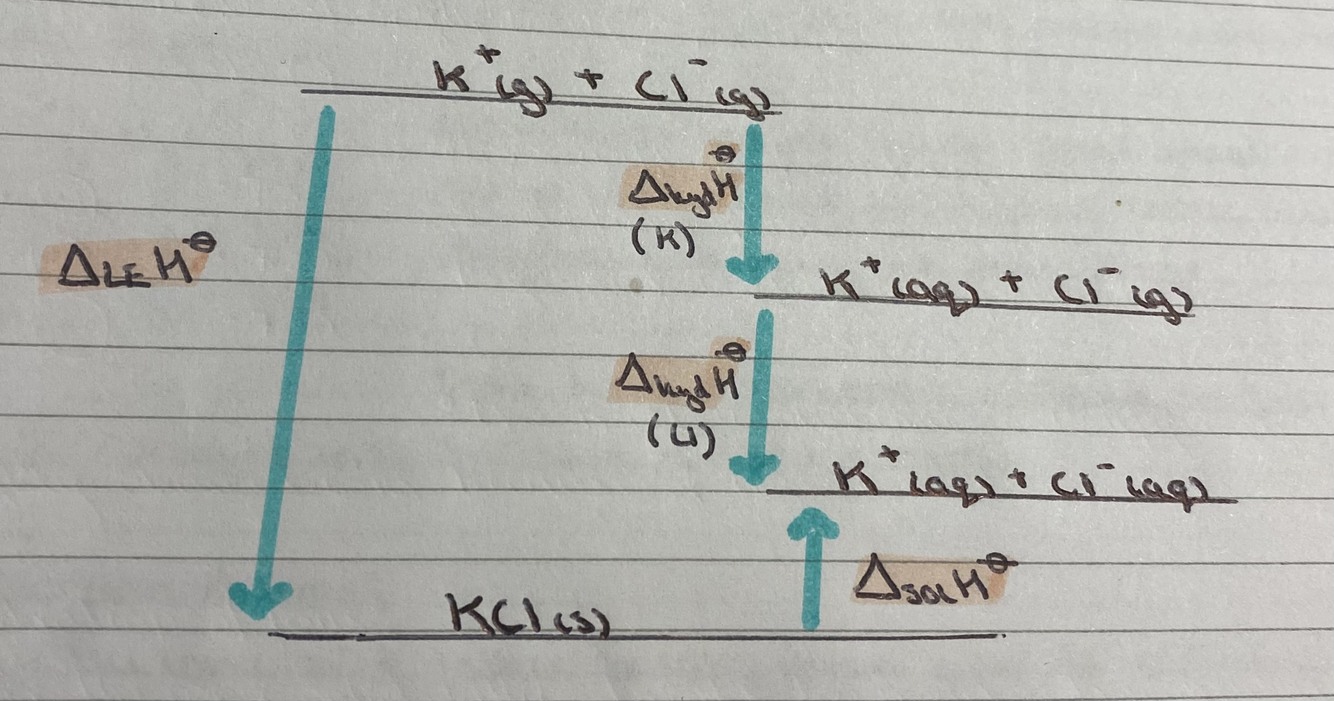
State the two factors effect the exothermic value of lattice enthalpy
• Size of ions in the ionic lattice • The charges of those ions
Explain how the size of ions in the ionic lattice effect the value of lattice enthalpy
• Smaller ions get closer together so will have greater attraction so give more exothermic (negative) lattice enthalpy value
Explain how the charge of ions in the ionic lattice effect the value of lattice enthalpy
• Ions with higher charge cause greater electrostatic attraction so give more exothermic (negative) lattice enthalpy value
State the two factors effect the exothermic value of the standard enthalpy change of hydration
• Size of ions in the ionic lattice • The charges of those ions
Explain how the size of ions effect the value of the standard enthalpy change of hydration
• Smaller ions can get closer to water molecules so greater attraction to water molecules so give more exothermic (negative) enthalpy change of hydration
Explain how the charge on ions effect the value of the standard enthalpy change of hydration
• Higher charge on ion means greater attraction to water molecules so more exothermic (negative) enthalpy change of hydration
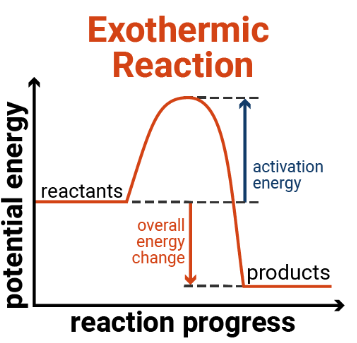
Explain why exothermic reactions are spontaneous.
• Exothermic reactions result in products that are more energetically stable than reactants which allows it to proceed without external influence
Define entropy, S
• the measure disorder in a system
Explain the difference in entropy, S of solids, liquids and gases
• solids < liquids < gases • Gases have the highest entropy because their particles have most kinetic energy so have highest disorder • Solids have the lowest entropy because their particles have lowest kinetic energyso have the lowest disorder