Further consideration for Quadrupolar nuclei and fluxionality
暂无描述。系统推荐的高质量记忆内容,适合每天坚持背诵学习。
卡片预览 (11 张)
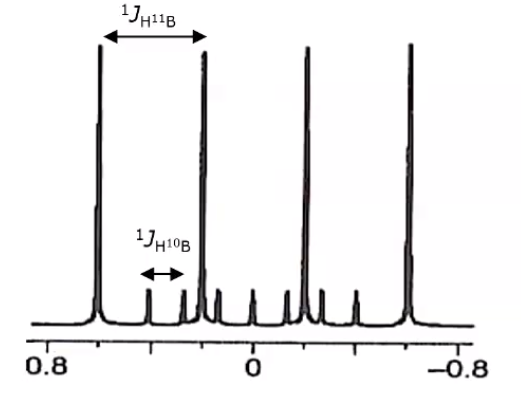
What would the ¹H NMR look like for isotopically unenriched KBH₄ ¹¹B (I = 3/2; 80.4%) ¹⁰B (I = 3; 19.6%)
The ¹H NMR spectrum will therefore contain sets of resonances from both isotopes ¹⁰B: (2x1x3) + 1 = 7 = septet ¹¹B: (2x1x3) + 1 = 4 = quartet 1:4:6:4:1 ratio
What is a quadropole moment (eQ) ?
Measure of distortion from spherical charge distribution I > 1/2
All I = 1/2 nuclei have eQ =
0 all I > 1/2 nuclei have eQ ≠ 0 (quadropolar nuclei)
What creates a defined line width in a NMR spectra
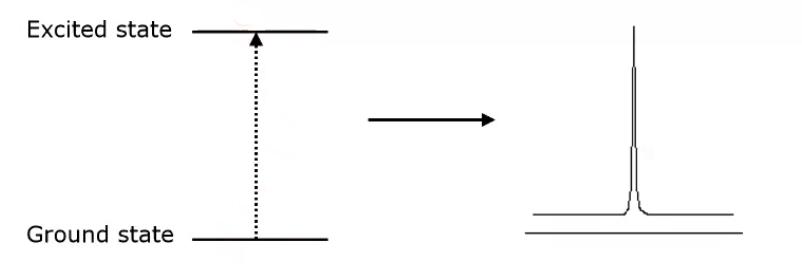
• Any nucleus with I > 0, absorption of radiation occurs, raising the nucleus to a higher energy level • If the energies of the inital and final states are well defined the resulting line in the spectrum will be very sharp
How does Heinsenburg uncertainity principle relate to NMR spectra lines?
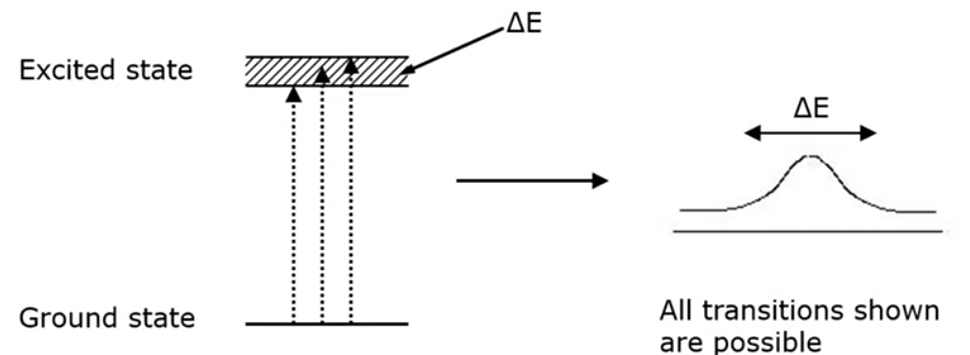
• Heisenburg consideres ΔE = uncertainity in energy state and Δt = uncertainity in time specified • If the nucleus occupies a state for a long time, then Δt is very large so ΔE is very small, and energy can be defined very precisely • Ground state is always long lived - so well defined (the case for I = 1/2) • But for I - >1/2 the excitied state is only occupied for a short time, therefore a much larger uncertainity with ΔE = uncertainity in energy state, which gives a much broader line (high res may not be possible)
How can we get high resolution spectra for quadropolar nuclei?
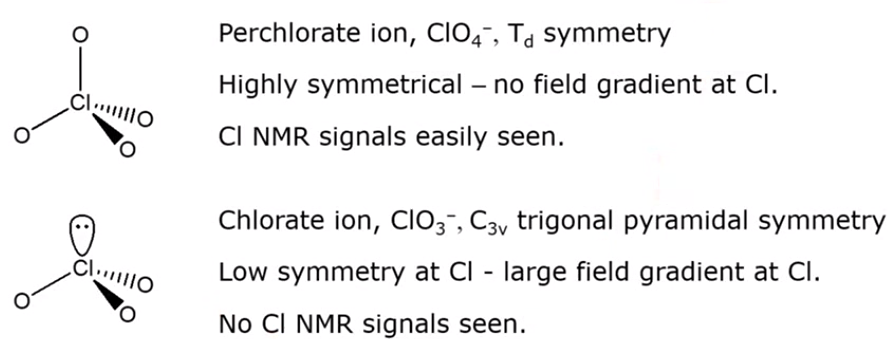
For many quadrupolar nuclei, we only get high-resolution spectra (narrow lines) when they are in a very symmetrical situation (low or no field gradient at the nucleus because of lost dipole moment)
Why is there no spin-spin splitting by quadrupolar nuclei for a spectra of a I = 1/2 nuclei
• looking at spectra of I = 1/2 nuclei - if any quadrupolar nuclei are present in the molecule, these nuclei will not give any spin-spin splitting if they are in an unsymmetrical environment, and they can be ignored • This is due to the nuclei rapidly transitioning between their spin states • e.g. the Cl in ClO₃⁻
What do you expect the NMR to look like for the following molecule?
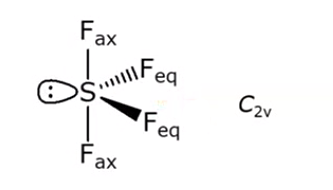
• SF₄ is an AB₄L shape (see-saw) predicted by VSEPR • Results in 2 axial Fs, and 2 equatorial F • Hence we would expect two ¹⁹F resonances of equal intensity, split into a 1:2:1 triplet
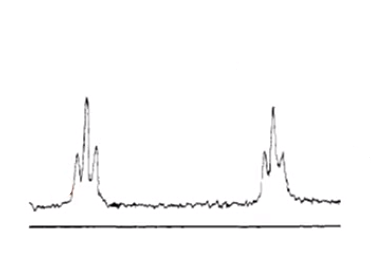
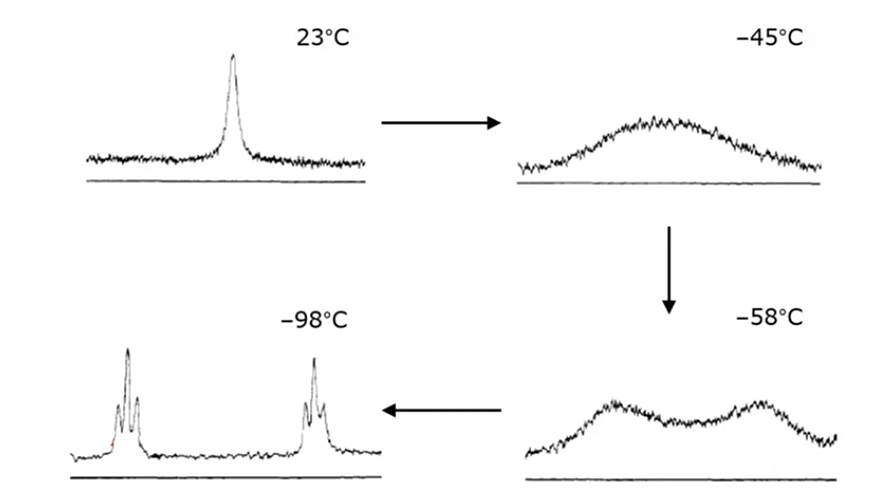
What does the NMR to look like for the following molecule look like in reality
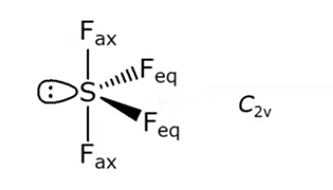
• A singlet due to fluxionality between the axial and equatorial positions (NMR is slow) • However upon cooling the sample within the NMR, preventing the fluxionality, the expected outcome is seen instead
What is the difference between the ³¹P NMRs for the following molecule where there is static vs rapid exchange?
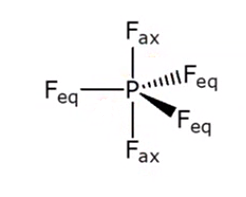
rapid exchange: (2x5x0.5)+1 = 6 = sextet static exchange: (2x2x0.5)+1 = 3 = triplet AND (2x3x0.5)+1 = 4 = quartet SO a quartet or triplets is produced
What is the difference between the ¹⁹F NMR for the following molecule where there is static vs rapid exchange
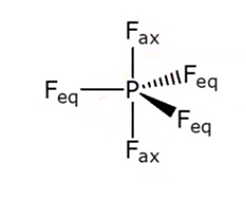
rapid exchange: (2x1x0.5)+1 = 2 = doublet static exchange: 1J FeqP: (2x1x0.5)+1 = 2 AND 2J FeqFax: (2x2x0.5)+1 = 3, SO doublet of triplets 1J FaxP: (2x1x0.5)+1 = 2 AND 2J FaxFeq: (2x3x0.5)+1 = 4, SO doublet of quartets