Clinical composites
No description yet. This curated deck is ready for daily study.
Card preview (24)
when would you apply direct filling materials? 4
• primary dental caries • failed restorations / secondary caries • abrasion / erosion • trauma
what are the ideal properties of direct filling materials? 10
• mechanical - strength, rigidity, hardness • bonding to tooth • thermal properties • aesthetics • handling/viscosity • smooth surface finish / polishable • low setting shrinkage • radiopaque • anticariogenic • biocompatible
what makes up composite resin? 5
• filler particles - glass • resin • camphorquinone • low weight dimethylacrylates • silane coupling agent
what are the filler particles that make up composite resin?
• microfine silica • quartz • borosilicate glass • lithium aluminium silicate • borium aluminium silicate etc.
what monomers are in the resin? what are the key characteristics? 2,2
BIS-GMA and urethane dimethacrylates * difunctional molecule * undergoes free radical addition polymerisation
what is camphorquinone? 3
• activated by blue light • produces radical molecules which initiate free radical addition polymerisation of BIS-GMA • leads to changes in resin properties -stronger, more viscous
why are low weight dimethylacrylates added to composite resin?
adjusts the viscosity and reactivity, easier to manipulate
what is silane coupling agent added to composite resin?
bonds filler particles and resin
when would you use composite rather than other materials? 7
• where aesthetics are important • class 3, 4, 5 permanent restorations • class 2 - limited occlusal wear • labial veneers • inlays, onlays - indirect technique • cores • modified forms as luting cements
what are good handling characteristics of composite resin? 3
• condensable - greater porosity • syringeable - good adaption, lesser porosity, easy to apply • flowable - lower filler content, more shrinkage, difficult to apply
describe the size of hybrid filler particles
hybrid composites have filler particles of different sizes
what is the effect of adding filler particles to composite resin? 6
• improved mechanical properties - strength, rigidity, hardness, abrasion resistance • lower thermal expansion • lower polymerisation shrinkage • less heat of polymerisation • improved aesthetics • some are radiopaque
how do different types of curing development for composite resins? 5
• self curing - two pastes • UV activation - one paste • light curing - blue light, one paste • direct curing - in mouth • indirect curing / post curing - in lab
how do self curing composites set?
benzoyl peroxide + aromatic tertiary amine = polymerisation
how do light curing composites set?
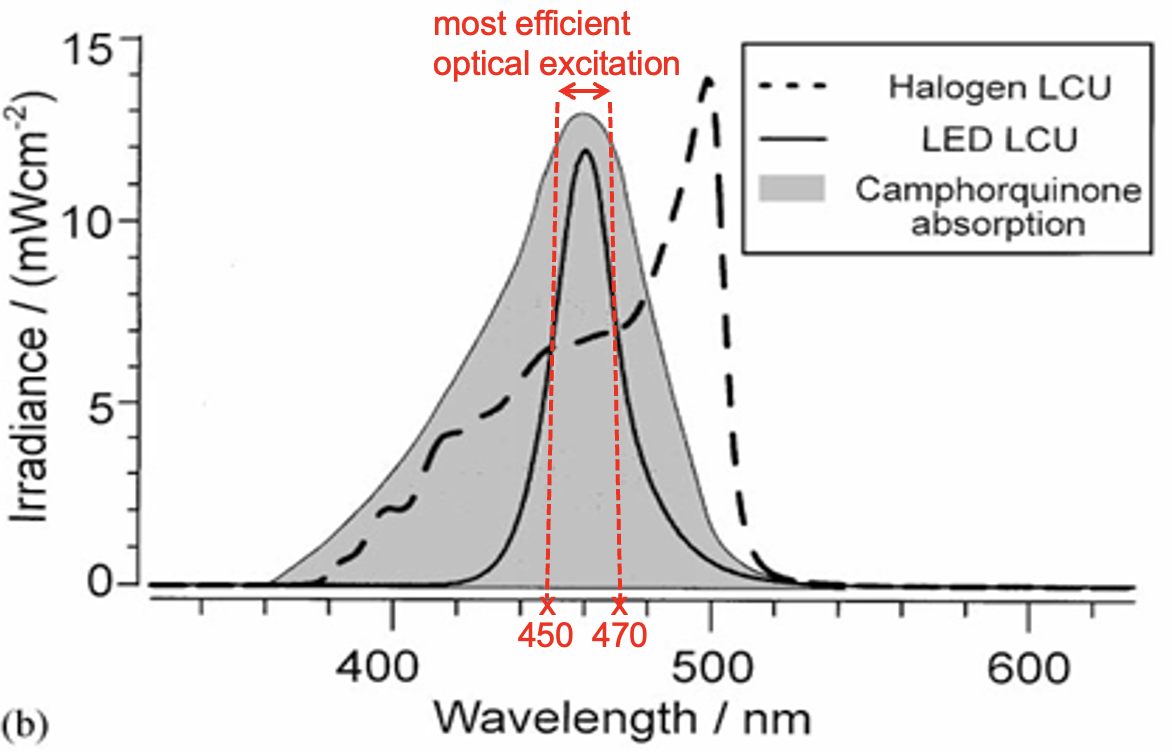
camphorquinone + blue light (430-490nm)
what are the two light sources for curing composite resin? which is better and why?
halogen and LED * difference in optical spectral range * LED is better as it absorbs the same wavelengths as camphorquinone, especially at optical excitation
what are the advantages of light curing systems? 6
• extended working time - command set • less finishing • immediate finishing • less waste • higher filler levels (not mixing 2 pastes) • less porosity (not mixing 2 pastes)
where on composite is light absoprbed most?
close to the surface * composite resin nearest the surface sets teh most readily and becomes hard
describe the depth of cure ISO 4049
• column of composite is light cured • soft composite is removed from bottom of column • hard composite is reached and no longer can be scraped • distance of hard composite is measured • distance is divided by 2 • remaining distance is considered the depth of cure
what does the depth of cure show?
the depth to which the composite resin polymerises sufficiently * indicated increment thickness to use when restoring
how deep can hybrid composites be cured? what happens when more composite is used?
2mm * using >2mm increments results in under-polymerised base and poor bonding to tooth = early failure
what is depth of cure defined as?
depth at which material hardness is about 80% of the cured surface
describe this depth of cure profile
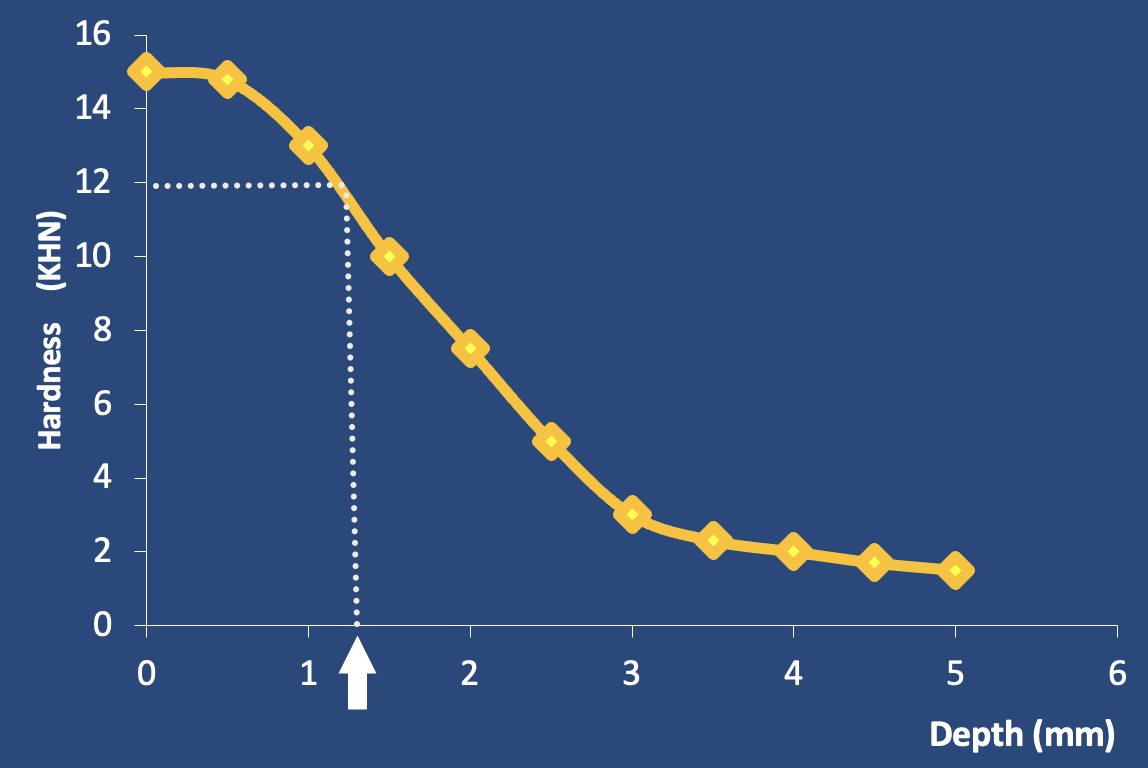
• around 80% of material hardness of cured surface is around 12 • if you read a hardness of 12 on the graph, the depth equivalent is around 1.5mm • so the depth of cure is <1.5mm
what are the potential problems of light curing 5
• light / material mis-match • premature polymerisation from dental lights • optimistic depth of cure values (too high) • recommended setting times too short • polymerisation shrinkage