Electron Transfer
No description yet. This curated deck is ready for daily study.
Card preview (24)
As the reduction potential for a molecule become more negative, it becomes a stronger __________. Reducing agent or Oxidizing Agent
Reducing agent (The oxidized form is thermodynamically more stable)
Two of the same element in different oxidation states combine to the same oxidation.
Comproportionates Pb(s) + PbIVO2 + 2H2SO4 —–> PbIISO4 + 2H2O
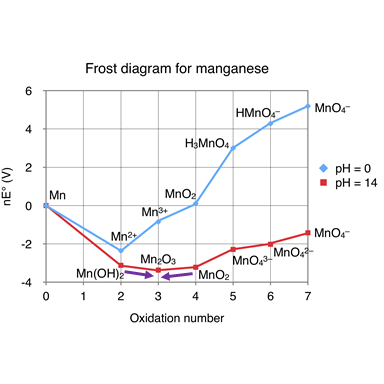
What oxidation state of Manganese is more stable under strongly basic conditions?
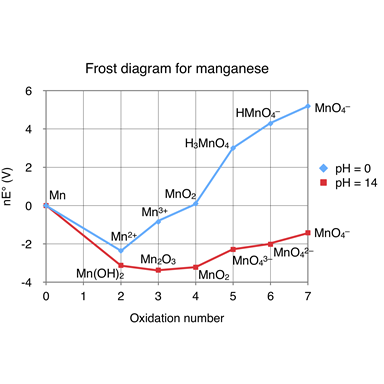
Oxidation state +3 Mn2O3
If Ecell < 0, than the electron transfer reaction is __________. Endergonic or Exergonic
Endergonic (non-spontaneous) (Remember: ΔGo = -nFEocell)
If Ecell > 0, than the electron transfer reaction is __________. Endergonic or Exergonic
Exergonic (spontaneous) (Remember: ΔGo = -nFEocell)
Electron transfer that occurs with no direct bond between redox partners.
Outer Sphere Electron Transfer
Electron transfer that occurs with the formation of bonds between redox partners and the bridging group often (though not always) transfers
Inner Sphere Electron Transfer
Mixed valence compounds where the valence is completely delocalized.
Class III - Valence Delocalized
Mixed valence compounds where there is some localization of distinct valences, but there is a low activation energy for their interconversion.
Class II - Intermediate
Compounds where the valences are trapped—localized on a single site.
Class 1-Valence Localized
What type of equilibrium exist between species across diagonal boundary lines in a Pourbaix diagram?
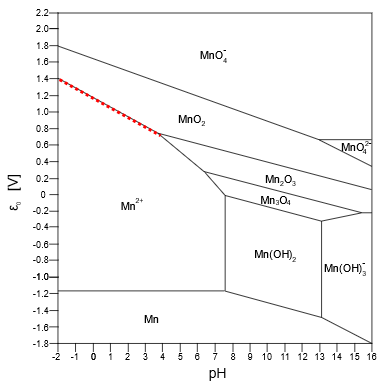
Proton Dependent Redox Reactions
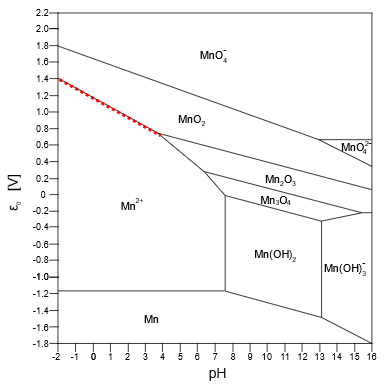
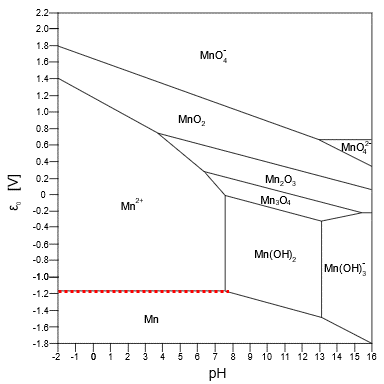
What type of equilibrium exist between species across horizontal boundary lines in a Pourbaix diagram?
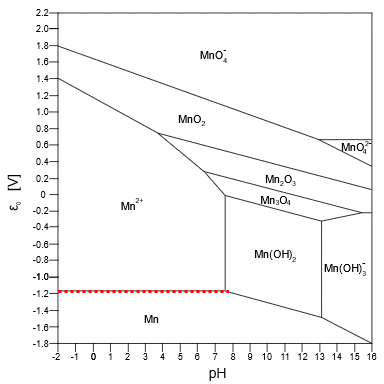
Proton Independent Redox Reactions
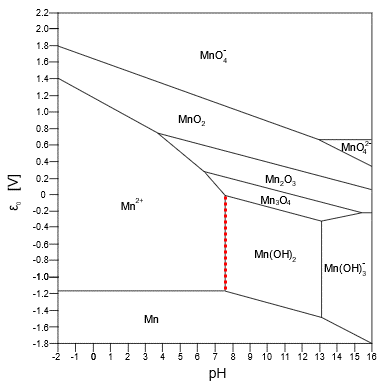
What type of equilibrium exist between species across vertical boundary lines in a Pourbaix diagram?
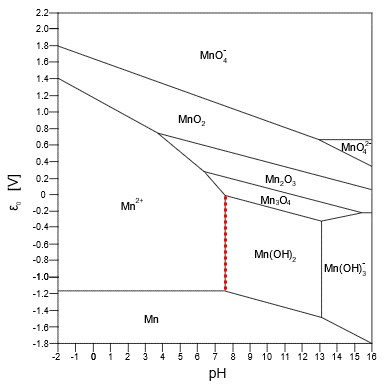
Acid-Base Equilibriums
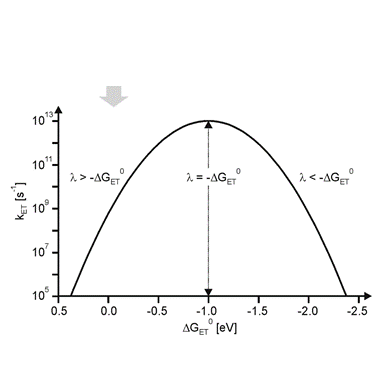
According to Marcus Theory, an increase in driving force leads to an increase in electron transfer rate in this region?
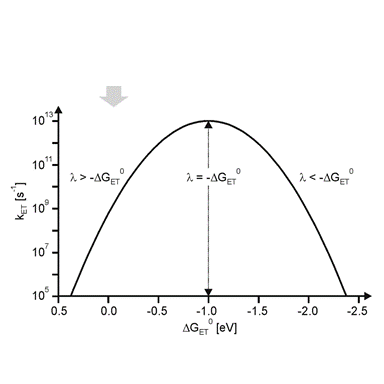
The Normal Region (Classical Region)
The biomolecular rate constants for outer-sphere self exhange mechanism tend to be ________ if they involve electron transfer to and from low lying antibonding orbitals. Fast or Slow
Slow Large changes in bond lengths are expected and therefore inter-sphere reorganization energy will be large
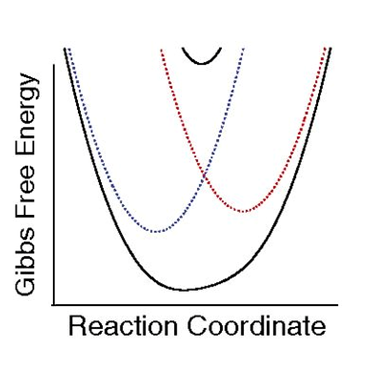
The parabolic potentials curve represent the_________.
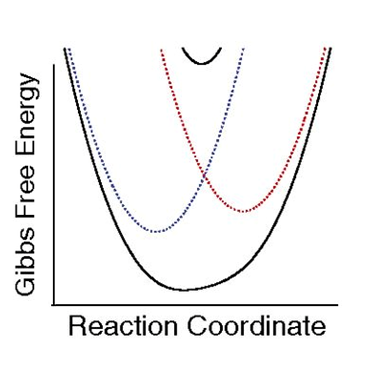
Potential energy for vibrational states as a funtions of nuclear coordinates.
The parameter β in Dutton’s Ruler represents the _______ in which the electron propagates.
Medium
The proton and electron always propagate in the same directions in proton coupled electron transfer reactions. True or False
False
A chemical reaction that involves the transfer of both an electron and a proton at roughly the same time.
Proton Coupled Electron Transfer (PCET) Note: This process lowers the free energy of successive electron transfers by creating a nearly charge neutral process.
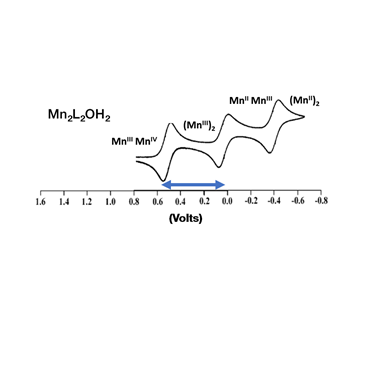
What is the voltage shift between each successive reduction with proton coupled electron transfer?
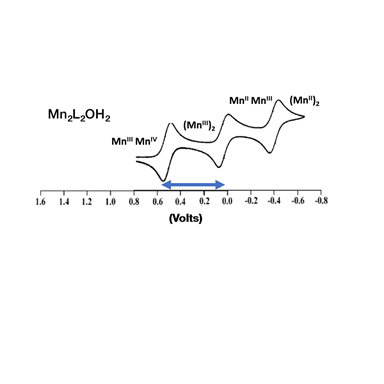
~400-600 mV shift per charge unit
According to Marcus Theory, an increase in driving force leads to a decrease in electron transfer rates in this region?
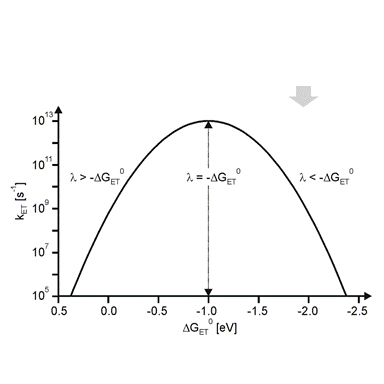
The Inverted Region (Note: Driving force is equal to the reorganization energy (λ) in this region)
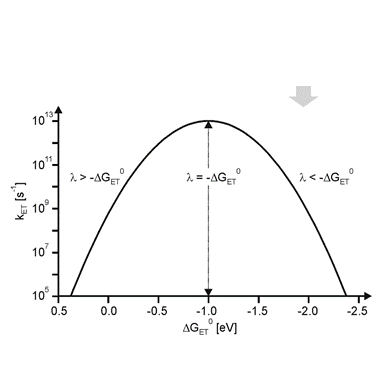
According to Marcus Theory, this region is where driving force is equal to the reorganization energy in this region?
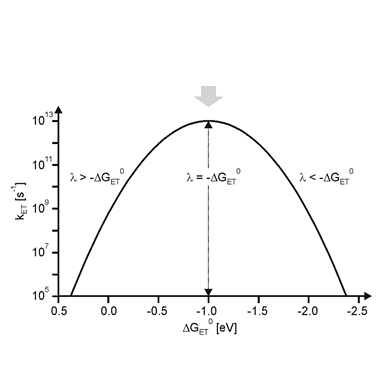
The Activtionless Region
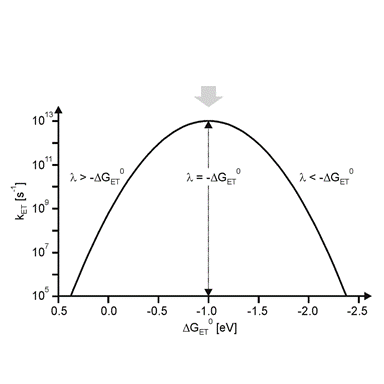
The reorganization energy that can be assoicated with the rearrangement of the solvent surrounding the electron transfer centers.
Outer-Sphere Reorganization Energy
The reorganization energy that can be assoicated with the instrictic geometry change that occurs on a redox center.
Inner Sphere Reorganization Energy