ChemPath: Acid-Base Handling
No description yet. This curated deck is ready for daily study.
Card preview (21)
What is the normal range for H+ concentration? What is normal pH
35-45 nmol/L in ECF pH 7.35-7.45
What equation links H+ concentration to pH?
pH = log1/[H+]
What are the three main physiological buffers?
• Bicarbonate (ECF, renal tubular fluid) • Haemoglobin (RBC) • Phosphate (renal tubular fluid/intracellular) NOTE: also protein and bone
What is the rate of production of H+ ions per day?
50 - 100 mmol/day
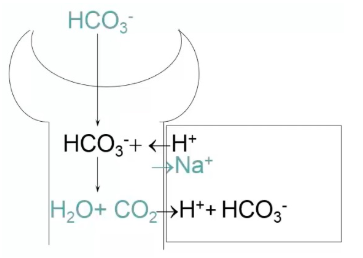
Describe how the kidneys excrete H+ ions. Where does this occur?
Via bicarbonate through the production of carbonic acid Occurs in proximal tubules
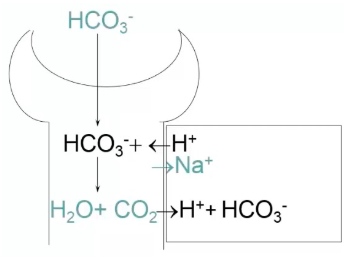
Describe how H+ ions pass through the renal epithelial membrane.
H+ ions cannot pass through the membrane itself so a transport system is necessary (Na+/H+ transporter)
What is the rate of production of carbon dioxide per day?
20,000-25,000 mmol/day
Describe the relationship between CO2 and repiratory rate
• Respiration is controlled by chemoreceptors in the hypothalamic respiratory centre • An increase in CO2 will stimulate an increase in ventilation which then brings down CO2 concentration
What information is provided by ABGs?
• pO2 • pCO2 • pH
What are 3 mechanism of metabolic acidosis?
Caused by: • Increased H+ production (e.g. DKA) • Decreased H+ excretion (e.g. renal tubular acidosis) • Bicarbonate loss (e.g. diarrhoea)
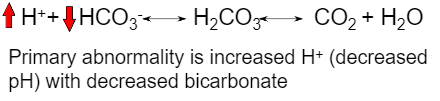
Describe the ABG results in a metabolic acidosis
• Low pH / increased H+ • Low pCO2 • Low HCO3-
What are 3 mechanisms of respiratory acidosis?
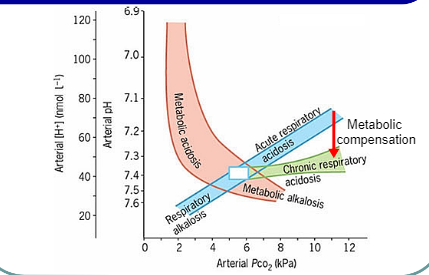
Caused by: • Decreased ventilation • Poor lung perfusion • Impaired gas exchange E.g. chronic lung disease (COPD), opioids, sedatives, neuromuscular weakness NOTE: metabolic compensation is slower than respiratory compensation
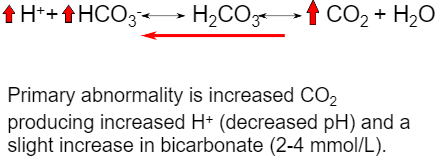
Describe the ABG results in a respiratory acidosis
• Low pH / increased H+ • High pCO2 • High HCO3-
What happens in chronic respiratory acidosis?
Metabolic compensation will drive H+ down to near normal range, however pCO2 and bicarbonate will remain elevated
What are 3 mechanisms of metabolic alkalosis?
Caused by: • H+ loss (e.g. pyloric stenosis) • Hypokalaemia • Ingestion of bicarbonate
Describe the ABG results in a metabolic alkalosis
• High pH / low H+ • High pCO2 • High HCO3-
What is the main mechanism behind respiratory alkalosis, and what are 3 causes?
Main mechanism is hyperventilation, which can be due to: • Voluntary • Artificial ventilation • Stimulation of the respiratory centre
Describe the ABG results in a respiratory alkalosis
• High pH / low H+ • Low pCO2 • Low HCO3-
What derangement of acid-base balance would be caused by pyloric stenosis?
Metabolic alkalosis due to loss of H+ from profuse vomiting
Which condition classically causes a mixed respiratory alkalosis and metabolic acidosis?
• Aspirin overdose • Aspirin causes high anion gap metabolic acidosis whilst simulataneously causing respiratory alkalosis by stimualting the respiratory centre
What is the cause of an elevated anion gap in metabolic acidosis?
• Ketoacidosis • Lactic acidosis • Uraemia • Toxins (ethylene glycol, methanol, salicylates)