Half-Life
No description yet. This curated deck is ready for daily study.
Card preview (10)
What type of process is radioactivity?
An entirely random process
What is activity?
The rate at which a radioactive source decays
What is activity measured in?
Activity is measured in becquerels, Bq (1 Bq is 1 decay per second)
Describe how a Geiger–Müller tube can be used to measure and detect radioactivity.
• A Geiger–Müller tube clicks each time it detects radiation • The tube can be attached to a counter, which displays the count-rate (the number of clicks per second)
Describe how photographic film can be used to detect radioactivity.
The more radiation the film is exposed to, the darker it becomes
It cannot be predicted when a particular nucleus will decay. If there are lots of nuclei though, how can you predict how many will have decayed in a given time?
This can be predicted based on the half-life of the source
State what is meant by half-life.
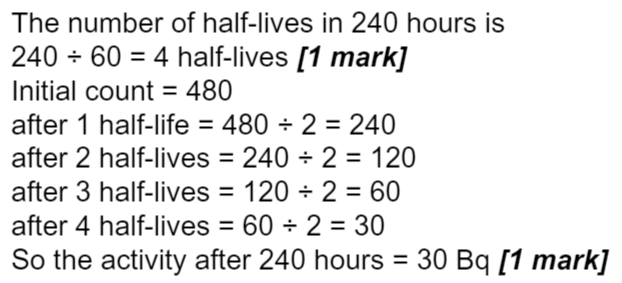
The average time taken for the number of radioactive nuclei in an isotope to halve (average time taken for the activity of a source to decay by half)
What does a short half-life indicate?
• This means the activity of a source falls quickly • This is because the nuclei are very unstable and rapidly decay
What does a long half-life indicate?
• This means the activity of a source falls slowly • This is because most of the nuclei don’t decay for a long time • (The source sits there, releasing small amounts of radiation for a long time)
(Exam-style question)