AQA A Level Chemistry - Bonding
No description yet. This curated deck is ready for daily study.
Card preview (21)
• What is metallic bonding?
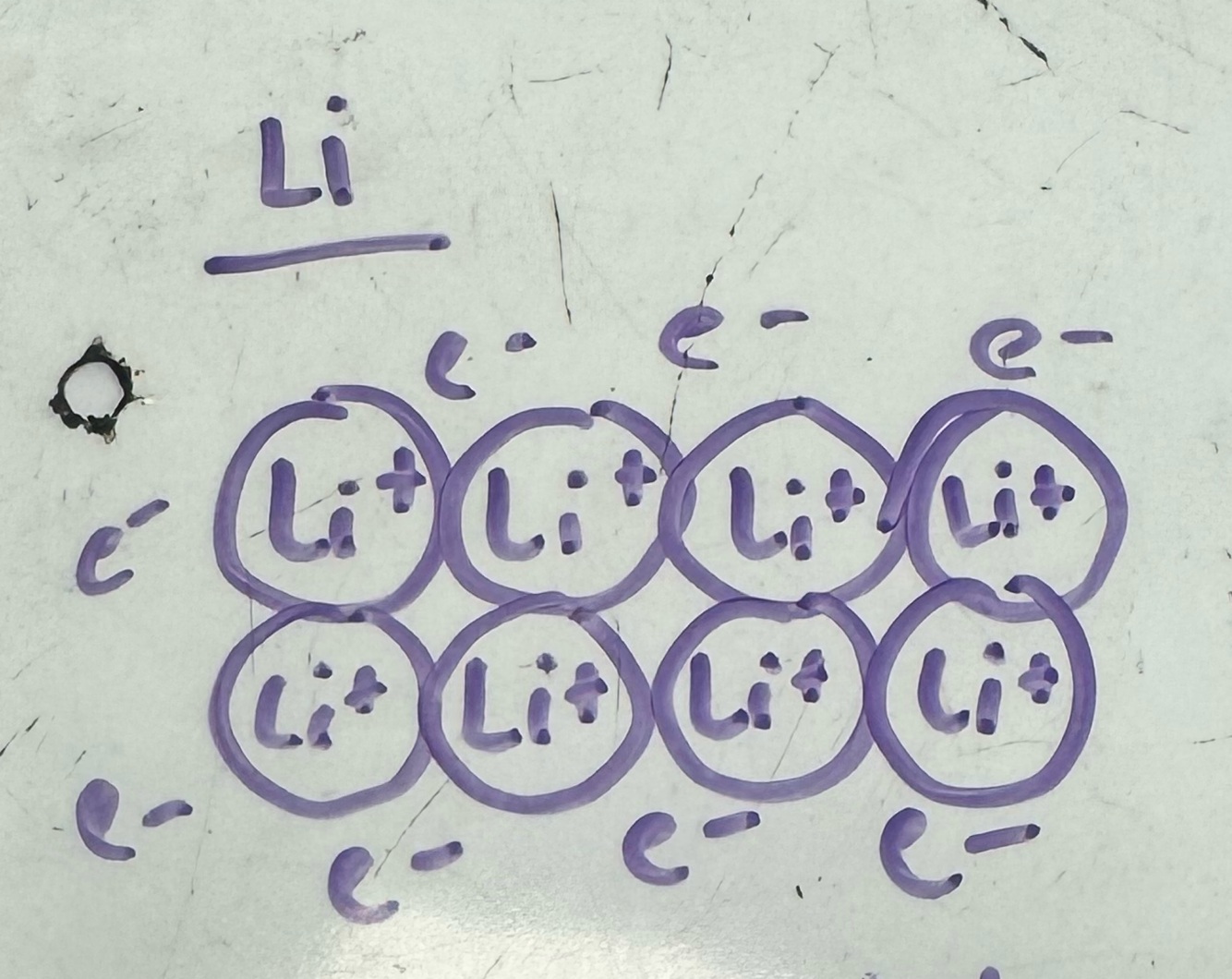
• Metallic bonding is the strong electrostatic attraction of positive metal cations surrounded by a sea of delocalised electrons
• Metallic bonding explanation:
• Lithium forms 1+ ions • When lithium bonds with other lithium atoms, electrons are delocalised (given up) into a cloud of electrons • There is a strong electrostatic attraction between the positive Li+ cations and the delocalised electrons • The more delocalised electrons there are and the higher the charge density, the stronger the electrostatic attraction • Al and My have higher melting points than Na because they have more delocalised electrons and a higher charge density - so the electrostatic attraction between their positive metal cations and delocalised electrons is stronger • The smaller the ion, the stronger the bond
• Why does Mg have a higher melting point than Na? (Model answer)
• Mg has stronger metallic bonding than Na and hence a higher melting point • The metallic bonding gets stronger because in Mg there are more electrons in the outer shell that are released to the sea of electrons • The Mg ion is also smaller and has one more proton • There is therefore a stronger electrostatic attraction between the positive metal ions and the delocalised electrons and higher energy is needed to break bonds • Magnesium ion (Mg2+) has a higher charger than sodium ion (Na+) • This attracts the delocalised sea of electrons more strongly
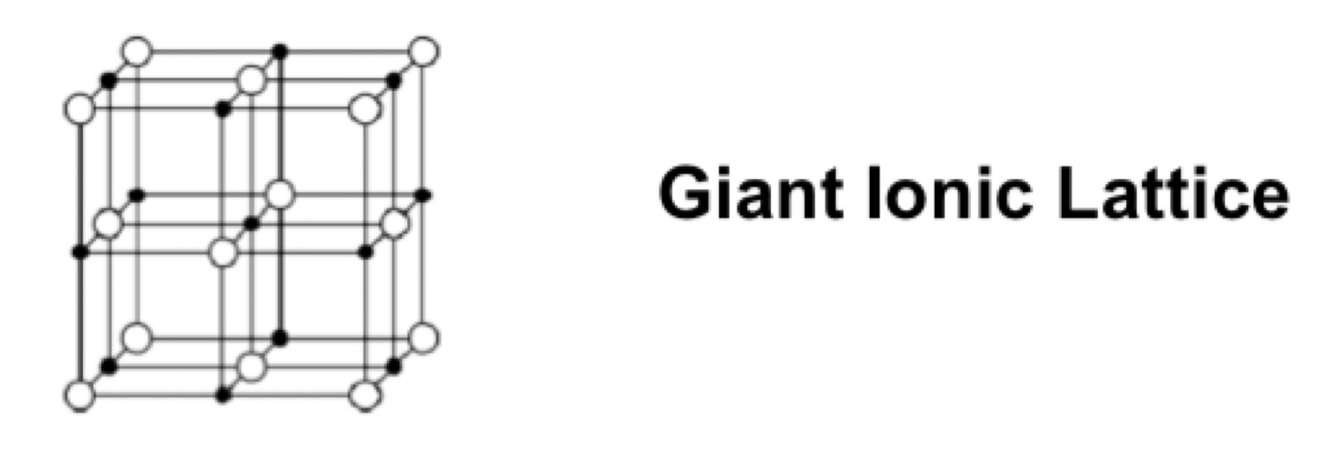
• What is the structure for ionic bonding?
Examples: - Sodium chloride - Magnesium oxide
• Which molecules are non-polar?
• Diatomic molecules eg Cl2, F2 • Molecules that only contain C and H • Molecules where all the outer atoms are the same eg PCl5 • Noble gases
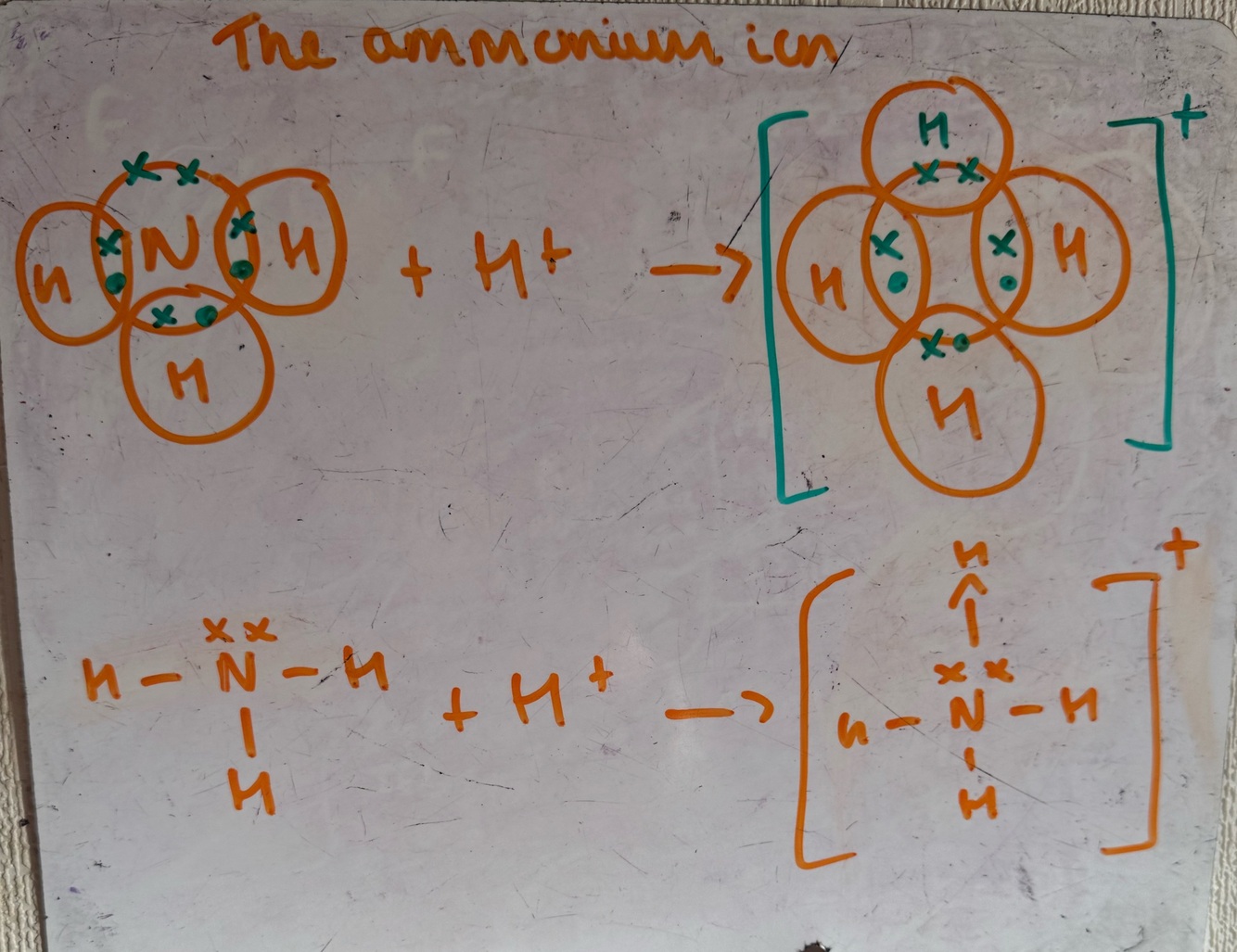
• How to draw dative covalent bond in the ammonium ion (NH4+)
• What is a covalent bond?
• A covalent bond is a shared pair of electrons
• What is ionic bonding?
• Ionic bonding is the strong electrostatic attraction between oppositely charged ions
• What are the physical and structural properties of ionic compounds?
• Physical properties: • High melting point and boiling point • Soluble/dissolves well • Electrical conductivity when molten or in solution • Structural properties: • Brittle - they shatter easily
• At room temperature, K2S is a solid but SF2 is a gas. Use ideas about structure and bonding to explain this difference (3 marks)
• K2S has a giant ionic lattice structure so is solid at room temperature because a large amount of energy is needed to break the strong electrostatic attraction between oppositely charged ions • SF2 has a simple covalent/molecular structure so is a gas at room temperature because a small amount of energy is needed to break the weak intermolecular forces between SF2 molecules
• What are ionic bonds between and what are covalent bonds between?
• Covalent: non metal + non metal • Ionic: metal + non metal
• What is electronegativity?
• Electronegativity is the power of an atom to attract the pair of electrons in a covalent bond
• What factors determine how electronegative an element is?
• The nuclear charge (number of protons) • The atomic radius (ie distance from nucleus to outer e-) • Shielding (number of electrons between nucleus and outer e-)
• Why does the electronegativity increase across period 2?
• The nuclear charge increases • The atomic radius decreases • The shielding remains the same • Therefore, the ability to attract electrons in a covalent bond increases
• Polarity
• Molecules made of atoms with no difference in electronegativity have their electrons distributed evenly • When there is a difference in electronegativity within a molecule, electron distribution is asymmetrical • This produces a polar covalent bond • Therefore the atom with a greater electron density is given a delta- charge and the atom with a lower electron density is given a delta+ charge
• What is hydrogen bonding?
• Hydrogen bonding is the strongest intermolecular forces • Occurs between H (bonded to N, O or F) and lone pairs on N, O or F atom on another molecule
• How does hydrogen bonding arise?
• Very large different in electronegativity between the oxygen and hydrogen (state which atoms) • creates a dipole on the O-H bond (state the bond) • Lone pair on oxygen atom in one molecule strongly attracts a partially positive hydrogen atom on a different molecule
• What are permanent dipole dipole forces?
• Generally weaker than hydrogen bonding • Occurs between polar molecules
• How do permanent dipole dipole forces arise?
• Difference in electronegativity leads to bond polarity • Dipoles do not cancel therefore the molecule has an overall permanent dipole • There is an attraction between delta positive on one molecule and delta negative on another
What are induced dipole dipole forces?
• Generally the weakest force but can be stronger than both hydrogen bonding and pdd if the molecule is large • This is due to the number of electrons increasing within the molecule • Occurs between all molecules (and atoms of noble gases) but is the most important force for non polar molecules (molecule that do not have the other IMF’s)
How do induced dipole dipole forces arise?
• Random movement of electrons in one molecule (atom) • Leads to a uneven distribution of electrons, creating a temporary dipole in one molecule (atom) • This induces a dipole in a neighbouring molecule (atom) • Dipoles attract