Combined Physics - 6.1
No description yet. This curated deck is ready for daily study.
Card preview (24)
In physics, what is a ‘system’?
A system is an object or group of objects
What changes are involved in the way energy is stored in an object projected upwards?
Chemical Energy → Kinetic Energy → Gravitational Potential Energy
What changes are involved in the way energy is stored in a moving objecting hitting an obstacle?
Kinetic Energy → Sound Energy / Thermal Energy
What changes are involved in the way energy is stored in an object accelerated by a constant force such as gravity when dropping a ball?
Gravitational Potential Energy → Kinetic Energy
What changes are involved in the way energy is stored in a vehicle slowing down?
Kinetic Energy → Heat Energy
What changes are involved in the way energy is stored bringing water to a boil in an electric kettle?
Electrical Energy → Thermal Energy
What equation is used to calculate the kinetic energy of a moving object?
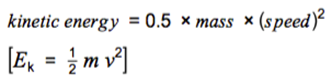
How can the gravitational potential energy gained by a raised object above the ground be calculated?

What is the specific heat capacity of a substance?
The amount of energy required to raise the temperature of 1kg of the substance by 1oC
What is power?
The rate at which energy is transferred / the rate at which work is done
What are the three equations associated with power?
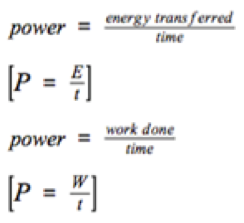
What energy transfer is equal to a power of 1 watt?
1 joule per second
Lifting an object takes 10’000J – machine A can do this in 50s but machine B takes 100s. Which machine is more powerful?
Both machines transfer the same amount of energy, but machine A is more powerful: P = W ÷ t Machine A has a power of 200W (10’000 ÷ 50) whilst machine B has a power of 100W (10’000 ÷ 100)
What is the conservation of energy principle?
Energy can be transferred usefully, stored or dissipated but never created or destroyed
What happens to the energy transfer in a closed system?
There is no net change to the total energy
When energy is transferred not all of it is transferred usefully (some energy is dissipated). What term is used to describe this dissipated energy?
Wasted energy
How does lubrication reduce unwanted energy transfers?
Lubrication reduces frictional forces
How does insulation reduce unwanted energy transfers?
Insulation reduces the rate of energy transfer by heating
List some examples of insulation
• Cavity wall insulation (reduces convection) • Loft insulation (reduces convection) • Double-glazed windows (reduces conduction) • Draught excluders (reduces convection)
What is conduction?
Conduction is the process where vibrating particles transfer energy to neighbouring particles (occurring mainly in solids)
What is convection?
Convection is the process where energetic particles move away from hotter regions to cooler ones (occurring in fluids)
In terms of conduction across the material what does an increased thermal conductivity of a material cause?
Increased thermal conductivity of a material means a higher rate of energy transfer
How do walls and the thermal conductivity of the material affect the rate of cooling in a building?
Thick walls made from a material with low thermal conductivity slows the rate of energy transfer (so the building remains warmer for longer)
What is the equation for energy efficiency for a given energy transfer, with regard to energy input/output?
