3.2.3 Group 7, The Halogens
No description yet. This curated deck is ready for daily study.
Card preview (24)
What colour is fluorine?
Pale yellow
What colour is chlorine?
green
What colour is bromine?
red-brown
What colour is iodine?
grey
What physical state is fluorine at room temperature?
gas
What physical state is chlorine at room temperature?
gas
What physical state is bromine at room temperature?
liquid
What physical state is iodine at room temperature?
solid
Boiling points _____ down the group
increase
Why do boiling points increase down the group? (3)
• ∵ Van der Waals forces between molecules • Increase with size or Mr or surface area • More energy needed to overcome these forces Trend is shown in changes of physical state from fluorine (gas) to iodine (solid))
Electronegativity _______ down the group
decreases
Why does electronegativity decrease down the group? (2)
• Shielding increases or the atomic size increases • Weaker attraction by nucleus for bonding pair of electrons in the covalent bond
Halogens become _____ oxidising down the group
less
Why do halogens become less oxidising down the group?
• Get less reactive down the group ∵ atoms become larger • Outer shell further away from nucleus ∴ electrons less attracted to it
How can you see the relative oxidising strengths of halogens?
By displacement reactions with halide ions
What is the basic rule for halogens in a displacement reaction with halide ions
A halogen will displace a halide from solution if the halide is below it in the periodic table
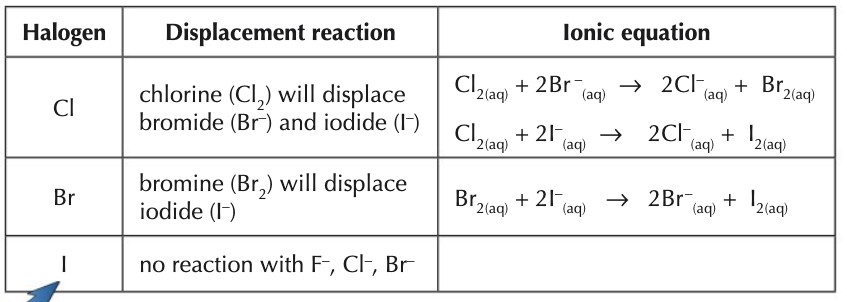
What can we use these displacement reactions (halogens and halides) for?
To help identify which halogen (or halide) is present in solution
Why can’t you investigate fluorine in aqueous solution?
∵ it reacts with water
Name 2 uses of chlorine
• Used to kill bacteria in water • Mix it with sodium hydroxide to make bleach
Describe how you get bleach
If you mix chlorine gas with cold, dilute, aqueous sodium hydroxide, you get sodium chlorate(I) solution (NaClO(aq)) = bleach
Write an equation to show how bleach is made

Write the oxidation states of chlorine in this equation

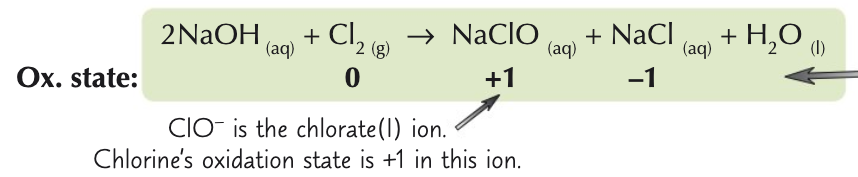
What do the oxidation states of chlorine in this equation tell us?
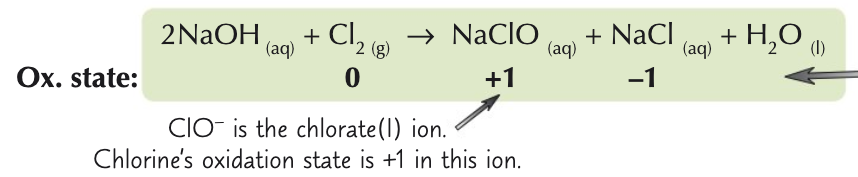
Oxidation state of Cl goes up and down, meaning chlorine is both oxidised and reduced. This is called disproportionation.
Name 3 uses of sodium chlorate(I) solution (bleach)
• Water treatment (kills bacteria) • Bleach paper and textiles • Cleaning toilets