Equilibrium
No description yet. This curated deck is ready for daily study.
Card preview (24)
equilibrium
reached when the concentrations of reactants and products become constant
dynamic equilibrium
forward and backward reactions are still occurring
forward reaction
reaction from left to right (reactants to products)
backward reaction
reaction from right to left (products to reactants)
equilibrium in terms of forwards and backwards reactions
rate of forward reaction equal to rate of backward reaction
equilibrium is dynamic
reaction has not stopped but both forward and backward reactions are occurring at the same rate
equilibrium is achieved in a closed system
both reactants and products and react with each other no exchange of matter with surroundings
concentrations of reactants and products remain constant at equilibrium
they are being produced and destroyed at an equal rate
at equilibrium there is no change in macroscopic properties
color/density do not change because dependent on concentrations of mixture
equilibrium can be reached from either direction
same equilibrium mixture will result under same conditions can have all reacts, all products or mixture of both
equilibrium position
proportion of reactant and product in equilibrium mixture
equilibrium position lies to the right
mixture contains predominantly products
equilibrium position lies to the left
mixture contains predominantly reactants
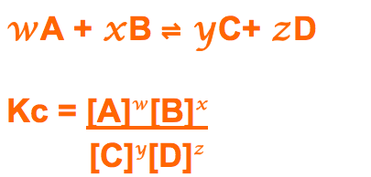
equilibrium constant equation (Kc)
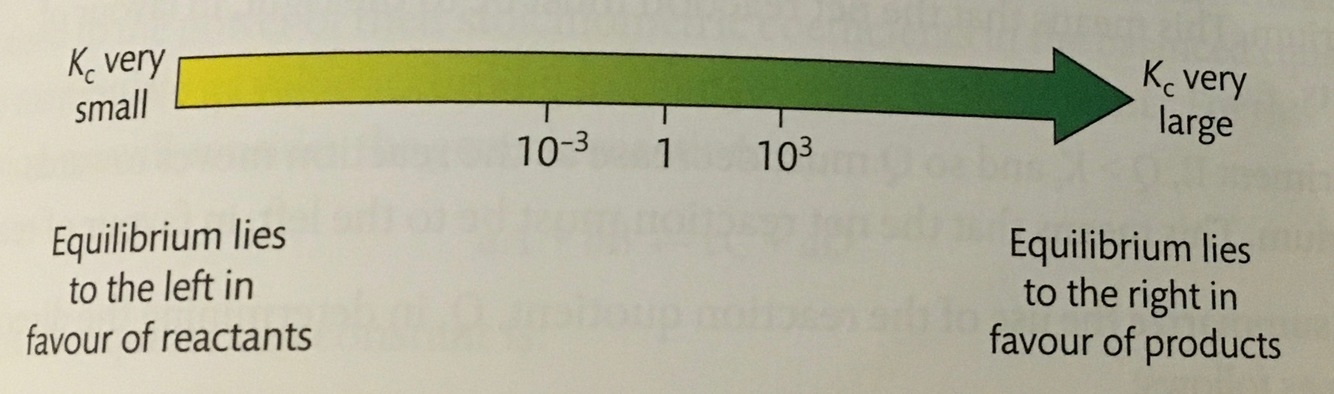
What does the magnitude of Kc tell you?
Kc > 1 reaction has very high conversion of reactants to products Kc < 1 reaction hardly proceeds
reaction quotient
• find Kc at equilibrium • measures the relative amount of products and reactants present during a reaction at a particular point in time
What does the magnitude of the quotient compared to the equilibrium constant tell us?
Q = Kc reaction is at equilibrium Q < Kc reaction proceeds to the right (favors products) Q > Kc reaction proceeds to the left (favors reactants)
What is Kc for an inverse reaction
1/Kc
Kc for a multiple of a reaction
Kcx
Kc when add two reactions
Kc1 + Kc2
Le Chatelier’s principle
when a system at equilibrium is subjected to a change, it will respond in such a way as to minimize the effect of the change
Effect of changing concentration on equilibrium (increase conc of reactants)
• forward reaction rate increases • new concentrations of reactants/products • equilibrium shifts in favor of products
effect of changing pressure on equilibrium position (increase pressure of reaction)
• seeks to decrease pressure • shift in equilibrium position to favour side with smaller number of molecules • Kc will remain the same
effect of changes in temperature on equilibrium position (decrease temperature)
• produces heat • favours exothermic reaction • Kc will change depending on shift • to right will increase Kc