Organic 9: Carboxylic Acids and Derivatives
No description yet. This curated deck is ready for daily study.
Card preview (24)
How do you name carboxylic acid compounds?
Suffix is -oic acid Carboxylic acid is always the root of the name E.g. benzene carboxylic acid
Describe the solubility of carboxylic acids.
Short chains are completely soluble in water Because they are able to form hydrogen bonds to water molecules Long chains are insoluble because the non-polar region predominates
Describe the melting points of carboxylic acids.
Much higher than alkanes of similar molecular mass Because of much stronger intermolecular forces (hydrogen bonds between molecules)
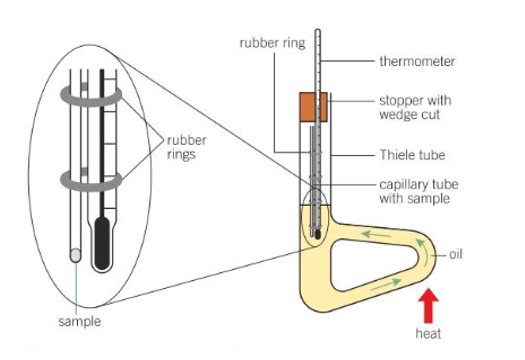
How can you identify the melting points of carboxylic acids?
Using a Thiele tube
Describe the main physical characteristic of carboxylic acids.
They have very characteristic smells E.g. ethanoic acid is vinegar, butanoic acid smells like rancid butter
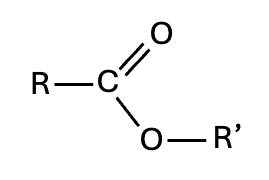
What are esters?
Derived from carboxylic acids The OH group is replaced with a hydrocarbon group (alkyl or aryl)
How do you name esters?
The first part of the name comes from the alcohol group: methyl, ethyl, propyl, etc The second part of the name comes from the carboxylic acid: methanoate, ethanoate, propanoate, etc
Describe the physical characteristics of short chain esters.
Fairy volatile Have fruity, pleasant smells Often used in flavourings and perfumes Can be used as solvents and plasticisers Generally insoluble in water
Describe the physical characteristics of longer chain esters.
Fats and oils Insoluble in water
How are esters formed?
Carboxylic acid + alcohol –> ester + water Catalysed by strong acid catalyst (e.g. sulfuric acid) Reversible reaction Equilibrium mixture of reactants and products
Write an equation for the esterification reaction of ethanoic acid and ethanol.
CH3COOH + C2H5OH –> CH3COOC2H5 + H2O
Describe acid hydrolysis of esters.
Ester is refluxed with water and a strong, dilute acid catalyst usually hydrochloric acid or sulfuric acid Reversible reaction Lots of water must be added to push equilibrium to the right Ester + water –> carboxylic acid + alcohol
Describe base hydrolysis of esters.
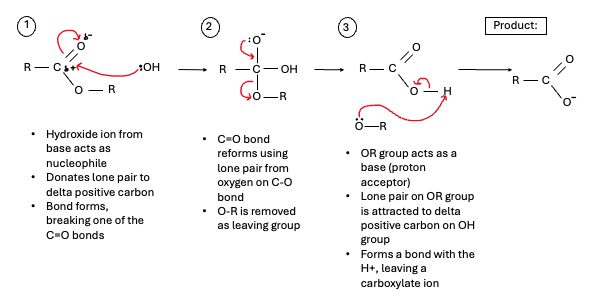
Ester + dilute alkali –> carboxylate ion + alcohol (reflux) Produces a negatively charged carboxylate ion which bonds with a positively charged ion from the base used, forming a salt
What is the mechanism for base hydrolysis?
Nucleophilic addition-elimination
What are triglycerides?
Glycerol (propane 1,2,3 triol) And 3 fatty acids
How are triglycerides hydrolysed?
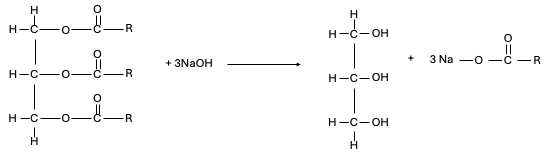
In acidic conditions to give a mixture of glycerol and fatty acids By boiling with sodium hydroxide to produce glycerol and a mixture of sodium salts (soaps)
Give a general equation for the hydrolysis of a triglyceride using sodium hydroxide.
What is saponification?
The reaction of sodium hydroxide with triglyceride to produce glycerol and sodium salts
Why is saponification useful?
Produces sodium salts Useful as cleaning agents because they are ionic and dissociate to form Na+ and RCOO- RCOO- has two ends: a non-polar hydrocarbon chain and a polar COO- group which is ionic The hydrocarbon mixes with grease while the COO- mixes with water
What is palmitic acid used for?
Making soaps
What is oleic acid?
A monounsaturated fatty acid Found in most fats and olive oil
What is linoleic acid?
A polyunsaturated fatty acid Present in many vegetable oils
Describe the structure and uses of glycerol.
Readily forms hydrogen bonds due to its 3 OH groups Very soluble in water Used in pharmacy and cosmetics as it attracts water Can be used to prevent ointments from drying out Solvent in many medicines and toothpaste Food colouring Plasticiser
What is biodiesel?
A type of fuel made from renewable organic matter Better for the environment as it produces less pollutants when combusted