3.3.4 Alkenes
No description yet. This curated deck is ready for daily study.
Card preview (24)
Why does the C=C double covalent bond in alkenes have a high electron density?
∵ they’re 2 pairs of electrons in the C=C double bond (High conc. of electrons )
Why is there restricted rotation around double bond in alkenes?
• C-C single bond & p-orbital (contains single electron) on each carbon • These 2 orbitals overlap & form an orbital with a cloud of electron density above and below the single bond • Called π orbital & its presence = bond can’t rotate
What is the only intermolecular forces between alkene molecules?
Van der Waals forces
Alkenes are ____ in water
insoluble
Alkenes are ____ reactive than alkanes
more
Why are alkenes more reactive than alkanes?
∵ C=C forms electron-rich area = can be easily attacked by electrophiles
Why do electrophilic addition reactions occur?
∵ double bond has lots of electrons = easily attacked by electrophiles
What are electrophiles?
electron-pair acceptors
Where are electrophiles attracted to?
Attracted to areas where there’s lots of electrons e.g. Positively charged ions (H+ NO2+) and polar molecules (δ+)
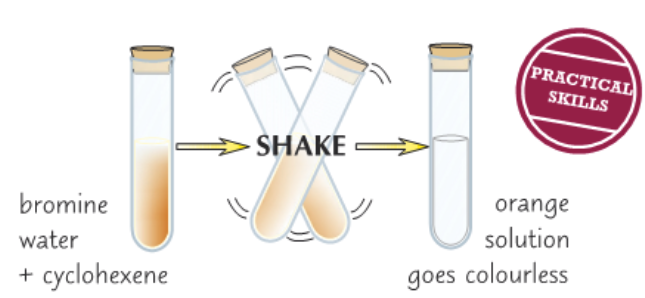
When you shake an alkene with orange bromine water, why does the solution decolourises?
∵ Bromine is added across C=C double bond to form colourless dibromoalkane (happens via electrophilic addition)
Electrophilic Addition Name the reactant + bonds & the products
• Halogen • X—X = dihalogenoalkane • Hydrogen Halides • H—X = halogenoalkane • Sulfuric Acid • H2SO<span>4</span> = alcohol
What happens when you add a hydrogen halide to an unsymmetrical alkene?
You get 2 possible products
Adding Hydrogen Halides to Unsymmetrical Alkenes What does the amount of each product formed depend on?
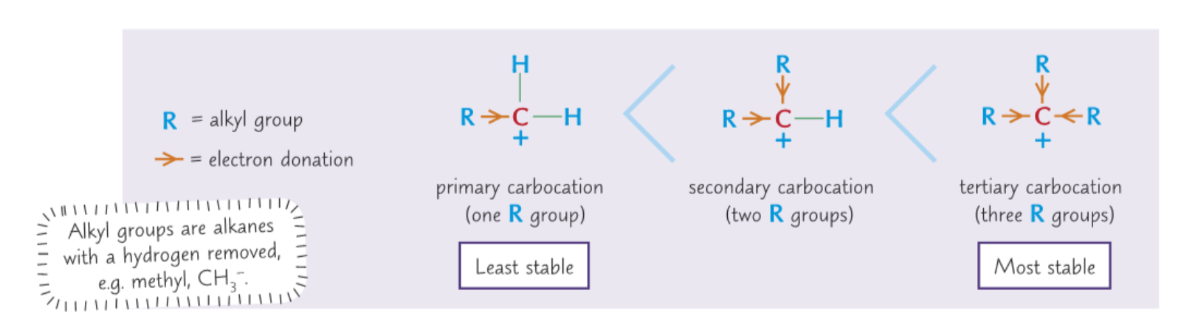
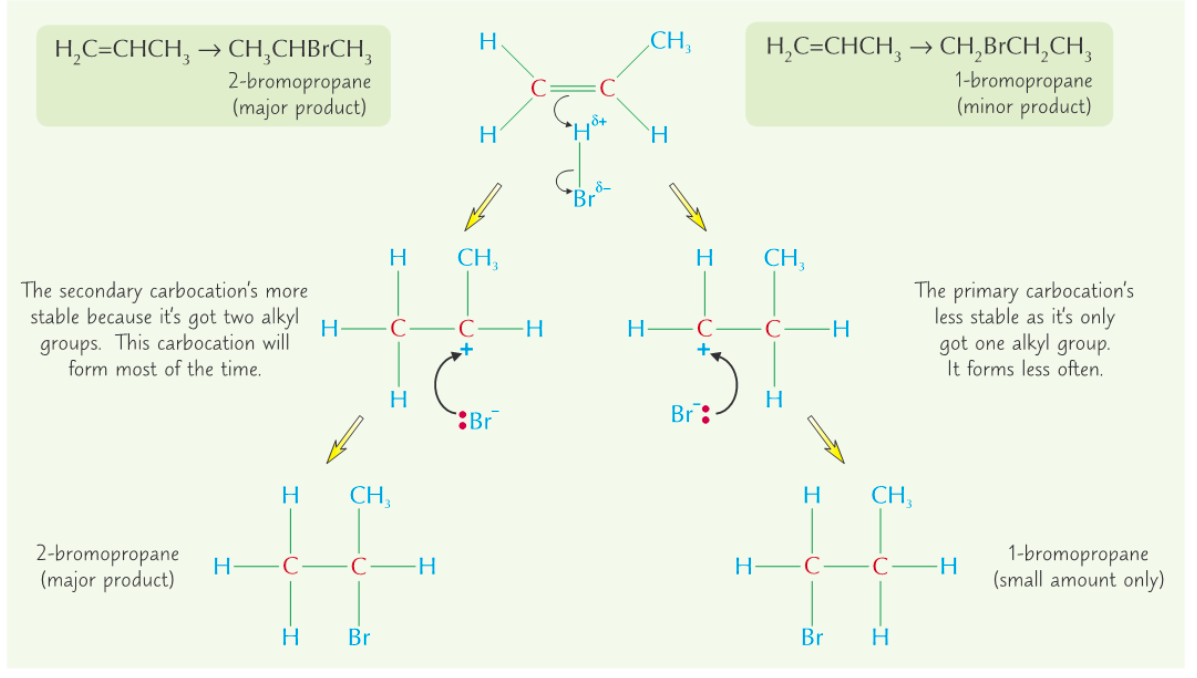
How stable carbocation formed is = known as carbocation intermediate
Why are carbocations with more alkyl groups more stable?
∵ alkyl groups feed electrons towards positive charge
Ethene + Br2 Balanced Equation (structural formula)

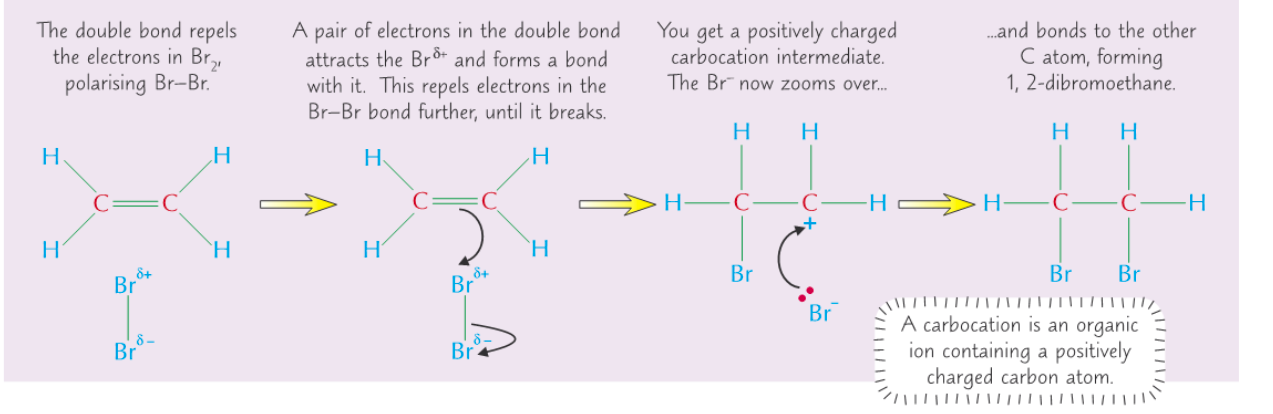
Ethene + Br2 Mechanism
Propene + HBr Mechanism
Ethene + H2SO4 Mechanism
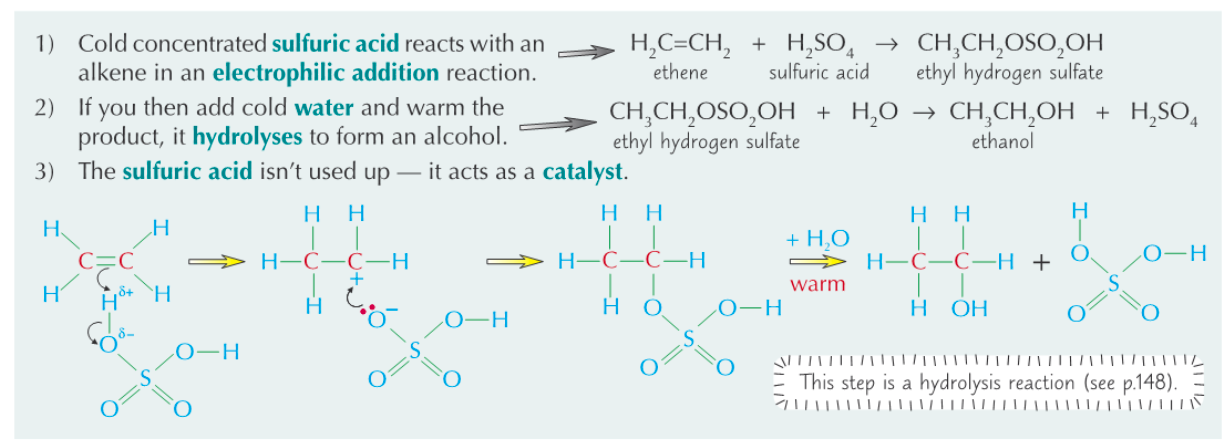
What do alkenes form initally when reacted with cold concentrated sulfuric acid?
Alkyl hydrogen sulfates
How can you convert alkyl hydrogen sulfates into alcohols?
By adding water & warming reaction mixture
What are polymers?
Long chain molecules formed when monomers join together
What are addition polymers formed from?
alkenes and substituted alkenes
Why can alkenes make up addition polymers?
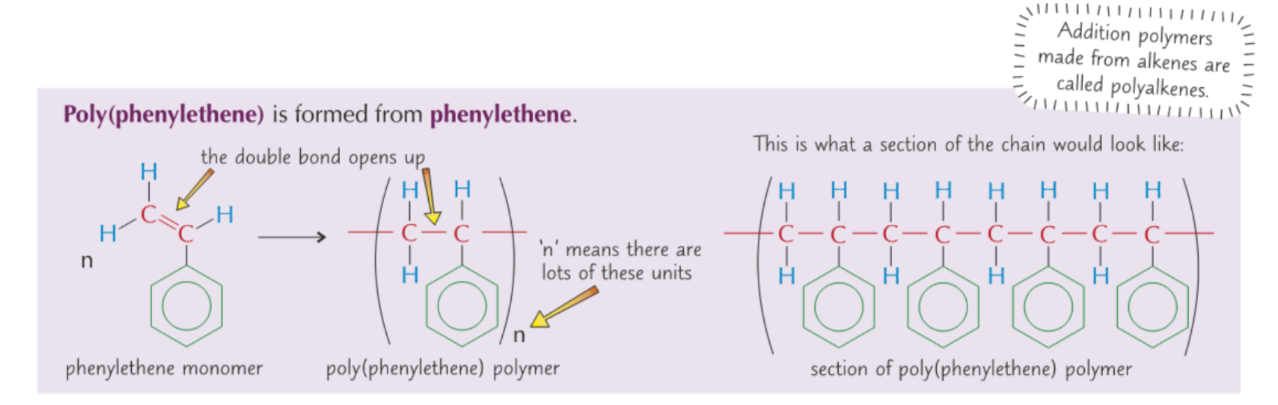
Can act as monomers and form polymers ∵ double bond can open up & join together to make long chains
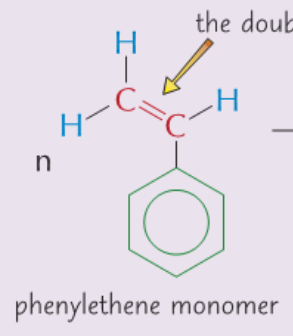
Draw poly(phenylethene) from phenylethene