3.3.3 Halogenoalkanes
No description yet. This curated deck is ready for daily study.
Card preview (24)
What is a halogenoalkane?
Alkanes with at least one halogen atom in place of hydrogen atom
Describe 3 physical properties of halogenoalkanes
• Insoluble in water ∵ polar Cδ+—Xδ- bonds are not polar enough • Main intermolecular forces of attraction are dipole—dipole attraction and van der Waals forces • Halogenoalkanes mix with hydrocarbons
Boiling points increase with … & increases when …
Boiling points increase with increased chain length & increases when going down the halogen group
Why do boiling points increase with increased chain length or when going down the halogen group?
∵ larger the molecule = greater the number of electrons ∴ greater the van der Waals forces
Why do halogenoalkanes have higher boiling points than alkanes with similar chain lengths?
∵ have higher relative molecular masses & more polar
Why are carbon-halogen bonds polar?
Halogens are much more electronegative than carbon
What makes halogenoalkanes prone to attacks from nucleophiles?
δ+ charge on carbon/polar carbon-halogen bond
What is a nucleophile?
Electron-pair donor (negatively charged ion or an atom with δ- charge)
What do nucleophiles have?
Has lone (unshared) pair of electrons
As you go down the halogen group, the bonds (C-X) get __ ___
less polar
What is a nucleophilic substitution reaction?
When a nucleophile reacts with polar molecules by replacing the functional group
Why are nucleophilic substitution reactions used?
To introduce new functional groups into organic compounds
Nucleophilic Substitution Name the reactant
Halogenoalkane
Nucleophilic Substitution Name the nucleophiles
:OH-, :CN- & :NH3
Nucleophilic Substitution Name the condition & product for the nucleophile :OH-
Warm, aqueous NaOH or KOH → Alcohol
Nucleophilic Substitution Name the condition & product for the nucleophile :CN-
Warm halogenoalkane with ethanolic KCN(aq) → Nitrile
Nucleophilic Substitution Name the condition & product for the nucleophile :NH3
Warm halogenoalkane with excess ethanolic ammonia → Amine
Why is the reaction between hydroxide ions & halogenoalkanes sometimes called hydrolysis?
∵ in the mechanism, the exact same reaction will happen with water
Bromoethane + aqueous NaOH Name the mechanism
Nucleophilic Substitution
Bromoethane + aqueous NaOH Balanced Equation
C2H5Br + NaOH → C2H5OH + NaBr
Bromoethane + aqueous NaOH Name of Organic Product
Ethanol
Bromoethane + aqueous NaOH Mechanism
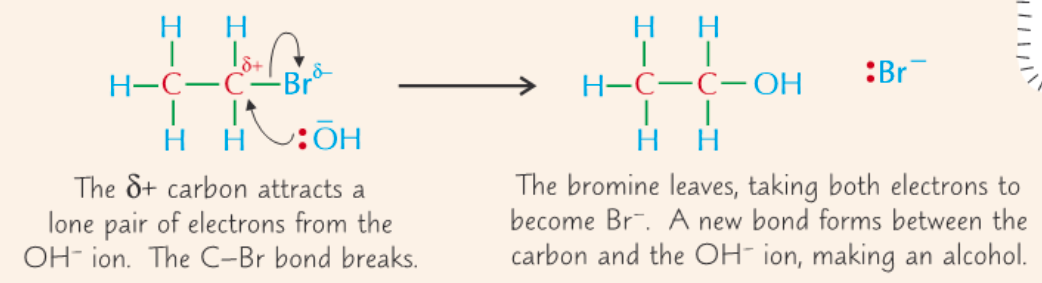
Bromoethane + NH3 Name of Mechanism
Nucleophilic Substitution
Bromoethane + NH3 Balanced Equation
