Topic 10 Equilibrium
No description yet. This curated deck is ready for daily study.
Card preview (17)
Dynamic equilibrium
-Must be in a closed system -Forwards and backwards reaction are happening at the same time -Concentrations of the products and reactants remain constant
How does pressure affect equilibrium?
It favours the side with the fewest moles of gas
How does concentration affect equilibrium?
Equilibrium shifts away from the one increased
How does temperature affect equilibrium?
Equilibrium favours the endothermic reaction
The equilibrium constant (Kc)
The magnitude of Kc tells us the relative proportions of reactants and products in the equilibrium system
The equilibrium constant values
-A Kc value of 1 indicates that equilibrium is halfway between reactants and products -A Kc value >1 indicates that equilibrium is towards the products -A Kc value <1 indicates that equilibrium is towards the reactants
A homogenous equilibrium
A homogenous equilibrium has everything present in the same phase
A heterogenous equilibrium
A heterogenous equilibrium has things present in more than one phase. The usual examples include reactions involving solids and gases, or solids and liquids.
Kc equations
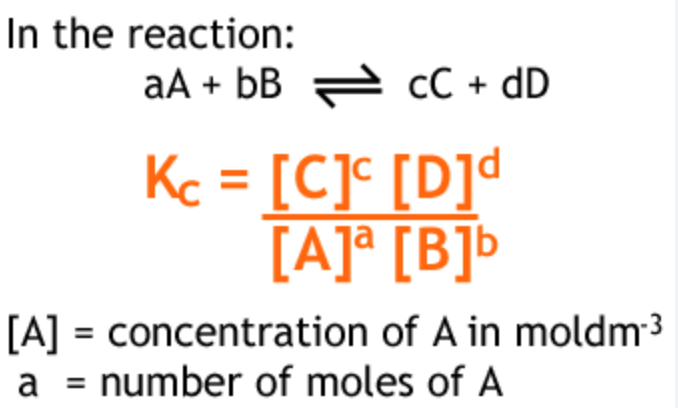
La Chatelier’s principle
La Chatelier’s principle states that a system at equilibrium moves in the direction that tends to minimise the disturbance. (Shifts in the direction that consumes energy).
The Contact Process
The contact process is a method of producing concentrated sulphuric acid which is required for industrial use. ΔH=-96 kjmol^-1 -Exothermic -2 atm pressure.
The Contact Process steps
-Step 1: Make sulfur dioxide S(g) + O2(g) –> 2SO2(g) -Step 2: Convert sulphur dioxide into sulfur trioxide (the reversible reaction at the heart of the reaction) 2SO2(g) + O2 ⇌ 2SO3(g) -Step 3: Convert sulfur trioxide into concentrated sulphuric acid H2SO4(l) + SO3(g) –> H2S2O7(l) H2S2O7(l) + H2O(l) –> 2H2SO4(l)
The Contact Process conditions- Volume and Concentration
-Increasing the concentration of oxygen causes the position of equilibrium to shift towards the right -By increasing the proportion of oxygen you can increase the percentage of the sulfur dioxide converted.
The Contact Process conditions- Temperature
-The forward reaction is exothermic, so increasing the temperature shifts the position of equilibrium to the left in the direction of the reactants. (Therefore, the higher the temperature, the lower the yeild of sulfur trioxide). -To get as much sulphur trioxide as possible in the equilibrium mixture, you need as low a temperature as possible -A compromise that allows a good speed of production and the right amount of sulfur trioxide is 400-450 degrees
The Contact Process conditions- Pressure
-To get as much sulfur trioxide as possible, you need as high a pressure as possible (high pressures also increase the rate of reaction) -However at relatively low pressures there’s still a high conversion of sulfur dioxide into sulfur trioxide (99.5%), so increasing the pressure for a small improvement isn’t worth the expense.
Why remove products before equilibrium?
-To shift equilibrium to right to increase yield of products. -Removal of products decreases rate of back reaction. -Time to reach equilibrium may be too long. -Unused reactants can be recycled.
The Haber Process
N2 + 3H2 ⇌2NH3 -Forward reaction is exothermic. ΔH=-92 kjmol^-1 450°, 250 atm -Iron catalyst -Products are removed to increase effeciency.