Principal Reaction Types
No description yet. This curated deck is ready for daily study.
Card preview (24)
Organometallic complexes can be stabilised over a range of oxidation states, and show a range of reactions with organic molecules to make catalysts and other useful compounds and reagents What are these 9 reaction types?
1) Salt Elimination 2) Protonolysis 3) Oxidative addition 4) Reductive Elimination 5) Oxidative Coupling 6) Reductive Cleavage 7) Migratory Insertion 8) Elimination Reactions 9) σ-bond metathesis
What is the reverse of oxidative addition?
Reductive Elimination
What is the reverse of oxidative coupling?
reductive cleavage
What is the reverse of migratory insertions?
Elimination reactions
Salt Elimination is a effective way to form… What is the undesired product also formed?
an organometallic compound, through reacting a metal halide with alkyl lithium or grignard Produces a inorganic salt as side product

What is the driving force for salt elimination reactions
• Thermodynamics: Salts have high lattice energy, hence highly stable • Kinetics: le chatelier’s principle, the salts of formed as solid, hence removed from the reaction solution, driving the reaction forward
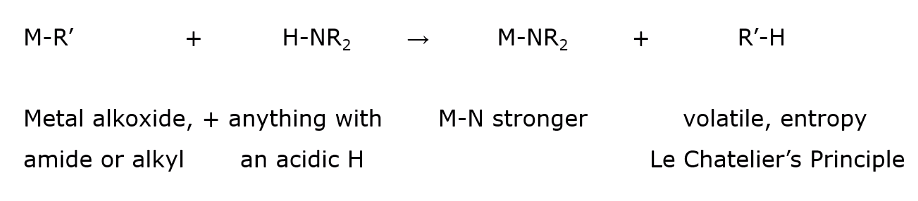
The following reaction is a protonolysis What is formed when a metal alkoxide reacts with an acid?
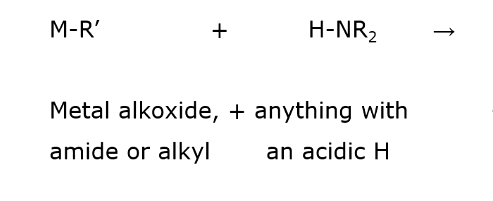
• The alkoxide/amide/alkyl becomes protonated • The conjugate base and metal form a new bond • (sometimes you can make the protonate species volatile meaning it will bubble off, driving the reaction forward)
Define oxidative addition (O.A.) and state the most well known example of this?
• This is the simultaneous addition of two ligands into the coordination sphere of a metal, it is an overall process with no mechanistic implications • The synthesis of Grignard reacts, RMgX, from Mg and RX is an O.A. reaction
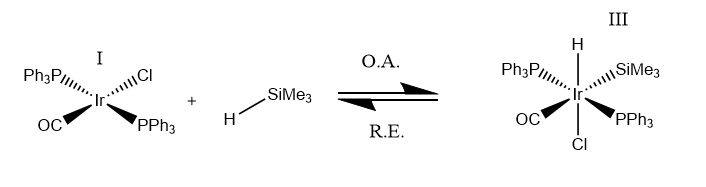
The following reaction is an oxidative addition What is the final product?
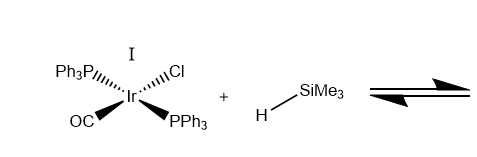
Going from a 16e to an 18e complex (typical for the oxidation state of the metal to increase by 2 during an oxidative addition)
Oxidative addition is most common for d⁸ and d¹⁰ metals, requires?
• Non-bonding electron density at the metal • A vacant coordination site • A metal with accessible oxidation states separated by 2 units
Oxidative addition is favoured for?
• Heavier elements of a group (more electron rich) • When the metal is electron rich (π-basic) • When hard or strong σ-donor ligands are present (push more e- density onto metal) • Small ligands are present (adding ligands - less steric hindrance the better) • The metal is large (less sterics the better) • For storng M-A and M-B and weak A-B bonds
What happens to the oxidation state, coordination number and valence electron count during a reductive elimination
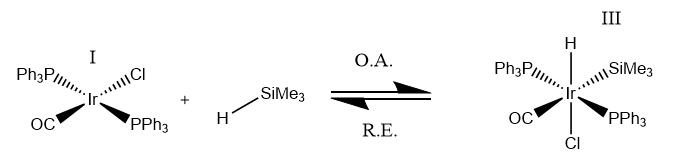
• Oxidation state: decreases by 2 • Coordination number: decreases by 2 • Valance electron count: decreases by 2
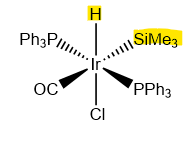
Reductive elimination only works if…
…the ligands that you’re eliminating are cis to one another e.g. the hydrogen and silicon are close enough together to allow the elimination to happen
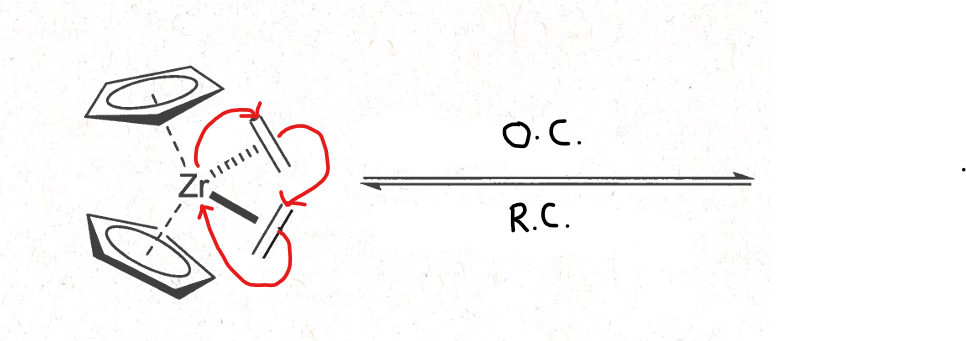
What is an Oxidative Coupling?
It generally involves an early transition metal with a d² configuration with unsaturated substrates (i.e. alkenes or alkynes or nitriles) which are coupled together to form an additional C-C bond, forming a metallocycle
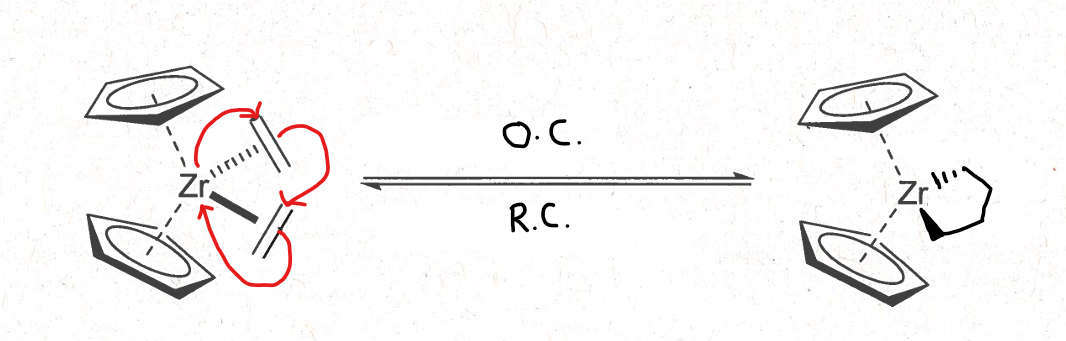
The following reaction is an oxidative coupling, what is the end product?
formation of a new metallocycle gone from Zn (II) to Zn (IV)
Migratory insetions are easy ways to form…
…. C-C and C-N bonds
The following reaction is a 1,1-migratory insetion What are the key change which have occured?
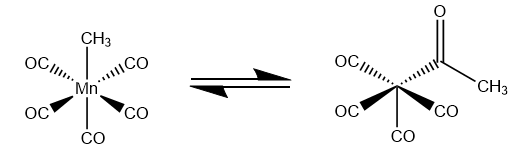
• oxidation state has not changed • gone from a 18e- to a 16e complex
The following reaction is a 1,2-migratory insertion What is the final product?
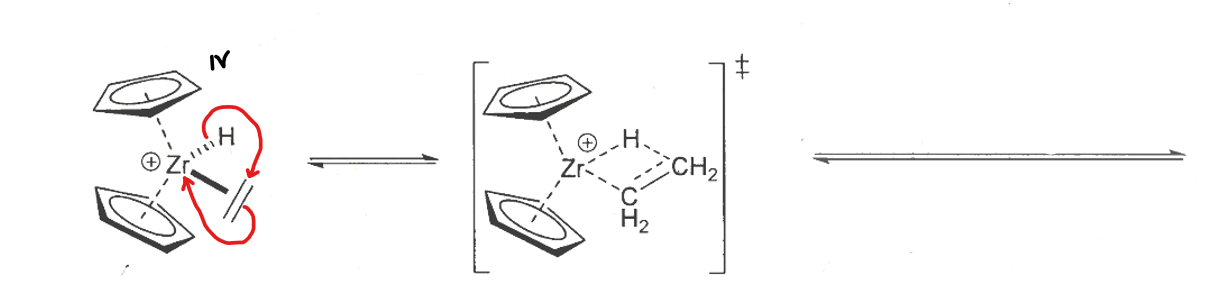
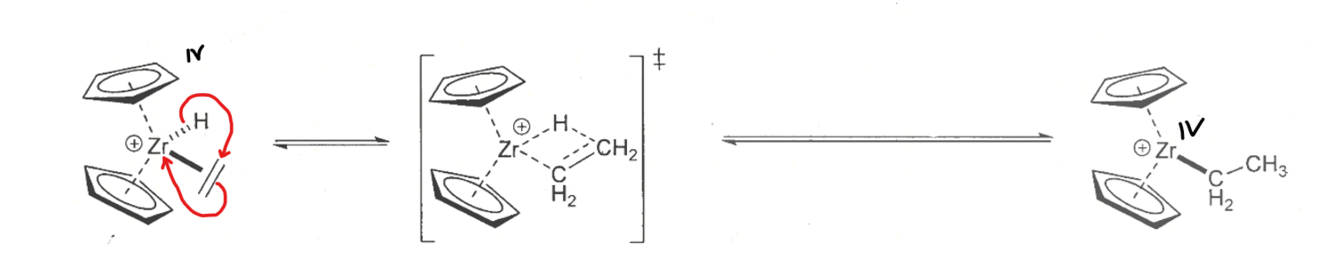
What is β-hydride elimination?
β-hydride elimination is the most common way for a metal alkyl to decompose (due to the stabiliity of the square transition state and final product) Involves the transfer of a hydride from the β-position on a ligand to the metal centre (most common is alkyl/alkoxide complexes) Has to have a hydride on the β-position for this reaction to occur
What must a complex have for a β-hydride elimination to occur?
• A complex must be coordinatively unsaturated for β-hydride elimination to occur • The metal complex must usually have <18 electrons, otherwise a 20-electron alkene-hydride intermediate would be formed
What is α-hydride elimination
• This is the transfer of a hydride from the α-position on a ligand to the metal centre • Forming a double bond between carbon and metal centre - carbene • Formally, the process is a type of O.A. reaction as oxidation state of the metal increases by 2 • (Hence cannot occur in a d⁰ or d¹ metal complex)
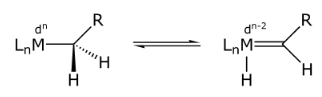
What is an α-hydride abstraction
• For d⁰ or d¹ metal complexes α-abstraction does not result in a change of oxidation state • Due to metal starting and ending with 2x M-C bonds • The α-hydrogen transfers directly to an adjaent ligand instead of the metal centre
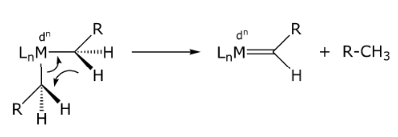
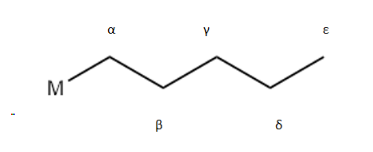
What other positions can hydride elimination occur at?
γ-, δ-, ε-eliminations
What is σ-bond metathesis?
• Essentially it is a swappint of the group attached to different σ-bonds • Occurs through a square transition state • Common reaction for early transition metals/lanthanides/actinides in high oxidation states where oxidative addition and reductive elimination are not viable
