Introduction to conformational analysis
No description yet. This curated deck is ready for daily study.
Card preview (19)
What is a conformer?
Structures that only differ through the rotation of single bonds
What is conformational analysis
the study of the energy chnages that occur during these rotations
Conformational analysis allows us to predict the 3D shapes of organic molecules, which has consequences for:
• Reactivity • Stereoselectivity • J-Coupling in ¹H NMR Spectroscopy
What is a conformer?
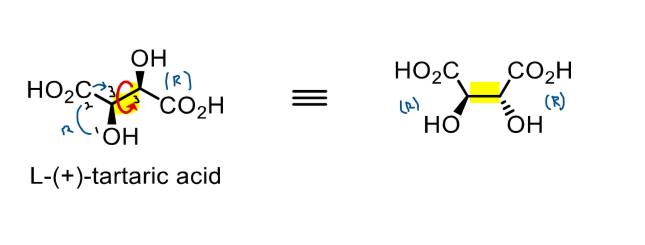
Molecular structures that can be interconverted by rotation around one or more single bonds (same connectivity + same chiral centre)
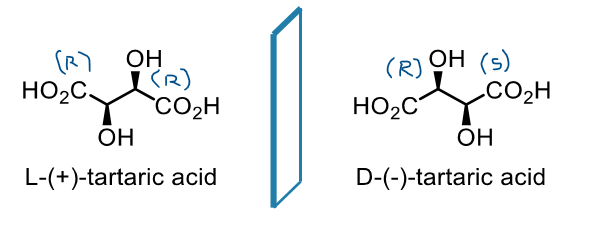
What are enantiomers?
Molecules that are non-superimposable mirror images of each other (no way you can convert one to the other)
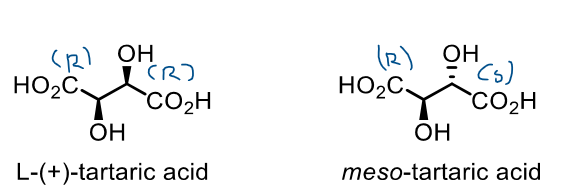
What are diasteroisomers?
They are Steroisomers that are ‘superimposable mirror images of eadch other (they have different chiral centre orientations
For the S-isomer, in which direction is the rotation?
Anticlockwise
For the R-isomer, which direction is the rotation?
clockwise
In ethane, the barrier to rotation is 2.5kcal/mol, while it is 6kcal in butane What is the reason for this difference?
Clash between the two terminal carbons (Sterics)
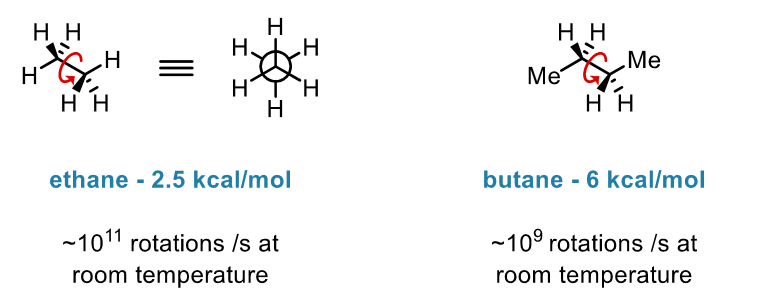
The barrier to rotation in ethane is 2.5kcal/mol, while the barrier to rotation in cyclohexane between two chain isomers is 11kcal/mol What is the reason for this difference?
Ring strain results in a higher energy barrier and hene a much slower equilibrium
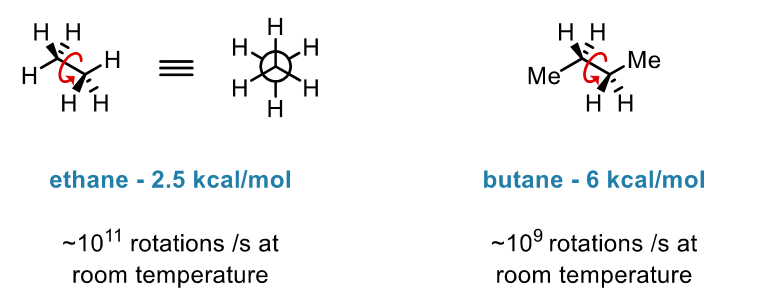
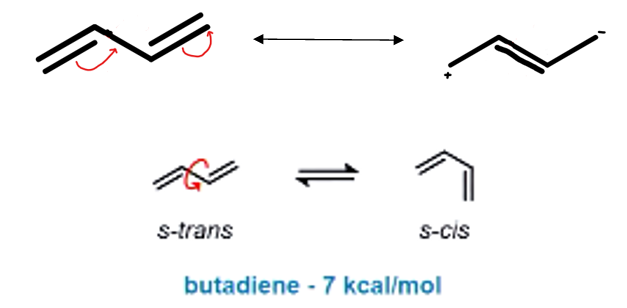
The barrier to rotation in butane is 6kcal/mol, while the barrier to rotation in butadiene is 7kcal/mol What is the reason for this difference
The single bond in the centre has partial double bond character due to resonance Hence making rotation higher in energy as it is more difficult
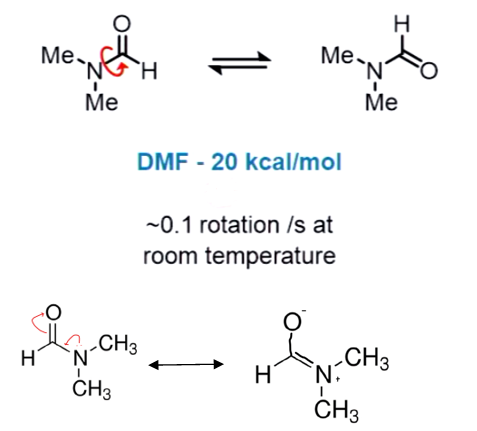
The barrier to Rotation in DMF is 20 kcal/mol Why is it so high
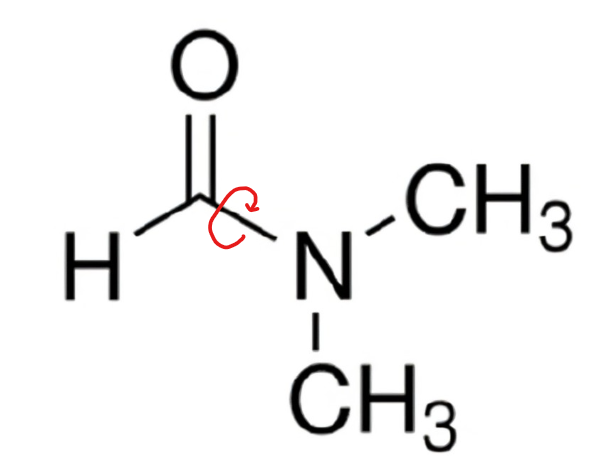
Single C-N bond has partial double bond character due to nitrogen donating its LP (more electronegative carbon) high more energy is required for rotation this is why two methyl groups are seen in NMR cuz rotation is so slow
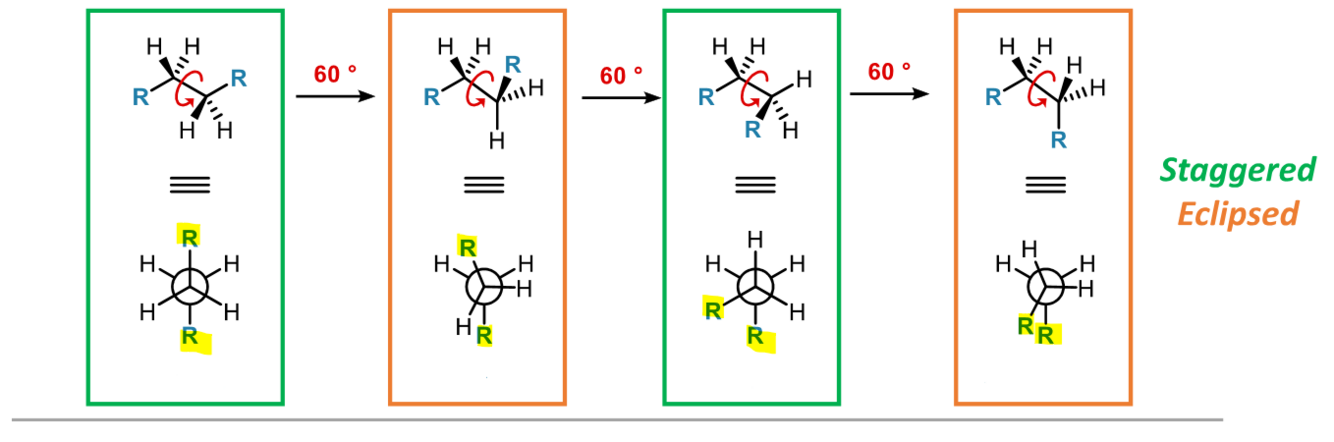
The following schematic shows rotation about a single bond What is the name of these conformers?
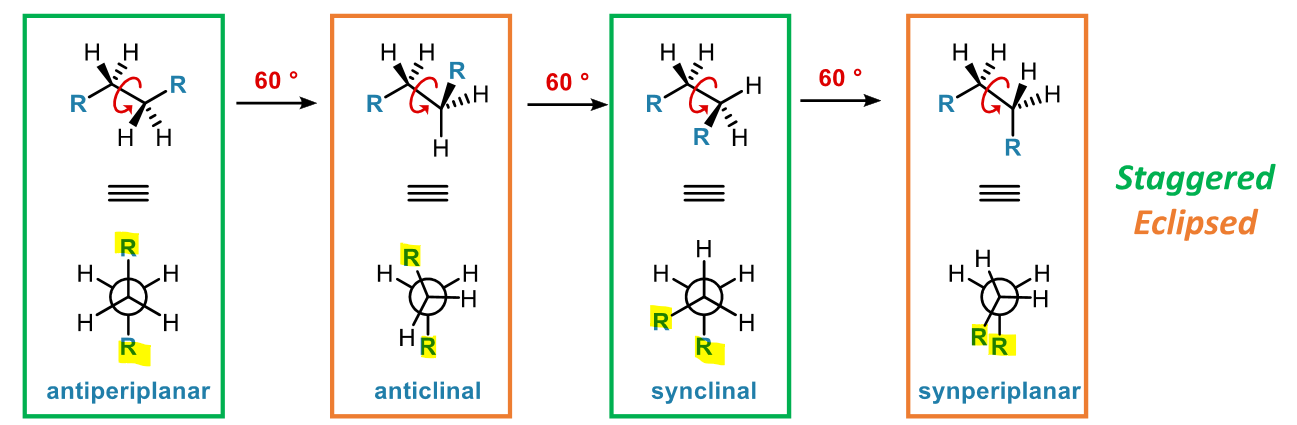
What is the difference in the energy profile for single bond rotation between ethane and butane
• All conformers apart from antiperiplanar are higher in energy in butane • The synperiplanar is the highest energy conformer in butane • Followed by the anticlinal conformer
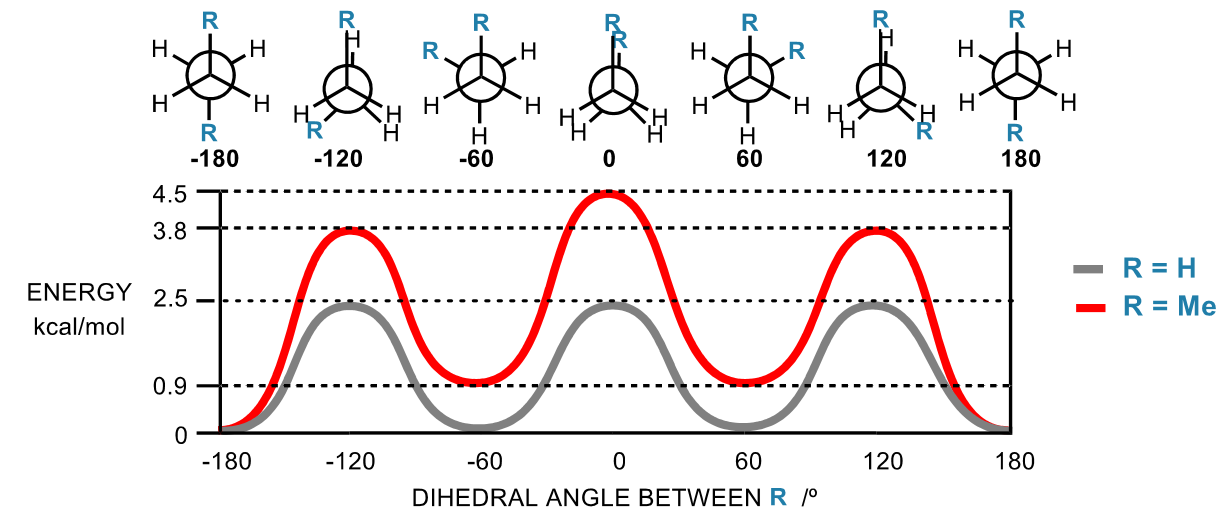
What are the 4 factors which contributes to the maxiumum of energy seen in the synperiplanar conformer?
• Sterics • Pitzer (Torsional) strain • Hyperconjugation • Hydrogen bonding
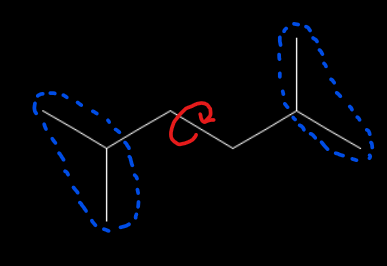
Why does Sterics contribute to conformation energy?
Repulsion between substituents destabilises eclipsed conformations e.g. neither of these big substituents in blue want to clash
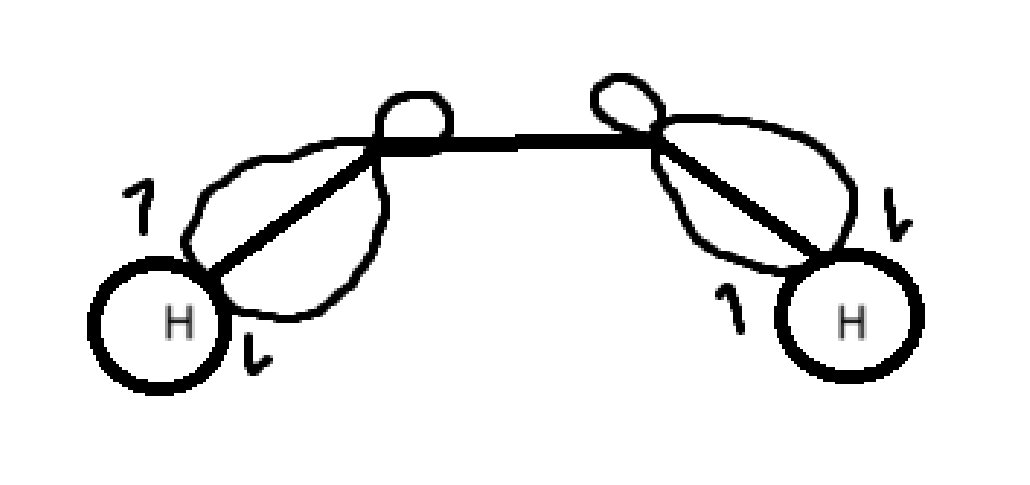
What is Pitzer (Torsional) Strain contribution to conformation energy
Electrostatic repulsions between electrons in filled orbitals destablilises eclipsed conformers
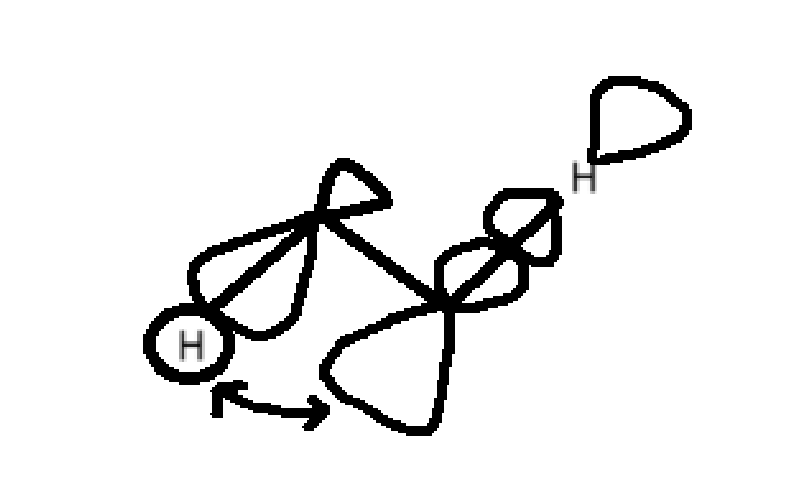
What is the Hyperconjugation contributions to conformational energy
Interaction between the filled σ orbitals and empty σ’ orbital leads to stabilisation This stabilises the antiperiplanar conformation (Hyperconjugation is most relevant when you have highly electronegative substituents)
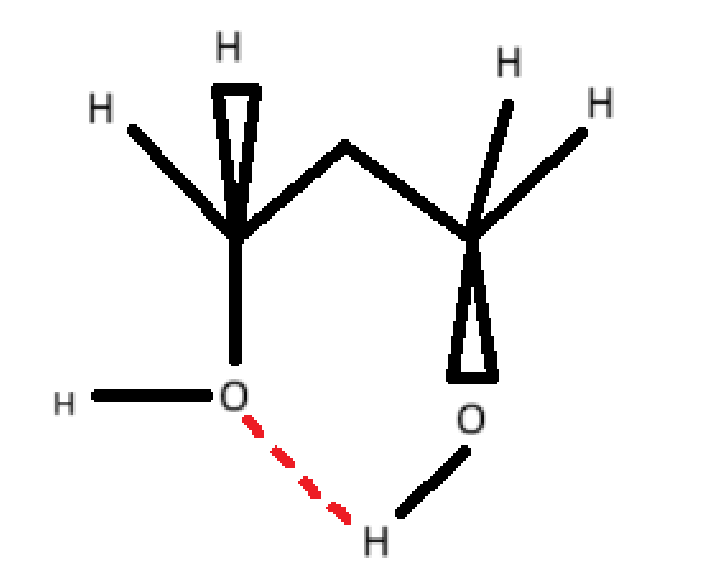
Why does hydrogen bonding contribute to the conformational energy
Hydrogen bonding stablilises the synclinal and synperiplanar conformation due to the formation of hydrogen bonds when the hydroxyl groups as in these positions (predominantly for staggered conformations)