Centeral nervous system
No description yet. This curated deck is ready for daily study.
Card preview (15)
Protection of the CNS: Bone
• Hardness of cranium that encases brain. • Spinal cord runs through vertebral canal in vertebrae.
Protection of the CNS: Meninges
3 layers of connective tissue in between brain/spinal cord. Outer layer: Tough and fibrous, sticks closely to cranium. Inflexibility prevents brain from moving around. Middle layer: Loose mesh of fibres. I Inner layer: Delicate, many blood vessels, sticks close to brain/S.C. Creates a seal that protects brain from infection.
Protection of the CNS: Cerebrospinal fluid
• Clear watery fluid between middle and inner layer of meninges. • Few cells with some glucose, protein, urea and salts. • Circulates through cavities in brain and spinal cord. Functions: • Protection (shock absorber). • Support (brain is suspended in cranium and floats in CSF). • Transport (carries nutrients/waste to and from brain).
Cerebral cortex
• Largest part of brain. • Outer surface of grey matter (2-3mm thick). • Separated by shallow folds, sucli and deep folds, fissures. • Longitudinal deep fissure separate cerebrum into left and right hemispheres. • Main fissures subdivide each hemisphere into • Frontal, Temporal, Occipital, Parietal lobes.
Tracts
Large bundle of transverse myelinated fibres under cerebral cortex. • Connect various areas in same hemisphere. • Carry impulses between hemispheres. • Connect cortex to other parts of brain or spinal cord.
Basal ganglia
Grey matter tracts, deep in cerebral cortex.
Types of functional areas
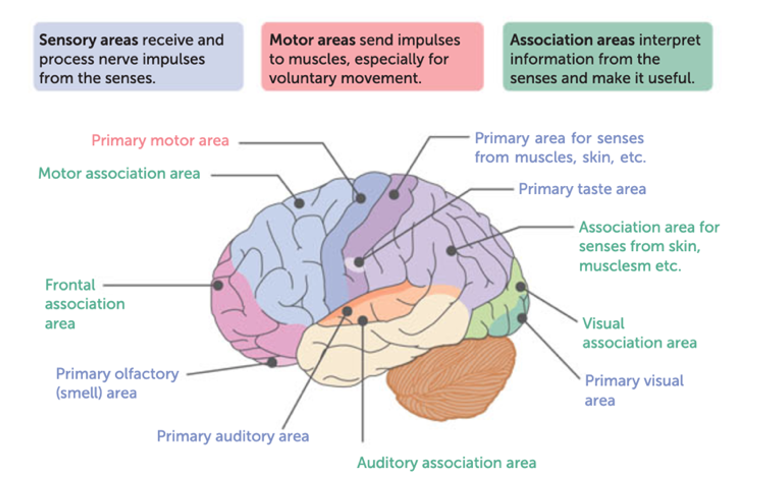
Sensory: Interpret impulses from receptors. Motor: Control muscular movements. Association: Intellectual and emotional processes.
Primary motor cortex
Part of cerebrum that generates motor messages to body. If damaged paralysis to voluntary muscles.
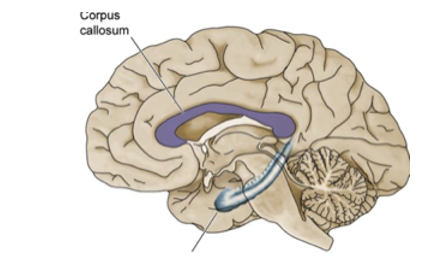
Corpus collosum
• Wide band of nerve fibres that lie underneath cerebrum. • Nerve fibres cross from one hemisphere to other, allowing two sides to communicate.
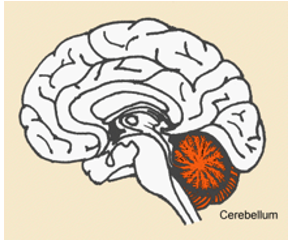
Cerebellum
Located under cerebrum. Folded into a series of parallel ridges (outer folds grey inner folds white). Control of posture, balance and fine coordination (non – conscience). Role • Receives input from senses and make adjustments to muscles if necessary. • Smooth’s contraction of muscles, maintains muscles tone and posture, coordinates movements of joints.
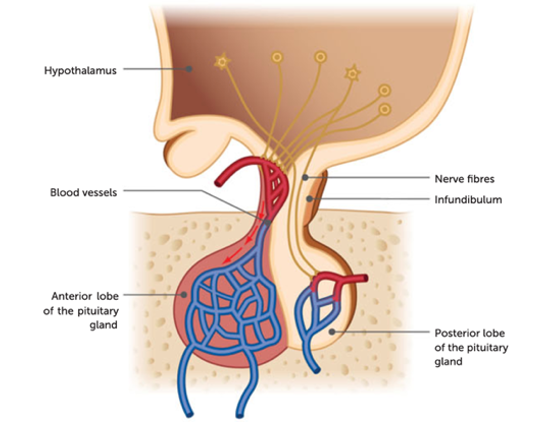
Hypothalamus
Located in middle of brain. Mostly controls homeostasis. Role (Andy Bites Fred, Sometimes Controls Emotional Sam). • Autonomic NS. • Body temperature. • Food and Water intake. • Sleeping patterns. • Contraction of urinary bladder. • Emotional responses. • Secretion of hormones.
Medulla Oblongata
• A continuation of spinal cord (3cm long). • Passage for nerves going to or from other parts of brain. • Upper motor neurons cross medulla, they become lower motor neurons when they exit S.C. Role: Swallowing, coughing, sneezing, vomiting. • Cardiac centre: Regulates rate and force of heartbeat. • Respiratory centre: Control of rate and depth of breathing. • Vasomotor centre: Regulates diameter of blood vessels.
Spinal cord
• Surrounded by 3 meningeal layers and vertebrae. • Foramen magnum is hole in base of cranium. • Central canal runs entire length of spinal cord and contains CSF.
Label a picture of the brain
Hypothalamus and Pituitary