B5 Energetics II
No description yet. This curated deck is ready for daily study.
Card preview (24)
Define Lattice Enthalpy
Enthalpy change that occurs with the formation of 1 mole of an ionic lattice from gaseous ions
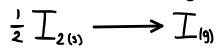
What is atomisation
Formation of 1mol of gaseous atoms from their elements
Atomisation equation for iodine
What is electron affinity
Formation of 1mol of gaseous anions from atomised elements and electrons
First electron affinity of chlorine equation

When must data be multiplied by 2 in a Born-Haber Cycle
When the product has a molar mass of two
When calculating lattice enthalpy from a Born-Haber Cycle, how should the equation be structured
With enthalpy of formation of the left-hand side of the equation, and the route on the right
Going clockwise round a Born-Haber cycle, what is the order of the processes
• Atomisations • Ionisations • Electron Affinities • Lattice Enthalpy
What must be remebered with electrons in Born-Haber Cycles
The electrons produced by ionisation energies, are used in the affinities
Define Enthalpy Change of Solution
Dissolving of one mole of a solute in water
Define Enthalpy Change of Hydration
Dissolving one mole of gaseous ions in water, to form aqueous ions
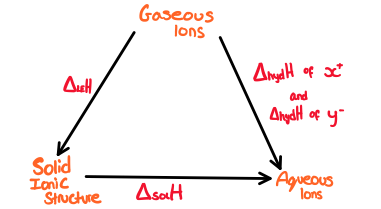
Draw a solution enthalpy cycle, with general terms
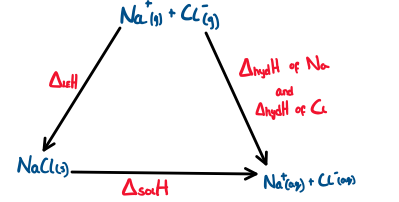
Draw a solution enthalpy cycle, for sodium chloride
What is the affect on deltaT, and the enthalpy change of solution, when the volume of water in an experiment is doubled
• deltaT will half, as the same ammount of energy is transferred to double the volume of water • Enthalpy of solution stays the same as the ratio of energy releases: moles, is the same, and so the same energy is released per mole
What is the affect on deltaT, and the enthalpy change of solution, when the mass of the solid is doubled
• deltaT will double, as double the ammount of energy is being transferred to the same volume of water • Enthalpy of solution stays the same, as the ratio of energy released: moles, is the same, and so the same ammount of energy is released per mole
How does a greater ionic radius affect the attraction to ions
Weaker attraction to ions
How does a smaller ionic radius affect the attraction to ions
Stronger attraction to ions
How does a greater ionic charge affect the attraction to ions
Stronger attraction to ions
How does a smaller ionic charge affect the attraction to ions
Weaker attraction to ions
Explaination of comparing two lattice enthalpies with different ionic radii
• Lattice enthalpy of X is more exothermic than Y • As ion X is smaller, so has a smaller ionic radius • Therefore attraction to Z- ions are stronger • So more energy is needed to break ionic bonds between ions
Explaination of comparing two lattice enthalpies with different ionic charge
• Lattice enthalpy of X is more exothermic than Y • As X has a 2+ charge, compared to Y which has a 1+ charge • X has a greater ionic charge • Therefore attraction is stronger to Z- ions • So more energy is needed to break ionic bonds between ions
Define entropy
The term used to describe the dispersal of energy (disorder) within the chemicals making up the chemical system
Describe and explain how entropy changes from (s) to (l) [or (l) to (g)]
• Entropy increases • As disorder increases • As liquid particles have more disorder than solid particles
Describe and explain how entropy changes from (l) to (s) [or (g) to (l)]
• Entropy decreases • As disorder decreases • As solid particles have less disorder than liquid particles