electrochemistry(I)
No description yet. This curated deck is ready for daily study.
Card preview (24)
what is a galvanic cell
it converts chemical energy to electrical energy via a spontaneous redox reaction
what is an electrolytic cell
it uses an electrical energy(from a external power source) to drive a non-spontaneous redox reaction.
diagram of a galvanic cell and its key points
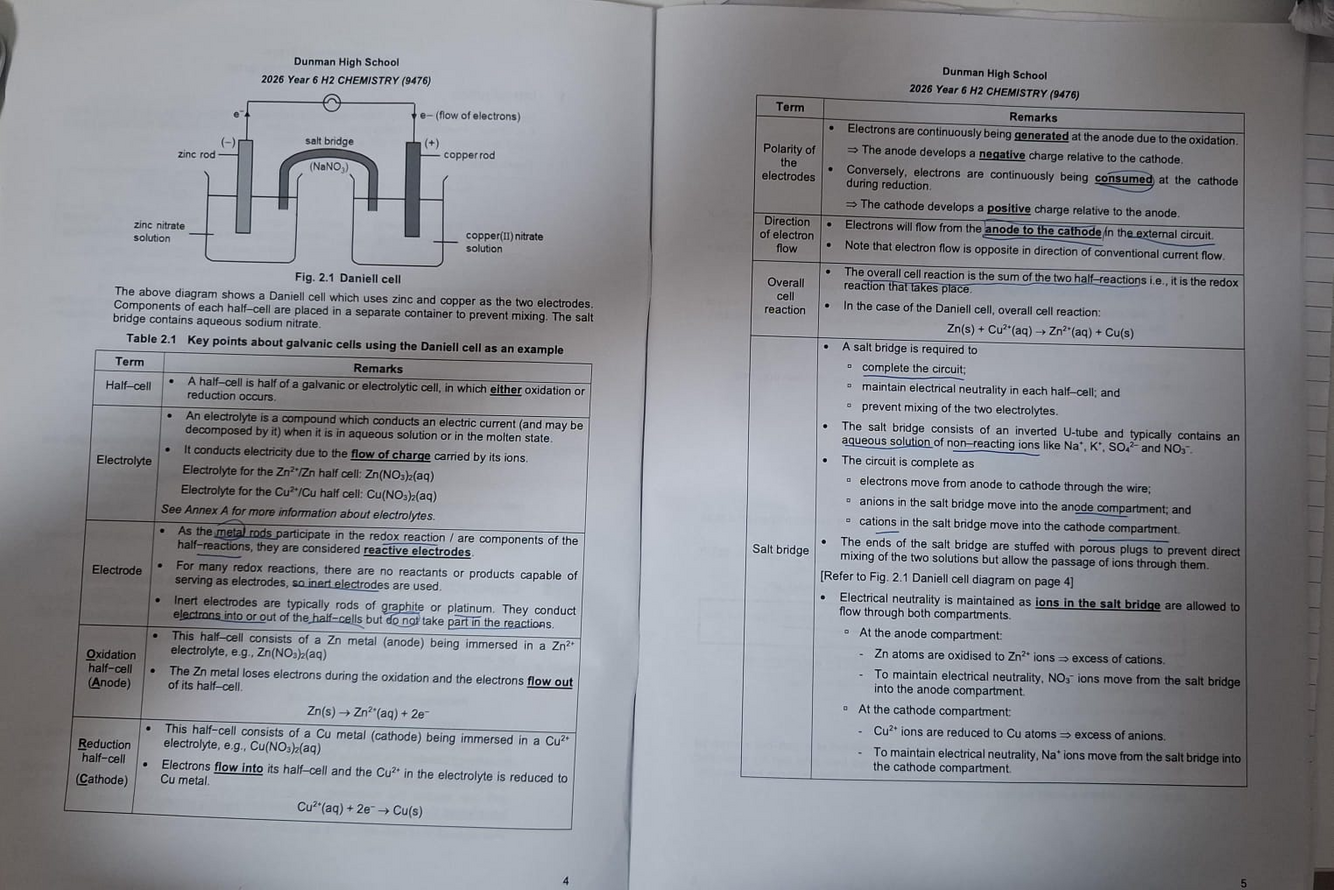
describe all the different key parts of a cell notation for galvanic cell: Zn(s) l Zn2+(aq) ll Cu2+(aq) l Cu(s)
• components of the anode compartnet(Ox half-cell) written to the left of components of cathode compartment(reduction half-cell) • l : represents a phase boundary between an electrode and the electrolyte, or between two chemical species in different physical states in the same compartment • (,): separates the half-cell components that are in the same phase • ll: indicates the separated half-cells and represents the phase boundary on either side of the salt bridge. • if a different inert electrode is used, have to write it down also, after writing reduction/oxidation species example: Cu(s) l Cu2+(aq) ll Fe3+(aq), Fe2+(aq) l Pt(s)
what is the standard cell potential, Ecell?
it is the maximum potential difference between 2 half-cells under standard conditions.
how to measure E cell value
• need standard electrode potential of each half-cell • measurmeent of each standard electrode potential of a half-cell requires: - standard conditions and a standard electrode as a reference electrode
what are the standard conditions?
temperature:298k(25c) pressure: 1 bar/ 100000Pa concentration(of ionic species): 1 mol dm^-3 in the absence of a metal in the half-cell, platinum is used as the electrode under standard conditions the plimsoll symbol can only be used under STANDARD conditions
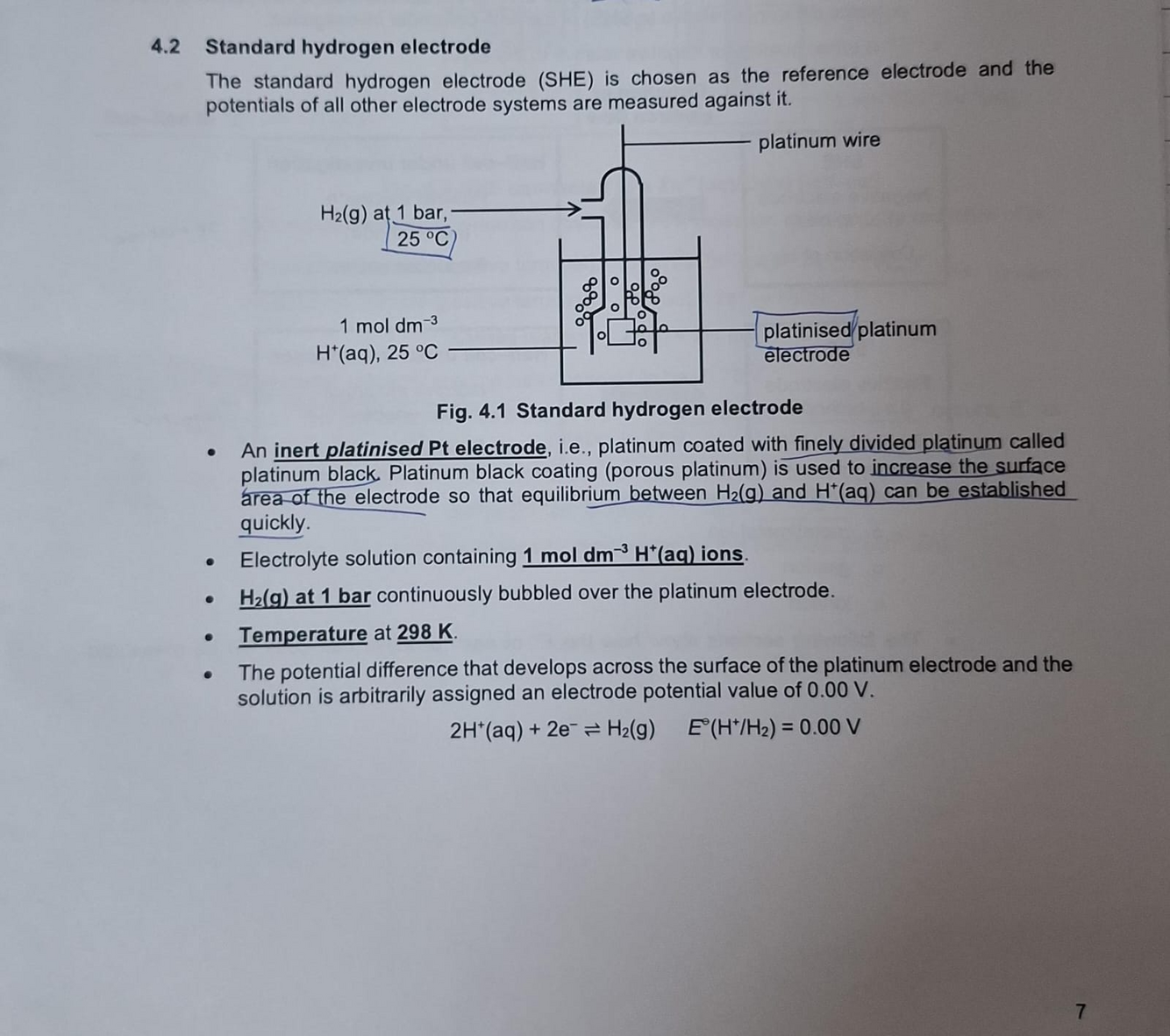
describe the standard hydrogen electrode (SHE)
SHE is chosen as the reference electrode and the potentials of all other electrode systems are measured against it.
describe the standard electrode potential, Enode, of a half-cell
the electromotive force between the half-cell and the standard hydrogen electrode, measured at standard conditions.
what is the polarity of Enode of half-cell if electron flows from SHE(anode) to half-cell under investigation(cathode)?
positive
what is the polarity of Enode of half-cell if electron flows from half-cell under investigation(anode) to SHE(cathode)?
negative
what are the 3 common types of half-cells?
• metal/metal ion • gas/ion • ion/ion
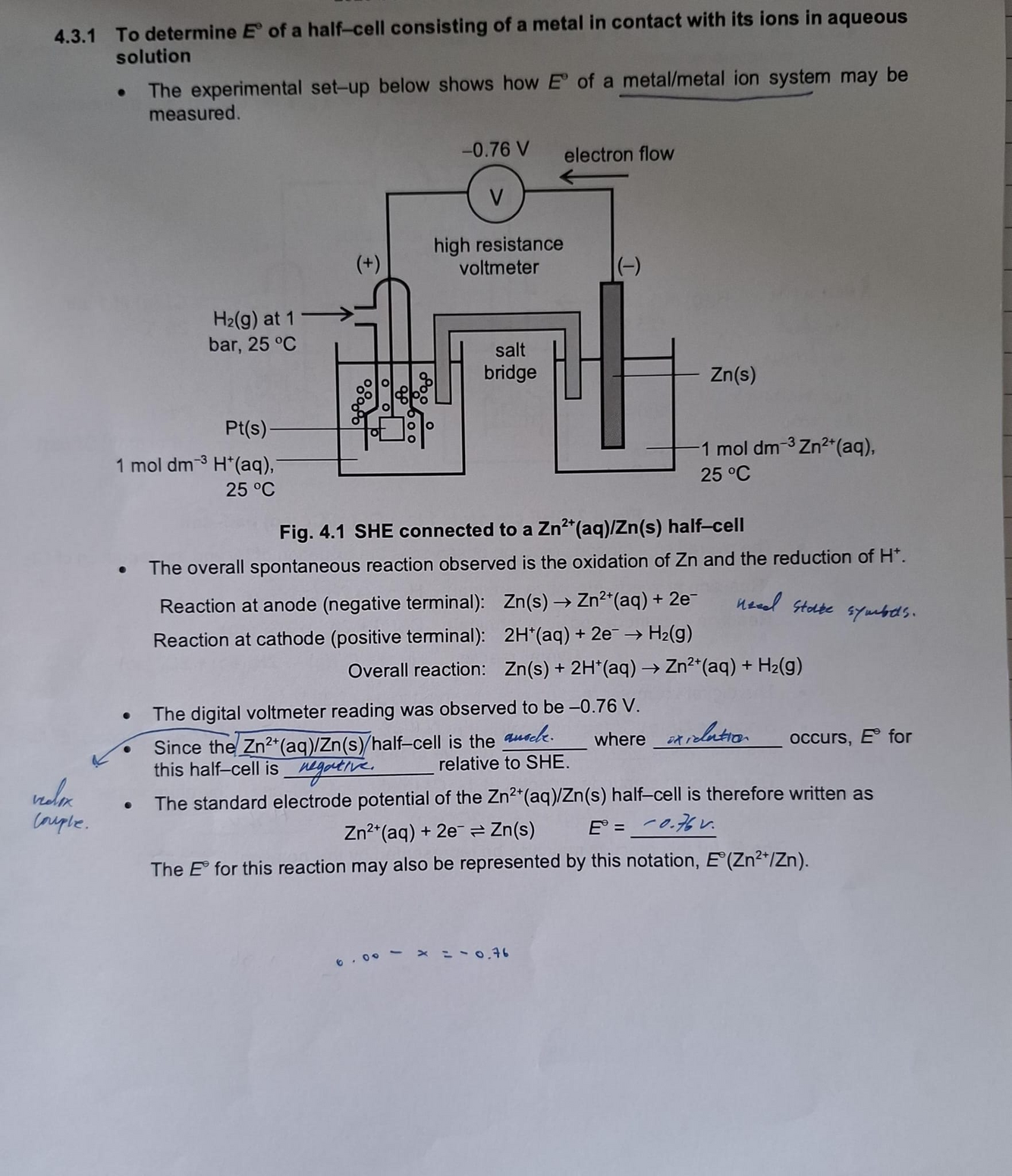
how to determine the Enode of a half-cell consisting of a metal in contact with its ions in aqueous solution?
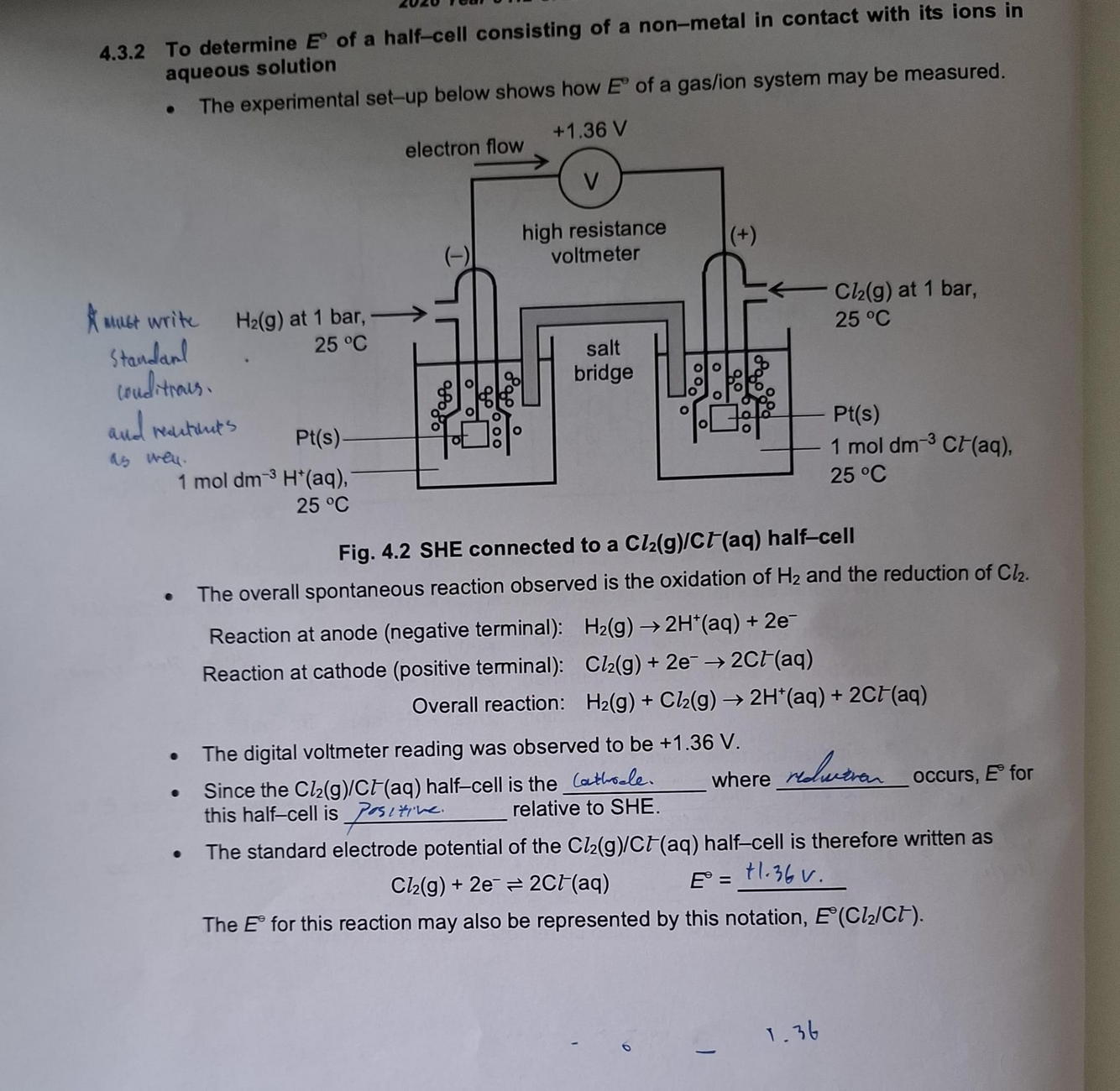
how to detemrine Enode of a half-cell of a non-metal in contact with its ions in aqueous solution.
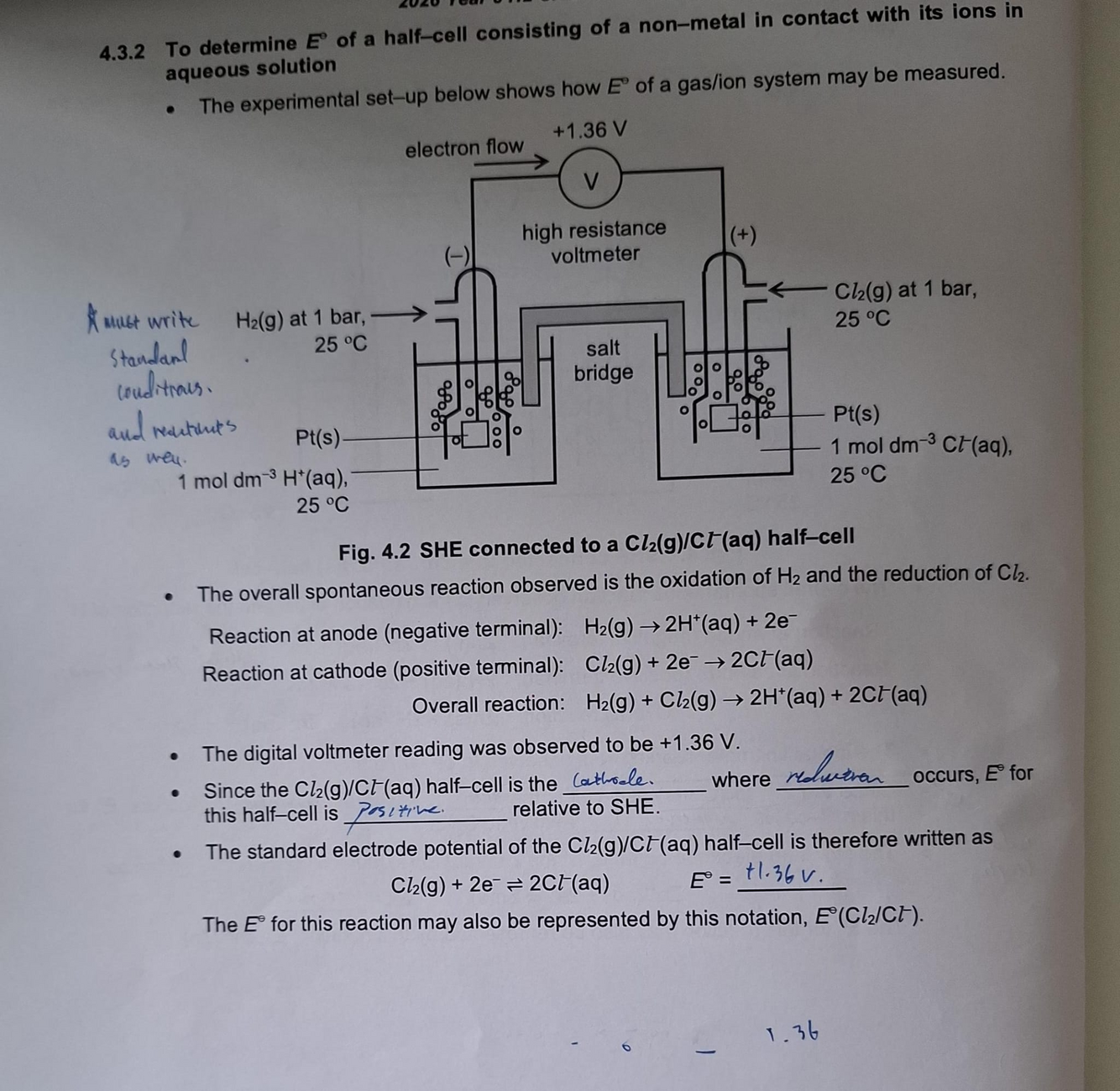
How to determine Enode of a half-cell consisting of a non-metal in contact with its ions in aqueous solution.
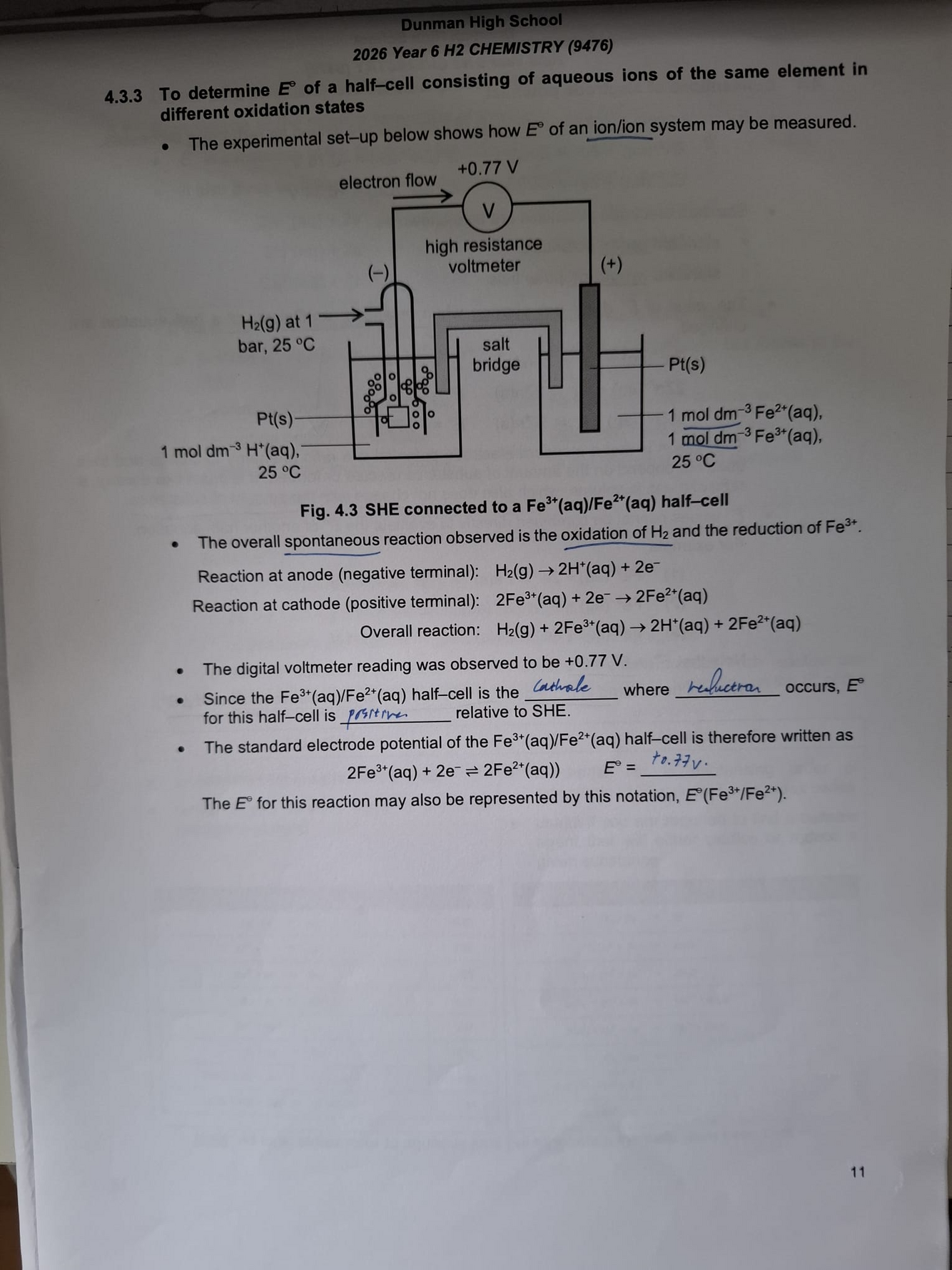
how to determine Enode of a half-cell consisting of aqueous ions of the same element in different oxidation states.
how are electrode potentials of half-cells written?
they are written as reduction processes. E(Zn2+ / Zn) =-0.76 V
does the value of Enode change when balancing coefficients of a half-equations are changed? why?
no this is because a standard electrode potential is a ratio of energy to charge and thus does not depend on the amount of substance reacted or formed. it is much like density, a ratio of mass to volume, which also does not change with the amount of substance.
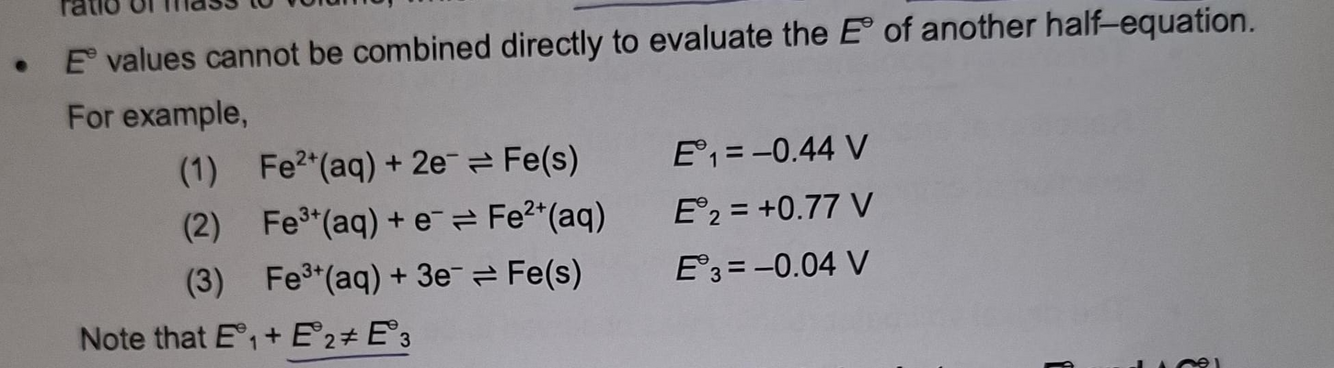
Can Enode values be combined directly to evaluate the Enode of another half-equation?
no.
what does Enode measure?
it is the tendency for reduction to occur it also indicates the position of equilibrium. all half-equations are shown with an equilibrium because each reaction can occur either as a reduction process or an oxidation process depending on the Enode of the process occurring in the other half-cell.
what does a more positive Enode value imply?
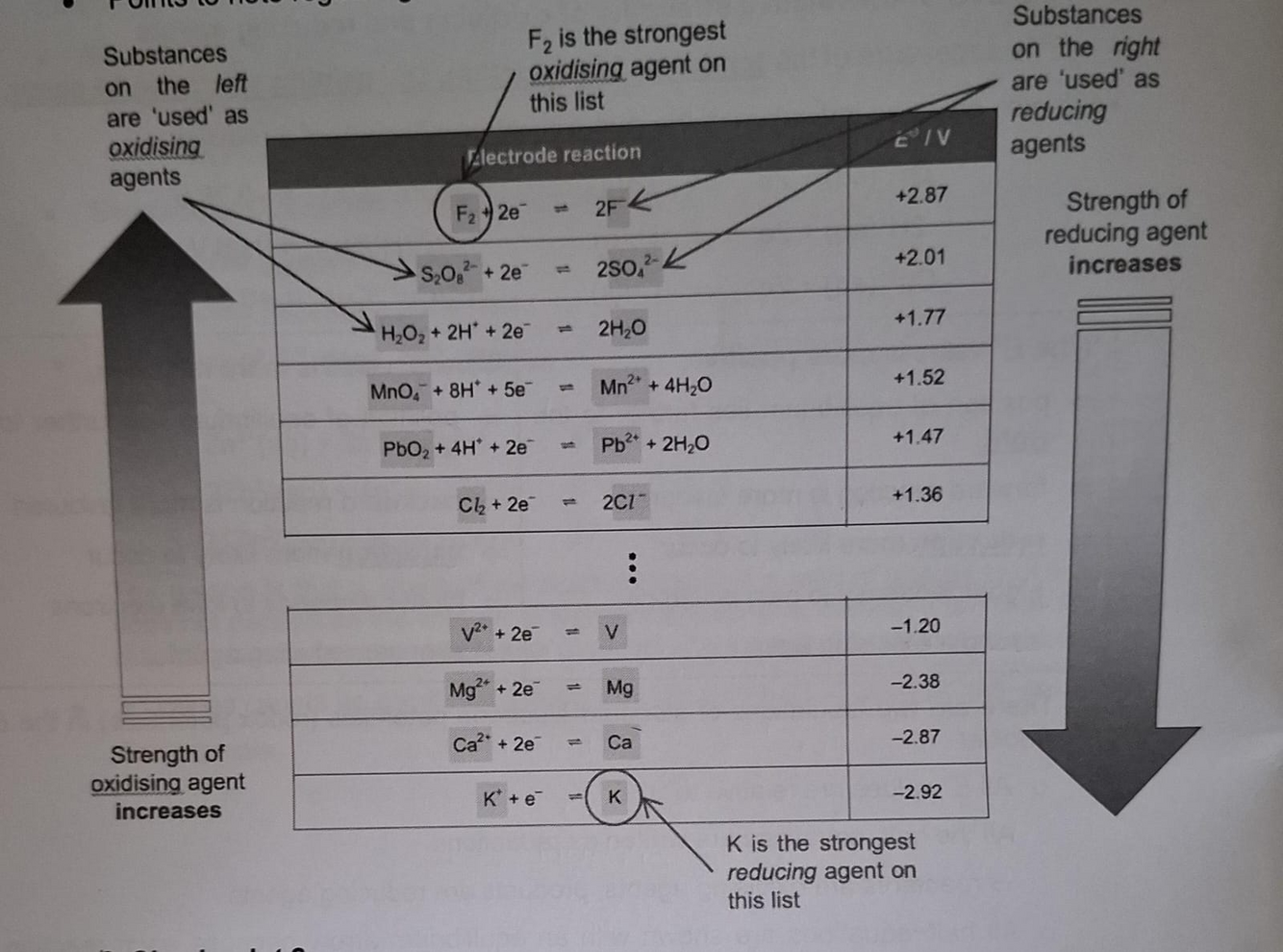
position of rquilibrium lie further to the right forward reaction is more favoured reduction more likely to occur higher tendency to gain electrons stronger oxidising agent
key things to take note of for electorde potentials in data booklet.
what does a more negative Enode value imply?
poe lie further to the left backward reaction is more favoured oxidation more likely to occur higher tendency to lose electrons stronger reducing agent.
how to find standard cell potential
it is the difference between the standard electrode potential of the reduction half-cell and the standard electrode potential of the oxidation half-cell Eqn: - Enode cell = Enode cathode - Enode anode