3.1.2 Amount of Substance
No description yet. This curated deck is ready for daily study.
Card preview (24)
How many particles does 1 mole contain (i.e. what’s Avogadro’s constant)?
6.02 x 10²³ particles
What is the formula for converting between no. of particles and no. of moles?

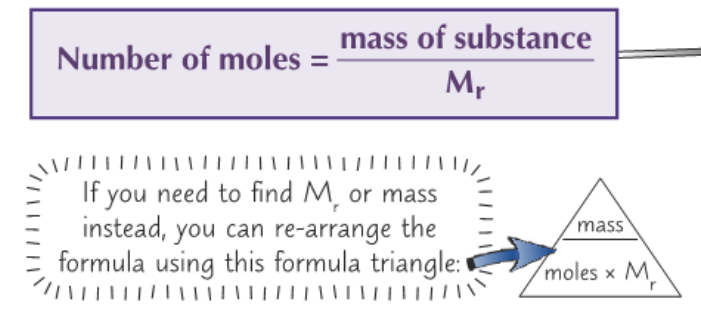
What formula do you use to calculate the no. of moles from mass?
What formula do you use to calculate the no. of moles from concentration?

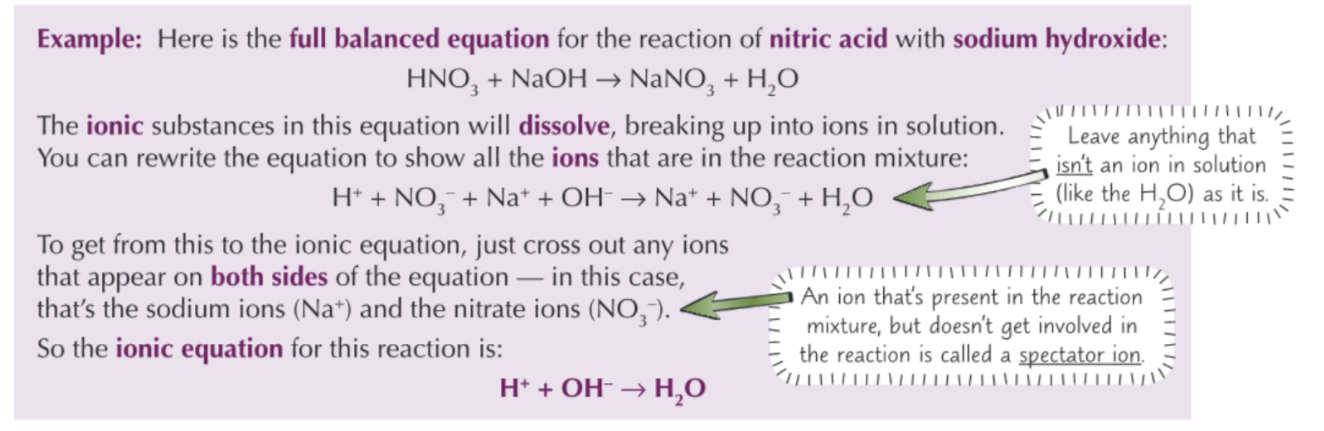
Write the ionic equation for this reaction: HNO3 + NaOH → NaNO3 + H2O
What does ‘aq’ mean?
Aqueous (solution in water)

When you’ve written an ionic equation, what should you do?
Check the charges & atoms are balanced
What is the formula for percentage yield?
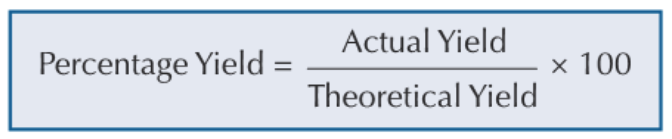
What does percentage yield tell you?
Tells you how wasteful process is = based on how much product is lost (Doesn’t measure how wasteful reaction itself)
What is atom economy?
Measure of proportion of reactant atoms that become part of desired product (rather than by-products)
What is the formula for atom economy?

Why do companies in the chemical industry try to use processes with high atom economies?
• Better for environment • ∵ produce less waste • More efficient use of raw materials • More sustainable (use natural resources more slowly) • Less expensive • Spend less on separating desired product from waste products & less on treating waste
What is empirical formula?
Simplest whole number ratio of atoms of each element in a compound
What is molecular formula?
Actual no. of atoms of each element in a compound
What is a standard (volumetic) solution?
Solution that you know the exact concentration of
What does the making of standard solution involve?
Involves dissolving a known amount of solid in known amount of water to create known concentration
Describe how you would make 250 cm3 of a 2.00 mol dm-3 solution of sodium hydroxide (8 steps)
• Work no. moles of sodium hydroxide needed (0.5 moles) • Work out no. of grams of sodium hydroxide (20.0 g) • Place weighing boat on digital balance & weigh out mass of solid • Tip it into beaker • Re-weight boat • Subtract mass of boat from mass of boat and solid together = find precise mass of solid used • Add distilled water to beaker (e.g. 100 dm3) & stir until sodium hydroxide dissolved • Pour solution into large enough volumetric flask, using funnel • Rinse beaker & stirring rod with distilled water & add that to flask • Top flask up to correct volume with distilled water - make sure bottom of meniscus reaches the line • Stopper the flask & turn it upside down a few times = makes sure it’s mixed
Making a standard solution: Why do you re-weigh the boat?
∵ it may contain traces of solid
Making a standard solution: Why do you rinse the beaker & stirring rod with distilled water and add that to the flask?
Makes sure no solute clings to beaker/rod
What do titrations allow you to do?
Allow to find out exactly the volume of acid needed to neutralise a measured quantity of alkali (& vice versa) Use this data to work out concentration of alkali
Describe a method for a titration
• Use pipette to measure set volume of solution that you want to find concentration of • Put into flask • Add drops of indicator • Fill burette with standard solution of acid • Use funnel to pour acid into burette • Do this below eye level • Do rough titration to get idea of end point • Add acid to alkali using burette = give flask regular swirls • Do accurate titration • Take initial reading of acid in burette • Run acid within 2 cm3 of end point • Add acid dropwise until reach end point • Work amount of acid used to neutralise alkali • (Final reading - initial reading = volume of titre) • Repeat titration few times - until have 3 concordant results • Use results to calculate mean volume - leaving anomalous results
What kind of indicators are used in a titration?
Indicators that change colour quickly over very small pH range = used so you know exactly when reaction has ended
Name 2 indicators that could be used in a titration (for for acid/alkali reactions)
• Methyl orange • Phenolphthalein
What colour is methyl orange in acids?
Red