Unit 1-Neutralisation
No description yet. This curated deck is ready for daily study.
Card preview (23)
What is a neutralisation reaction?
A reaction where an acid and a base form a salt and water
What happens to pH during neutralisation?
It moves towards pH 7
Acid + metal oxide → ?
Salt + water
Acid + metal hydroxide → ?
Salt + water
Acid + metal carbonate → ?
Salt + water + carbon dioxide
How do you name the salt formed?
Metal from base + ending from acid (chloride, sulfate, nitrate)
What salt does hydrochloric acid form?
Chlorides
What salt does sulfuric acid form?
Sulfates
What salt does nitric acid form?
Nitrates
What are spectator ions?
Ions unchanged during the reaction
Ionic equation for metal hydroxide neutralisation
H+(aq) + OH-(aq) → H2O(l)
Ionic equation for metal oxide neutralisation
2H+(aq) + O2-(aq) → H2O(l)
Ionic equation for metal carbonate neutralisation
2H+(aq) + CO32+(aq) → H2O(l) + CO2(g)
What is the purpose of a titration?
To find an unknown concentration using neutralisation
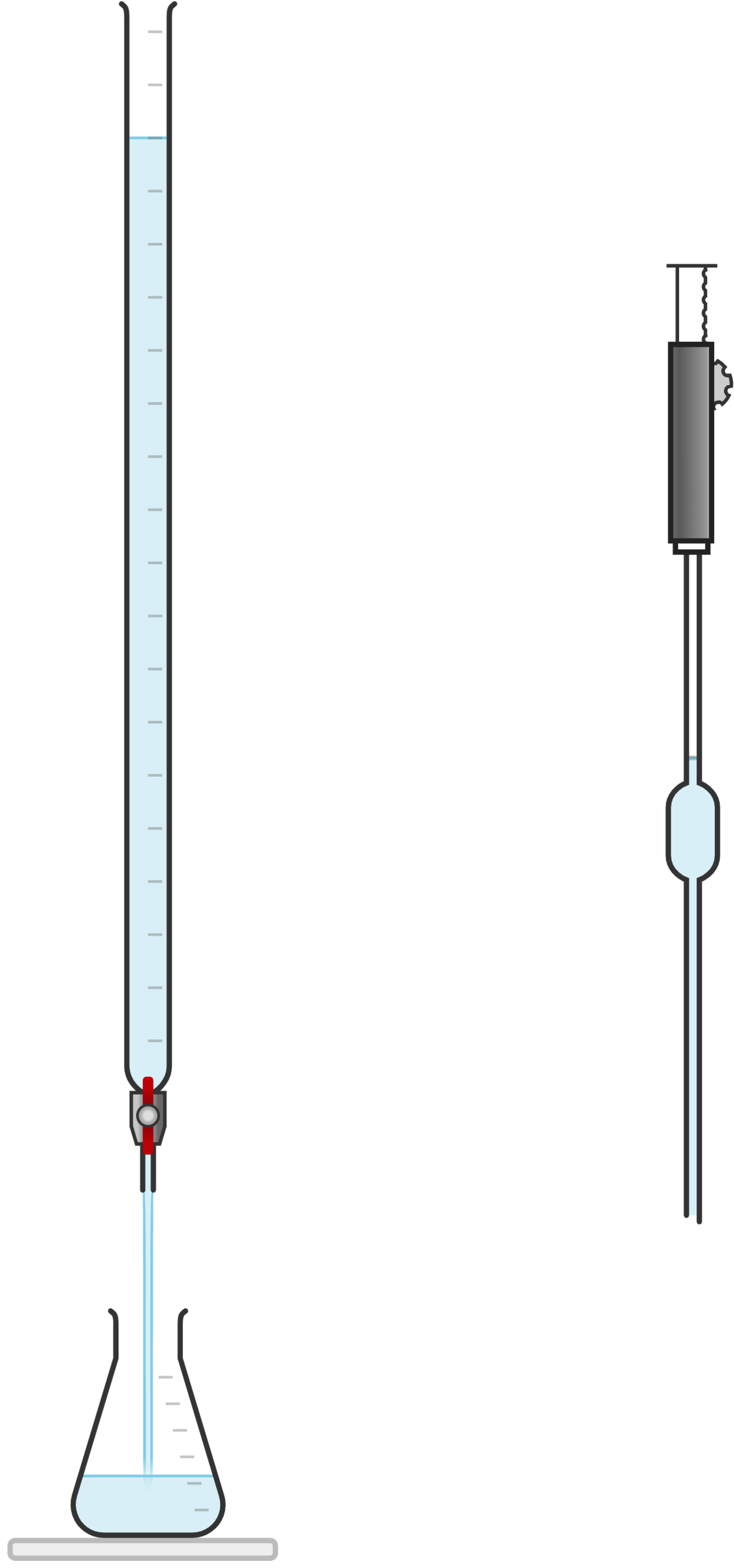
What apparatus is used in a titration?
Burette, pipette, pipette filler, conical flask
Which titres are used for the average?
Concordant titres (within 0.2 cm3)
What is the key relationship in titration calculations?
n = c × V
What must you always use before calculating?
A balanced equation
What can titration calculations find?
Unknown concentration or unknown volume
Given 25.0 cm3 of 0.2 mol l-1 NaOH reacts with 20.0 cm3 of HCl, find the concentration of HCl. NaOH + HCl → NaCl + H2O
Number of moles of NaOH = concentration x volume n = 0.2 x 0.025 = 0.005 moles. 1:1 ratio therefore 0.005 moles of HCl needed. concentration = number of moles ÷ volume c = 0.005 ÷ 0.02 = 0.25 mol l-1
13.3 cm3 of 0.5 mol l-1 H2SO4 reacted fully with 0.89 mol l-1 NaOH, find the volume of NaOH needed. 2NaOH + H2SO4 → Na2SO4 + H2O
Number of moles of H2SO4 = concentration x volume n = 0.5 x 0.0133 = 0.00665 moles. 1: 2 ratio therefore 0.0133 moles of NaOH needed. volume = number of moles ÷ concentration V = 0.0133÷ 0.89 = 0.015 l or 15 cm3
How do you prepare a soluble salt using titration?
Repeat the titration without indicator, then evaporate to dryness
How do you prepare a soluble salt using an insoluble base?
Add excess base → filter → evaporate filtrate to dryness