4.2 Joint Movement, and muscle contractions
No description yet. This curated deck is ready for daily study.
Card preview (20)
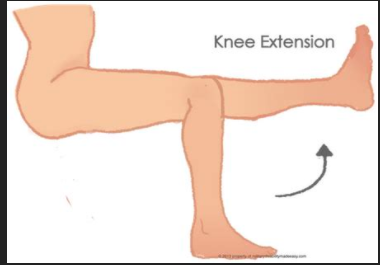
Extension of a joint is best described as…
Increasing the angle between the two bones involved in that particular movement. (hinge joints always move with flexion an extension) For example knee, flexion, and extension. Knee extension increases the angle between the tibia and femur. (see image attached)
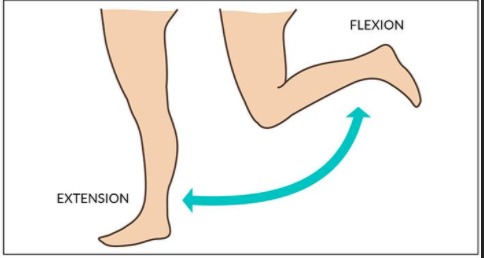
Flexion of a joint is best described as…
Decreasing the angle between the two bones involved in that particular movement. (hinge joints always move with flexion an extension) For example knee, flexion, and extension. Knee flexion decreases the angle between the tibia and femur. (see image attached)
Explain the concept of reciprocal inhibition.
Muscles pull on joints in pairs, these pairs are called antagonistic pairs. Antagonistic pairs, work with the concept of reciprocal inhibition. The Agonist contracts while the antagonist relaxes. When the agonist motor neuron is stimulated, the motor neuron to the antagonist is inhibited, preventing it from contracting strongly”
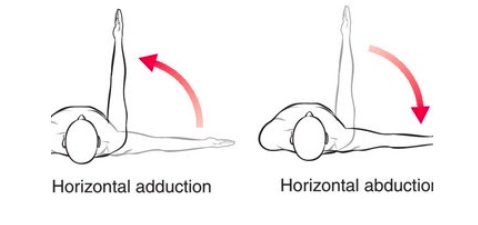
Explain the movements Abduction and Adduction and give an example.
Abduction The movement of a limb (arm or leg) away from the midline of the body. Adduction The movement of a limb (arm or leg) towards the midline of the body. Example in pictures attached (note horizontal ab/adduction is also possible.
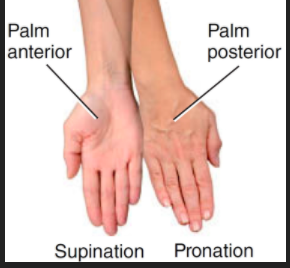
What is pronation and supination and give an example?
The ‘twist’ movement in an limb. E.g. twisting the hand from palm up to palm down position.
What is a Synergist muscle?
Assists Prime mover When performing an exercise, other muscles may join in and assist the prime mover. These muscles are called synergists
What is a fixator muscle?
Stabilizes the joint which is moving. Muscles can also contract isometrically to stabilize the origin to maintain a correct or stable position. When a muscle performs this function it is called a fixator
Which antagonistic pair is involved in Elbow flexion, and extension.
Flexion AGONIST (prime mover) = Biceps Brachii ANTAGONIST (relaxed) = Triceps Brachii Extension AGONIST (prime mover) = Triceps Brachii ANTAGONIST (relaxed) = Biceps Brachii
Which antagonistic pair is involved in Shoulder flexion, and extension.
Flexion AGONIST (prime mover) = Anterior Deltoid & Pectoralis Major ANTAGONIST (relaxed) = Posterior Deltoid & Latissimus Dorsi Extension AGONIST (prime mover) = Posterior Deltoid & Latissimus Dorsi ANTAGONIST (relaxed) = Anterior Deltoid & Pectoralis Major
Circumduction is possible at which type of synovial joint?
Ball and socket joints. Hip joint Shoulder joint.
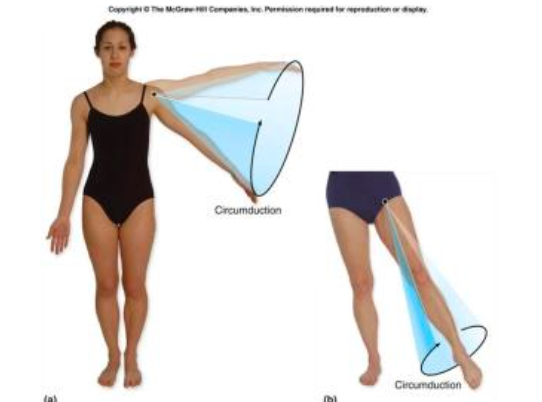
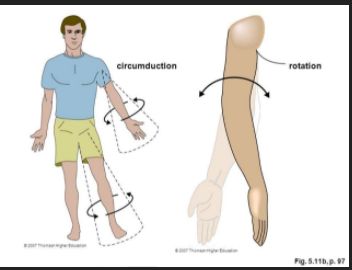
How does rotation of a joint differ from circumduction?
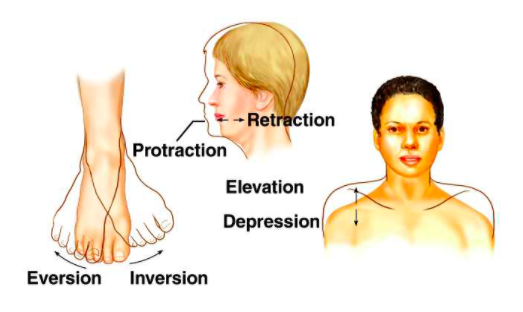
The difference between? Protraction - Retraction Inversion - Eversion Suppression - Depression.
What are the 5 different muscle contractions?
Isotonic Isometric Isokinetic Concentric and Ecentric
Outline Isometric muscle contraction
Contraction with no change in muscle length (tension but no movement) (Ex. Arm wrestle)
Outline Isotonic muscle contraction
Tension with movement, Muscles moving Two kinds of Isotonic contraction (Concentric and Eccentric)
Outline Isokentic Muscle contraction
A muscle contracts at a constant speed (tension with movement at a constant speed, normally in a laboratory with special equipment)
Outline Concentric muscle contraction
Shortening of the muscle fibers (contracting bicep Brachii)
Outline eccentric muscle contractions
When the muscle is lengthening (Arm going down out of curl)
What is DOMS
DOMS is Delayed Onset Muscle Soreness
DOMS in relation to Concentric and eccentric muscle contractions
DOMS typically comes from eccentric muscle contractions and it causes the muscle to have small tears. The small tears give the soreness Running down a steep hill your quadriceps is eccentrically contracting causing DOMS