Osmoregulation
No description yet. This curated deck is ready for daily study.
Card preview (12)
Osmoregulation
Fluid gain must = fluid loss Most fluid gain is in the form of liquid or food consumed; some is produced as a by-product of chemical processes (metabolic water). Fluid is lost via the kidneys, through skin, from surface of lungs as water vapour and from alimentary canal.
Define excretion
Removal of metabolic wastes from body.
List the organs of excretion
• Lungs • Sweat glands • Alimentary canal • Kidneys
Regulation of osmosis in blood
• As water is lost from blood, plasma becomes more concentrated - lower water content, higher osmotic pressure. • High osmotic pressure in blood, detected by osmoreceptors in hypothalamus. • Water moves from intercellular fluid to plasma by osmosis. • Low concentration of water in intercellular fluid causes water to leave cells causing them to shrivel and shrink. • Water loss from lungs and alimentary canal cannot be regulated. • Water loss from skin (sweat) is directly related to temperature regulation. • Only water loss from kidneys can be regulated to achieve constant concentration of dissolved substances in fluids.
Regulation of osmosis in kidneys
Volume and composition of urine produced by kidneys depends on how much water is in body. Hydrated = large volume of dilute urine. Dehydrated = small volume of concentrated urine.
Nephron
Glomerulus filtration: blood enters glomerulus under high pressure, small molecules are filtered into capsule. Selective reabsorption: filtrate passes through tubules, water and nutrience are reabsorbed back into tubule. Tubular secretion: Unwanted substances and added to filtrate from blood. ADH reabsorbs water: Osmosis – Proximal convoluted tubule and Loop of Henle. Active Transport (Active Reabsorption) – Distal convoluted tubule and Collecting tubule.
Antidiuretic hormone
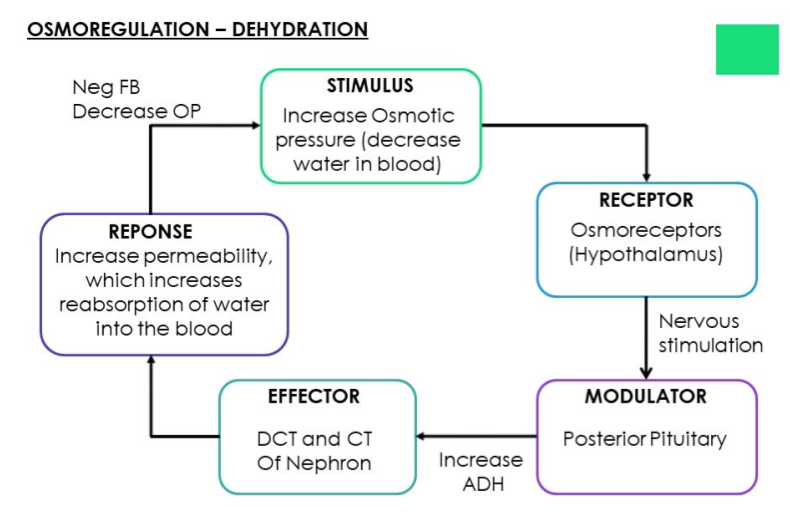
Control’s permeability of walls in DCT and CD. High ADH concentration = more permeable to water. Low osmotic pressure (high water concentration) in nephron -> water reabsorbed into bloodstream. Water leaving tubules decreases volume of filtrate and increases concentration of contents. If dehydrated (low water in blood) = osmotic pressure of blood is raised.
Aldosterone
Secreted by adrenal cortex, regulates water content. Water and sodium (salt) reabsorbed. More sodium reabsorbed into blood; more potassium excreted into urine. Increased water absorption -> increases blood volume (increases blood pressure).
Dehydration feedback loop
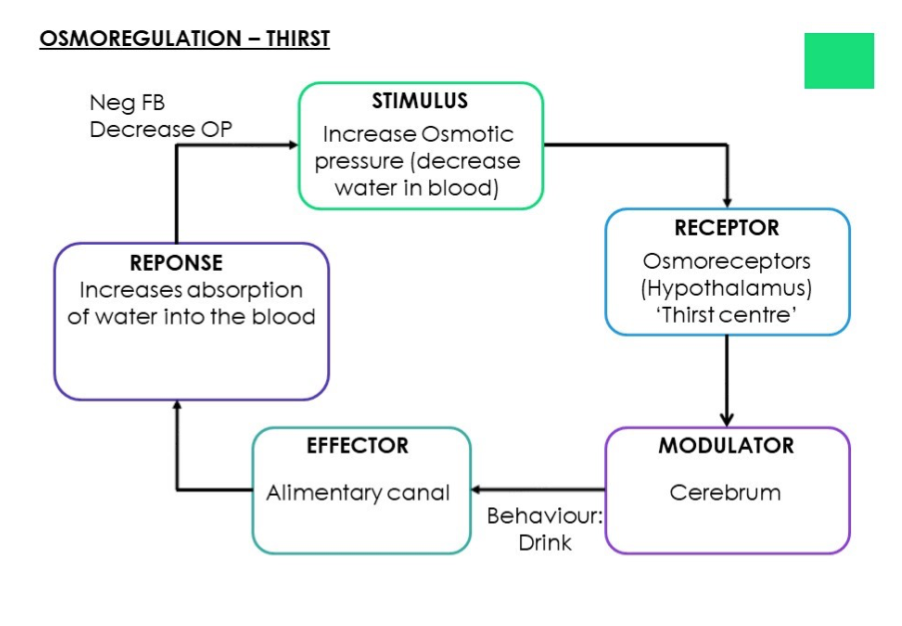
Thirst feedback loop
Dehydration
Water loss greater than water intake. Occurs when 2% normal body water is lost. Severe thirst, Low blood pressure, Dizziness, Headache. Could lead to loss of consciousness and death. Caused by sweating, vomiting or diarrhoea.
Water intoxication
Water intake greater than water loss. Body fluids become diluted, cells take in extra water by osmosis. Occurs when water and salts are lost by sweating, loss is replaced with only plain water. Light headedness, Headache, Vomiting.