Synthesis of saturated rings via cyclisation
No description yet. This curated deck is ready for daily study.
Card preview (16)
What is an irreversible cyclisation?
Formation for a ring from a linear system which then cannot return to its linear state it is a general route to small and normal rings (3-7 MRs)
What is then general mechanism of an irreversible cyclisation (in this case the EWG is a carbonyl)

• React with a base to deprotonate forming enolate • Then intramolecular sₙ² reaction • n = 1-5

Where does the base deprotonate during an irreversible cyclisation
On the carbon adjacent to the EWG OR sometimes on the EWG, e.g. OH
How can you undertake an irreversible cyclisation with a heteroatom as the Nucleophile e.g. OH
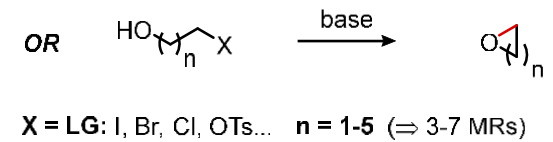
• Use a base to deprotonate • Intramolecular sₙ² • (in theory for amines a base isn’t needed)

How can you undertaken an irreversible cyclisation where the electron withdrawing group is SO₂Ph
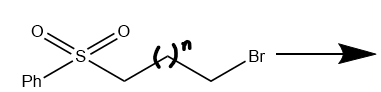
• nBuLi is used to deprotonate • The sulfur anion formed as an intermediate is very electron poor • Anion is used to attack δ⁺ carbon, breaking the C-Br bond

What makes an irreversible cyclisation, irreversible?
• Due to the formation of the ring • Reforming the C-Br is unfavourable
protons α to carbonyls are….
….acidic
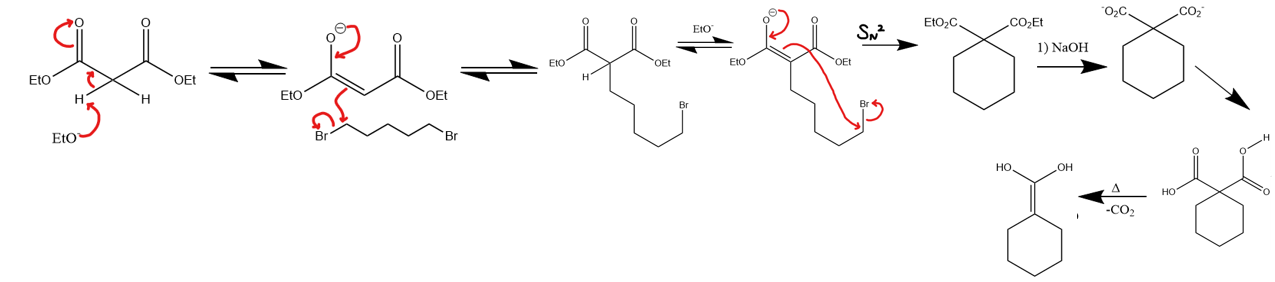
The following reaction is an irreversible cyclisation producing a carboxylic acid What is the mechanism for this?
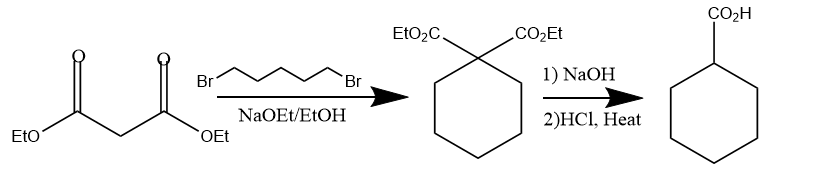
• EtO⁻ will deprotonate in the α-position • Formation of new C-C bond through breaking C-Br bond • EtO⁻ will deprotonate again in the α-position • Second new C-C bond is formed through breaking the second C-Br bond • Basic hydrolysis using NaOH • Use HCl to protonate forming dicarboxcylic acid • Use heat to deprotonate • Forms the tautomer
Why does attack on the electrophilic centre which is Sₙ²-like, lead to an inversion
• The Nu attacks the sigma (start) of the carbon • this is due to Nu being anti-periplanar to LG • leads to an inversion of spectrochemistry1
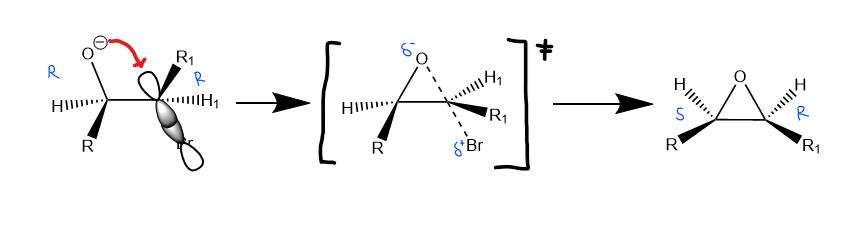
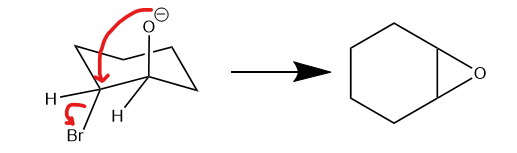
Where within the plane must the following groups lie to the nucleophile to reach to C-Br sigma (star’) orbtial for ring closure (i.e. forming an epoxide)
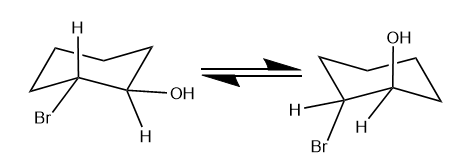
• Both groups must be antiperiplanar • meaning they are both axial • (on the right)
The rate of irreversible cyclisation changes dependent on ring size which ring size is the fastest? Why?
• 5> 6> 3> 7» 4> 8-10 (slowest) • The entropic cost of ring closure increases with ring size because more order must be imposed for the ends of the chain to be arranged correctly • BUT enthalpic cost of ring closure decreases with ring size because normal rings are less strained than small rings
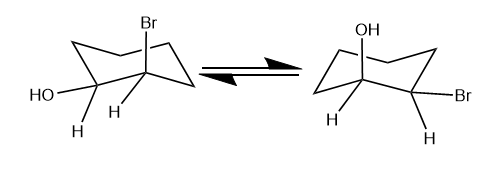
Why can the following compound not undergo reverse cyclisation?
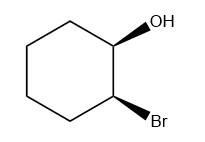
Because the Nu (OH) and the LG (Br) are not antiperiplanar to another
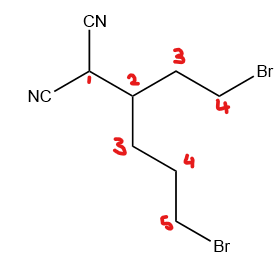
Describe the selectivity for the following compound if it was to undergo an irreversible cyclisation?
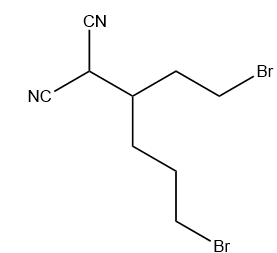
• A 5 membered ring would form over the other possible 4 membered ring because of a decreased enthalpic cost due to less ring strain
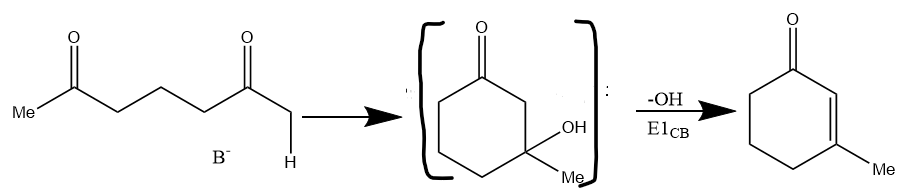
Define a reversible cyclisation
Reversibile cyclisation of molecules that contain both an electrophile and a nucleophile can only be used to form normal rings (5-7 MRs) Have the ability to revert back to a linear system
• The first part of this reaction involves a reversible cyclisation • However, the second part (dehydration) is irreversible • Describe the mechanism

Why are reversible cylicisations only effects for 5-7 MRs
Because if the ring was any smaller, the ring strain will mean the ring will immediatel revert back to the linear form