S4 - Rate of reaction experiments
No description yet. This curated deck is ready for daily study.
Card preview (11)
What does the reaction of hydrochloric acid and marble chips represent?
The effect of breaking the solid up into small bits
Describe an experiment using hydrochloric acid and marble chips
• Measure the volume of gas evolved with a gas syringe and take readings at regular intervals - Make a table and plot the results on a graph - Repeat the experiment with exactly the same volume of acid but with the marble crunched up - Then repeat with the same mass of powdered marble instead of marble chips - Compare results
On the graph for hydrochloric acid and marble chips, what should x and y be?
The independent variable (x) = time The dependent variable (y) = volume
What does the following graph conclude?
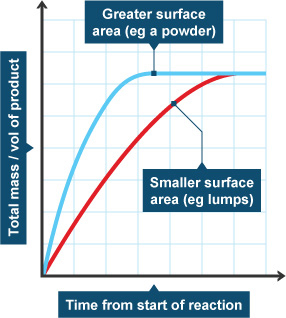
An increase in surface area (small chips) causes more frequent collisions, so the rate of the reaction is faster.
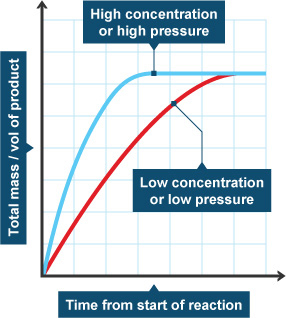
What does the reaction of magnesium metal with dilute HCL represent?
The effect of increases concontration (as is the marbe/acid reaction)
What does the reaction with magnesium metal and dilute HCL give off?
A hydrogen gas which can be measured with a mass balance.
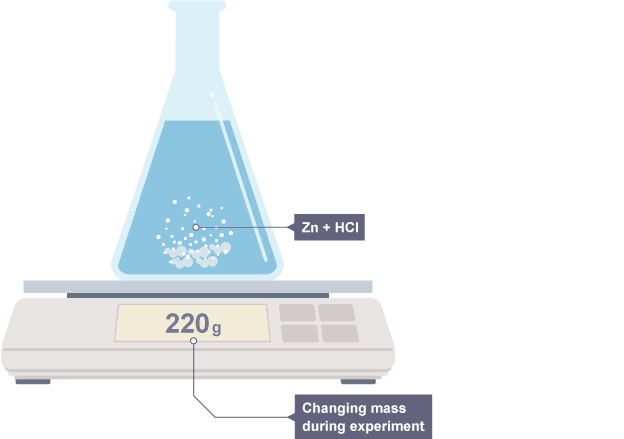
What are the independent and dependent varibles in the magnesium metal with dilute HCL?
• Independant variable = Time • Dependant variable = Mass loss
What else can be used instead of a mass balance?
A gas syringe
What is the method for the magnesium metal and dilute HCL?
• Take readings at regular intervals • Put the results in a table and work out the loss of mass for each reading • Plot a graph • Repeat with more concentrated acid solutions but the same amount of magnesium and volume of acid
What would you expect the rates of reaction graph to look like?