How much
No description yet. This curated deck is ready for daily study.
Card preview (24)
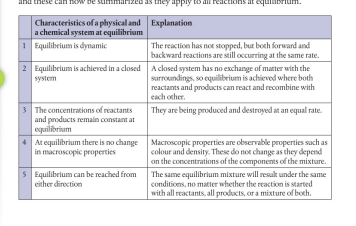
Define dynamic equilibrium and describe the conditions needed for it.
A state of dynamic equilibrium is reached in a closed system when the rates of forward and backward reactions are equal. A closed system has no exchange of matter with the surroundings, so equilibrium is achieved where both reactants and products can react and recombine with each other. - it is reached in both physical and chemical systems
Describe physical equilibrium using bromine.
Bromine is a volatile liquid with a boiling point close to room temperature, so a number of particles have enough energy to escape from the liquid state and form vapour in the process known as evaporation. - container is sealed, the bromine vapour cannot escape and its concentration increases. - Some vapour molecules collide with the surface of the liquid, lose energy and become liquid in the process known as condensation. - The rate of condensation increases as the concentration of vapour increases. Eventually, the rate of condensation becomes equal to the rate of evaporation and there is no net change in the amounts of liquid and gas present. Equilibrium is established when the rate of evaporation equals the rate of condensation. This only occurs in a closed system.
Why must equilibrium occur in a closed system?
A closed system prevents reactants or products from escaping, allowing both forward and backward reactions to continue.
What happens to concentrations at equilibrium?
The concentrations of reactants and products remain constant because they are produced and destroyed at equal rates.
Why do macroscopic properties remain constant at equilibrium?
Observable properties such as colour and density depend on concentration, which does not change at equilibrium as they depend on the concentrations of the components of the mixture
Does equilibrium mean reactant and product concentrations are equal?
No. The concentrations remain constant, but one side may still predominate depending on the equilibrium position.
What is meant by the equilibrium position?
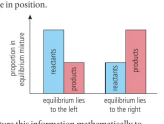
The proportion of reactants and products present in the equilibrium mixture.
What does it mean when equilibrium “lies to the right” or “lies to the left”?
Reactions where the mixture contains predominantly products are said to ‘lie to the right’ and reactions with predominantly reactants are said to ‘lie to the left’.
Can equilibrium be reached starting with either reactants or products?
The same equilibrium mixture will result under the same conditions, no matter whether the reaction is started with all reactants, all products, or a mixture of both.
characteristic of physcial and chemical equilibrium
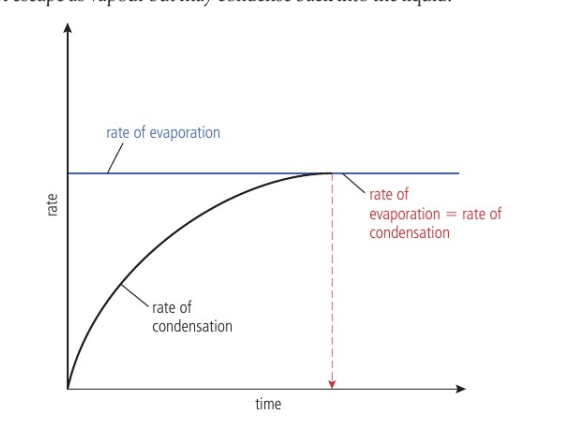
Describe the rate-time graph for bromine equilibrium.
The rate of evaporation remains constant because the liquid surface area stays the same. The rate of condensation starts at zero and increases as vapour concentration increases. Equilibrium is reached when both rates become equal.
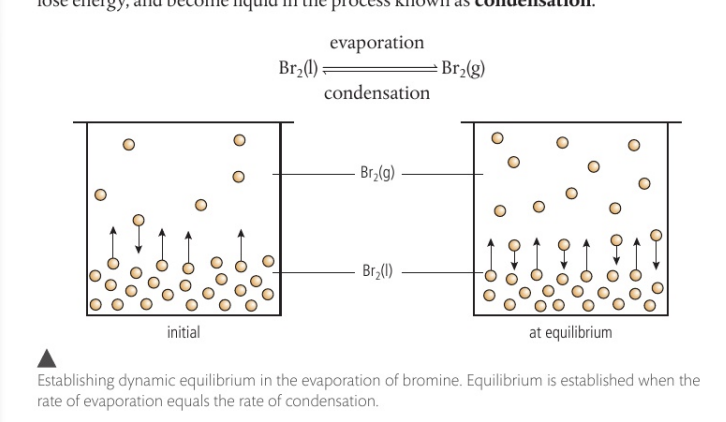
Describe how dynamic equilibrium is established between liquid bromine and bromine vapour.
Bromine molecules initially escape from the liquid by evaporation, increasing vapour concentration. As vapour concentration rises, more gas particles condense back into the liquid. Equilibrium is established when the rate of evaporation equals the rate of condensation. Br2(l)⇌Br2(g) - closed system
Describe how equilibrium is established in the hydrogen iodide reaction.
Initially, HI dissociates rapidly to form H₂ and purple I₂ gas. As HI concentration decreases, the forward reaction rate decreases. Meanwhile, the reverse reaction rate increases as H₂ and I₂ concentrations increase. Equilibrium is reached when both rates become equal and concentrations remain constant.
Describe the concentration-time graphs for the HI equilibrium system.
When starting with HI, the concentration of HI decreases while H₂ and I₂ increase until all concentrations become constant. When starting with H₂ and I₂, HI concentration increases while H₂ and I₂ decrease. In both cases, the same equilibrium mixture is reached.
What is the difference between the forward and backward reactions?
The forward reaction converts reactants into products, while the backward (reverse) reaction converts products back into reactants.
What symbol is used to represent equilibrium reactions?
⇌
Why is there no visible change at equilibrium even though reactions continue?
The forward and backward reactions occur at equal rates, so there is no net change in concentrations or observable properties.
State the five main characteristics of a system at equilibrium.
Equilibrium is dynamic. Equilibrium is achieved in a closed system. Concentrations remain constant. Macroscopic properties remain constant. Equilibrium can be reached from either direction.
What happens to the concentrations of substances at equilibrium if conditions remain unchanged?
If there is no change in conditions, the concentrations of reactants and products remain constant over time.
What is present in the flask when the HI system reaches equilibrium?
HI, H₂, and I₂ are all present in the equilibrium mixture, and their concentrations remain constant over time if conditions do not change.
Describe the concentration-time graph when starting with pure HI.
The concentration of HI starts high and decreases over time, while the concentrations of H₂ and I₂ start at zero and increase. Eventually, all concentrations become constant when equilibrium is reached.
Describe the concentration-time graph when starting with H₂ and I₂.
The concentrations of H₂ and I₂ decrease over time while the concentration of HI increases. Eventually, all concentrations become constant at equilibrium.
What important idea is shown by both HI concentration-time graphs?
The same equilibrium mixture is reached whether the reaction starts with reactants, products, or a mixture of both.
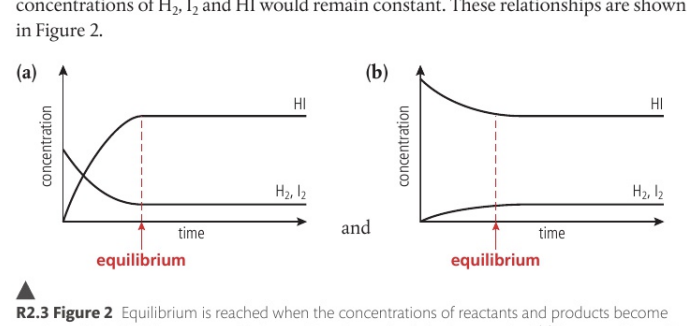
Q: How does a concentration-time graph show that equilibrium has been reached?
The concentrations become constant over time, shown by horizontal lines on the graph.