C2 - Elements, Compunds And Mixtures
No description yet. This curated deck is ready for daily study.
Card preview (24)
Definition of ‘pure’ in everyday life
The word ‘pure’ is often used to mean clean or natural
Definition of ‘pure’ in chemistry
In chemistry, a substance is pure if it’s completely made up of a single element or compound
How to distinguish between pure and impure substances:
Every pure substance has a specific melting point and boiling point. You can test the purity of a sample by comparing the actual melting point or boiling point to the expected value. If a substance is impure, the melting point will be too low and the boiling point will be too high
Definition of relative atomic mass
The relative atomic mass of an element is the average mass of one atom of the element compared to 1/12 of the mass of one atom of Carbon-12
Definition of relative formula mass
The relative formula mass of a compost is all the relative atomic masses in its formula added together
Definition of an empirical formula
An empirical formula of a compound tells you the smallest whole number ratio of atoms in the compound E.g. C2H6 —> CH3
Describe a ‘formulation’
Formulations are useful mixtures with a precise purpose that are made by following a ‘formula’. Each component is presented in a measured quantity, and contributes to the formulation’s properties. E.g. alloy size
Describe the process of filtration
Filtration is used to separate an insoluble solid from a liquid. You put filter paper into a funnel and pour your mixture into it. The liquid part of the mixture runs through, leaving behind a solid residue
Describe the process of crystallisation
Crystallisation separates a soluble solid from a solution Method: 1. Pour the solution into an evaporating dish and gently heat the solution. Some of the solvent will evaporate and the solution will get more concentrated 2. Once some of the solution has evaporated, or when you see crystals form, remove the dish from the heat and leave to cool 3. The salt should start to form crystals as it becomes insoluble in the cold, highly concentrated solution 4. Filter the crystals out of the solution, and leave them in a warm place to dry.
Describe the process of simple distillation
Simple distillation is used for separating out a liquid from a solution: • Pour your sample of seawater into the distillation flask. • Set up the apparatus as shown in the picture. Connect the bottom end of the condenser to a cold tap using rubber tubing. Run cold water through the condenser to keep it cool. • Gradually heat the distillation flask. The part of the solution that has the lowest boiling point will evaporate - in this case, the water • The water vapour passes into the condenser where it cools and condenses. It then flows into the beaker where it is collected • Eventually you will end up with just salt in the flask.
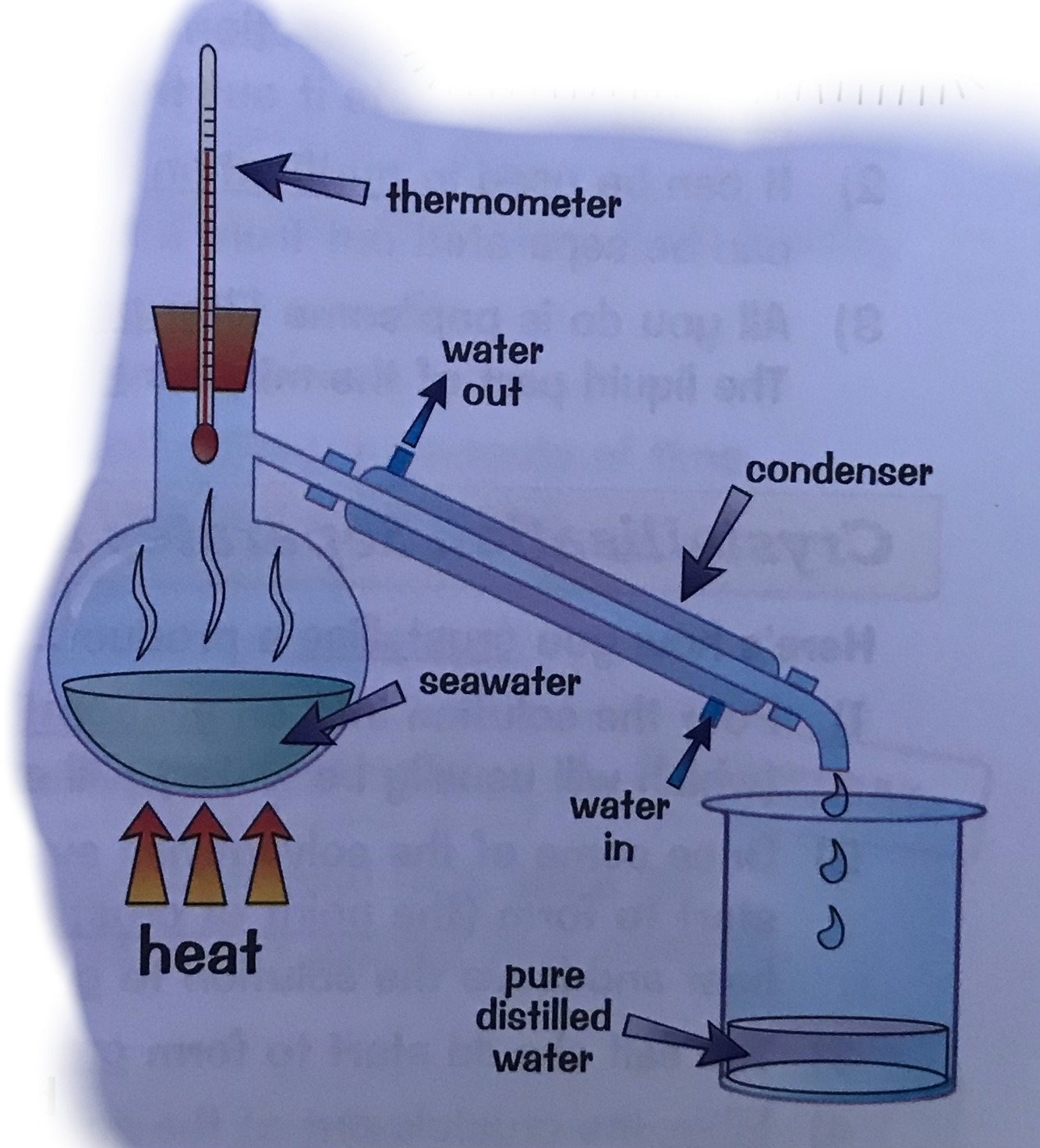
Describe the process of fractional distillation
Fractional distillation is used to separate a mixture of liquids Method for fractional distillation of crude oil: • Put your mixture into the flask. Attach a fractionating column and condenser above the flask as shown in the picture • Gradually heat the flask. The different liquids will all have different boiling points - so they will evaporate at different temperatures • The liquid with the lowest boiling point evaporates first. When the temperature on the thermometer matches the boiling point of this liquid, it will reach the top of the column • Liquids with higher boiling points might also start to evaporate. But the column is cooler towards the top, so they will only get part of the way before condensing and running back down towards the flask. • When the first liquid has been collected, raise the temperature until the next one reaches the top.
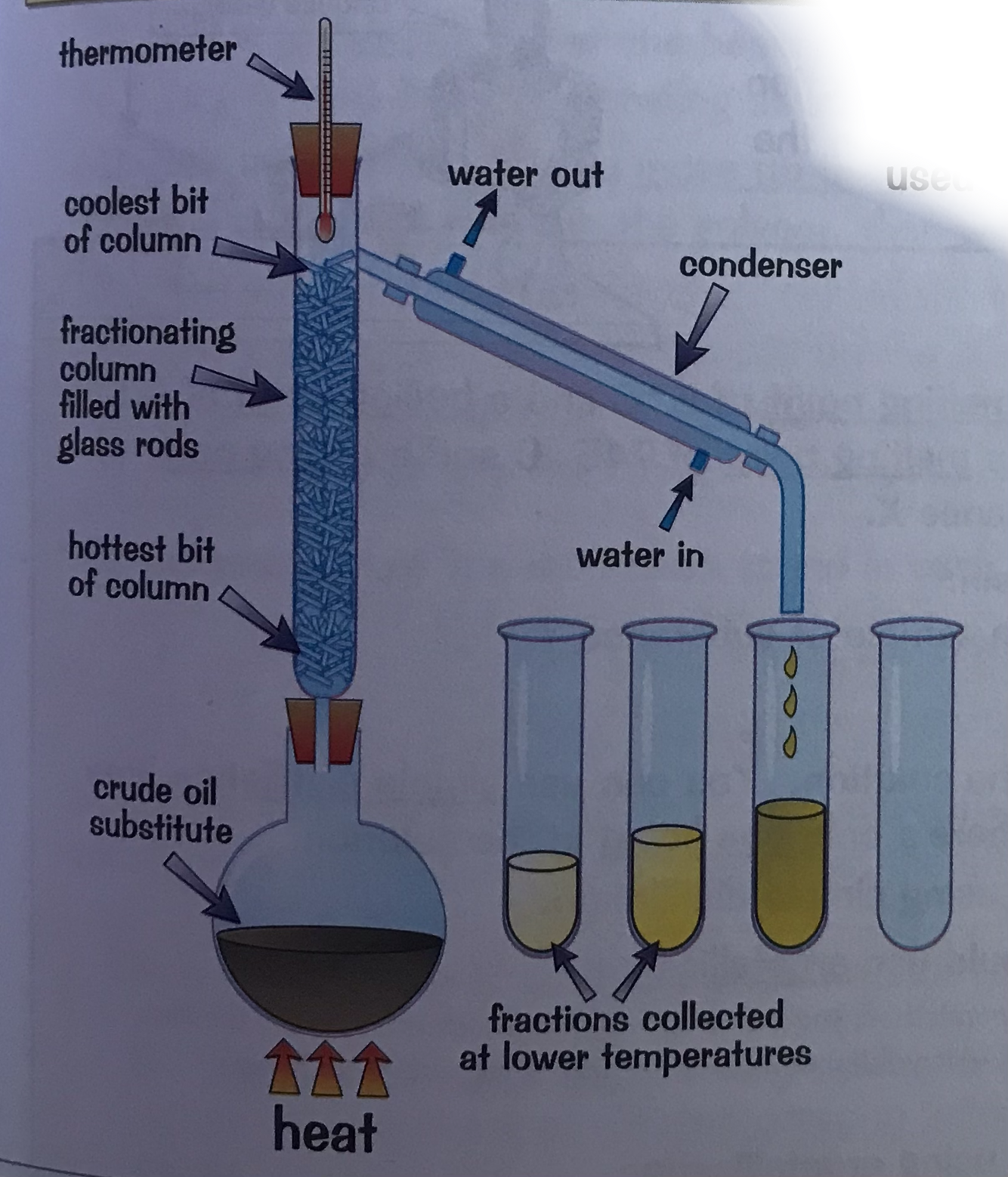
Describe thin-layer chromatography
In TLC, the stationary phase is a thin laye of a solid (e.g. silica gel) on a glass or plastic plate. The mobile phase is a solvent (e.g. ethanol). Method: • Draw a line near the bottom of the plate using a pencil as pencil marks are insoluble. Put a spot of the mixture to be separated on the line. • Put some of the solvent into a beaker. Dip the bottom of the plate (not the spot) into the solvent • Put a watch glass over the speaker to stop any solvent from evaporating away • The solvent will start to move up the plate. When the chemicals in the mixture dissolve in the solvent, they will move up the plate too. • You will see the different chemicals in the sample separate out, forming spots at different places on the plate • Remove the plate from the beaker before the solvent reaches the top. Mark the distance the solvent has moved (the solvent front) in pencil.
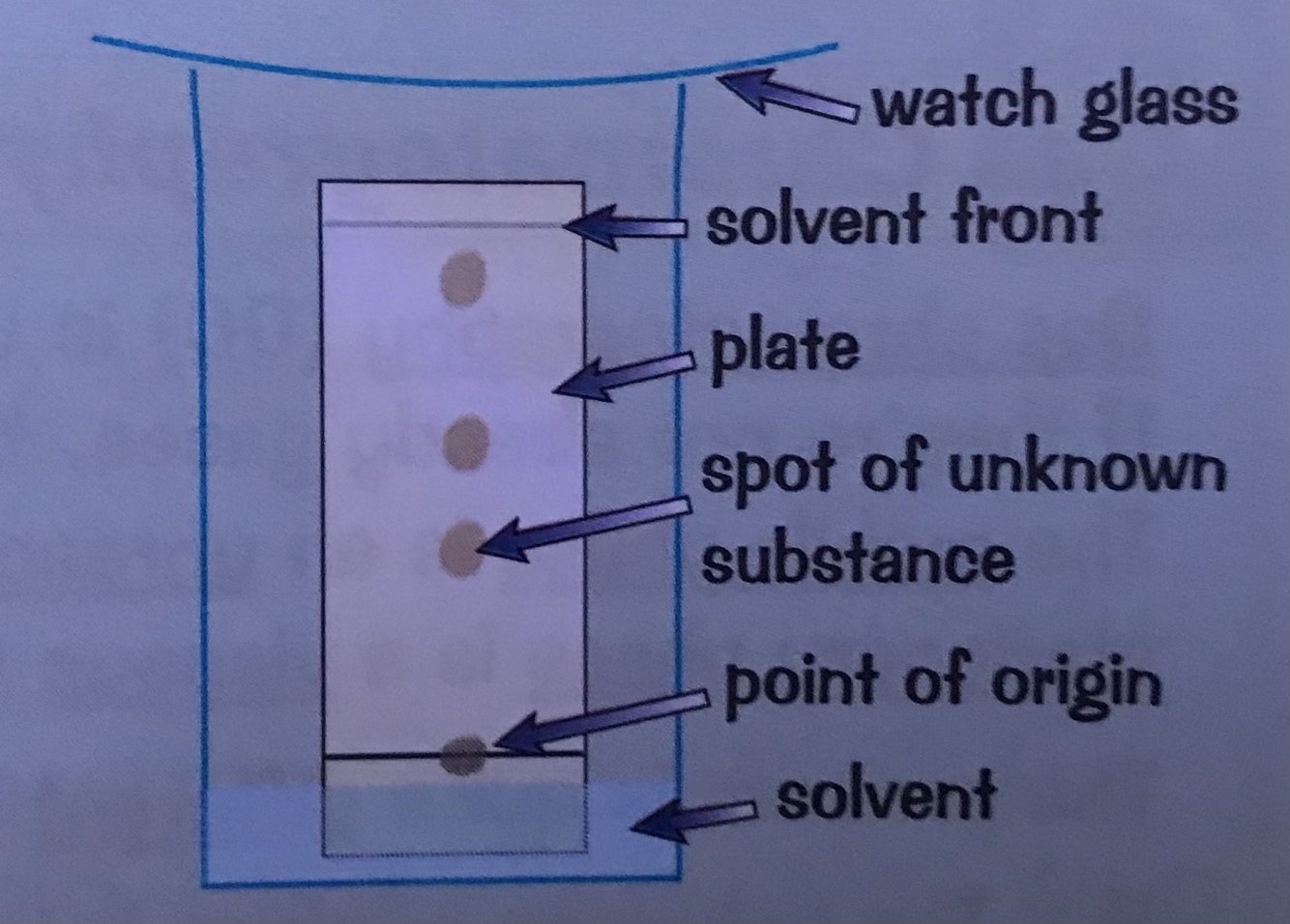
Describe paper chromatography
Paper chromatography is very similar to TLC, but the stationary phase is a sheet of chromatography paper The mobile phase is a solvent such as ethanol (just like in TLC)
What is the mobile phase?
The mobile phase is where the molecules can move. This is always a liquid or a gas
What is the stationary phase?
Where molecules cannot move. This can be a solid or a really thick liquid.
Formula for Rf value
Rf = Distance travelled by solute/Distance travelled by solvent
How to interpret a chromatogram?
The chromatogram from gas chromotography is a graph, each peak on the graph represents a different chemical: The distance along the x axis is the retention time - this can be looked up to find out what the chemical is The relative areas under the peaks show you the relative amounts of each chemical in the sample Theres one peak for each chemical, which means a sample of pure substance will produce a single peak
Describe the properties of metals
High melting points and boiling points High density Strong Malleable Good conductors of heat and electricity
Describe the properties of non-metals
Low melting and boiling points Weak Brittle Lower densities than metals Weak conductors of heat and electricity
Why are metals on the left hand side of the periodic table?
Metals were usually on the left hand side because of the bonding in solid metals - elements on the left of the table normally get a full outer shell by losing electrons so metal atoms find it easy to become positive ions
What does the group number correspond to?
Number of electrons in the outer shell
What does the period number correspond to?
Number of electron shells in the atom
Describe the structure of ionic compounds
Ionic compounds always have a giant ionic lattice structure. The ions form a closely packed regular lattice. There are very strong electrostatic forces of attraction between oppositely charged ions, in all directions
How do simple molecules join together?
Through covalent bonds