Developing Fuels
No description yet. This curated deck is ready for daily study.
Card preview (24)
What is the standard ethalpy change of a reaction? ΔrH
The enthalpy change that occurs between the no. moles of reactant specified by the equation under standard conditions with all substances in their standard states.
What is the standard enthalpy change of combustion? ΔcH
The enthalpy change when 1 mole of substance burns completely in oxygen under standard conditions in standard states
What is the standard enthalpy change of formation? ΔfH
The enthalpy change when 1 mole of a substance is formed from its constituent elements in their standard states unde standard conditions
What is the (standard) enthlpy change of neutralisation?
The enthalpy change when 1 mole of H+ ions react with 1 mole of OH- ions to form 1 mole H2O under standard conditions and in solutions with a concentration of 1moldm-3 Defined per mole of H2O formed Standard ionic equation is always the same
What are standard conditions?
Pressure: 1 atmoshpere (101kPa/1.01Nm-2) Temp: 298K Concs: 1.00moldm-3 State: Whatever state at 298K
Define system
The reactantd + products being measured (inside the reaction vessel)
Deine surroundings
Everything else that’s not the system - outside the reaction vessel
What is thermochemistry?
The study of the energy + heat associated with chemical reactions
What is enthalpy change? ΔH
The energy transfered to/from the surrondings when the reaction is carried out in an open container
Define enxothermic
A reaction that gives out energy from the system to the surroundings and heats them
Define endothermic
A reaction that takes energy into the system from the surroundings, cooling the surroundings
Why type of process is bond breaking? Why?
Endothermic as it requires energy
What type of process is bond forming? Why?
Exothermic as energy is released
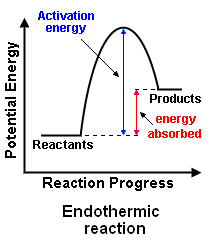
What are the main features of an endothermic reaction? What does an enthalpy profile for one look like?
Bond breaking ΔH positive Takes in energy from surroundings Cools surroundings
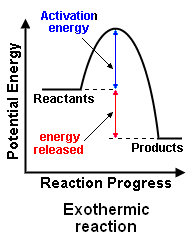
What are the main features of an exothermic reaction? What does an enthalpy profile for one look like?
Bond making ΔH negative Gives out energy to surroundings Heats up surroundings
If the energy released by forming bonds is greater than the energy required to break bonds, what type of reaction occurs?
An exothermic reaction
If the energy released by forming bonds is less than the energy required to break bonds, what type of reaction occurs?
An endothermic reaction
What formula is used to measure enthalpy change?
E = mcΔT E = energy transfered (KJmol-1) m = mass (g) c = specific heat capacity (Jg-1K-1) ΔT = temp. change (K)
What do experiments to measure enthalpy changes ususally involve?
Transfering energy to/from water
0.880g C7H16 undergoes complete combustion. The energy released is used to heat 250cm3 water, the temp of which increases by 19º. Calculate ΔcH in kJmol-1. Give to 2 sig figs.
Use E=mcΔT to calculate energy transfered to water. E = 250 x 4.18 x 19 = 19855J Convert to kJ = 19.855kJ • *Calculate moles** of C7H16 burnt using n= m/Mr 0. 880/100 = 0.0088mol • *Scale energy released** during experiment to that released for 1mol burnt 19. 855/0.0088 = 2256.25kJmol-1 Write down ΔcH with correct sign, sig figs, units etc. ΔcH = -2260kJmol-1
What general formula can be used to calculate ΔH of a reaction?
ΔH = Hproducts - Hreactants
What is the specific heat capacity (c) of water?
4.18Jg-1K-1
What is an alkane?
A saturated hydrocarbon
What are the 4 main features of alkanes?
Have the general formula CnHn+2 Have names ending in -ane Are saturated - all bonds between Cs single Are aliphatic - don’t contain benzene rings