A4 Kinetics I
No description yet. This curated deck is ready for daily study.
Card preview (15)
Describe how decreasing concentration affects rate
• Decreases rate • Less particles per unit volume • Less frequent collisions • Less successful collisions per unit time
Describe how increasing concentration affects rate
• Increases rate • More particles per unit volume • More frequenct collisions • More frequent collisions per unit time
Describe how increasing pressure affects rate
• Increases • Increases the concentration of molecules • More frequent collisions • More successful collisions per unit time
Describe how decreasing pressure affects rate
• Decreases rate • Decreases the concentration of molecules • Less frequent collisions • Less successful collisions per unit time
Describe how increasing temperature affects rate
• Increases rate • Particles have more kinetic energy • More particles have energy greater than the activation energy • More successful collisions per unit time
Describe how decreasing temperature
• Decreases rate • Particles have less kinetic energy • Less particles have energy greater than the activation energy • Less successful collisions per unit time
Describe a method to calculate initial rate
• Plot a XXX against time graph • Draw a tangent at t=0s • Gradient of tangent = XXX/Time • Gradient of tangent = initial rate
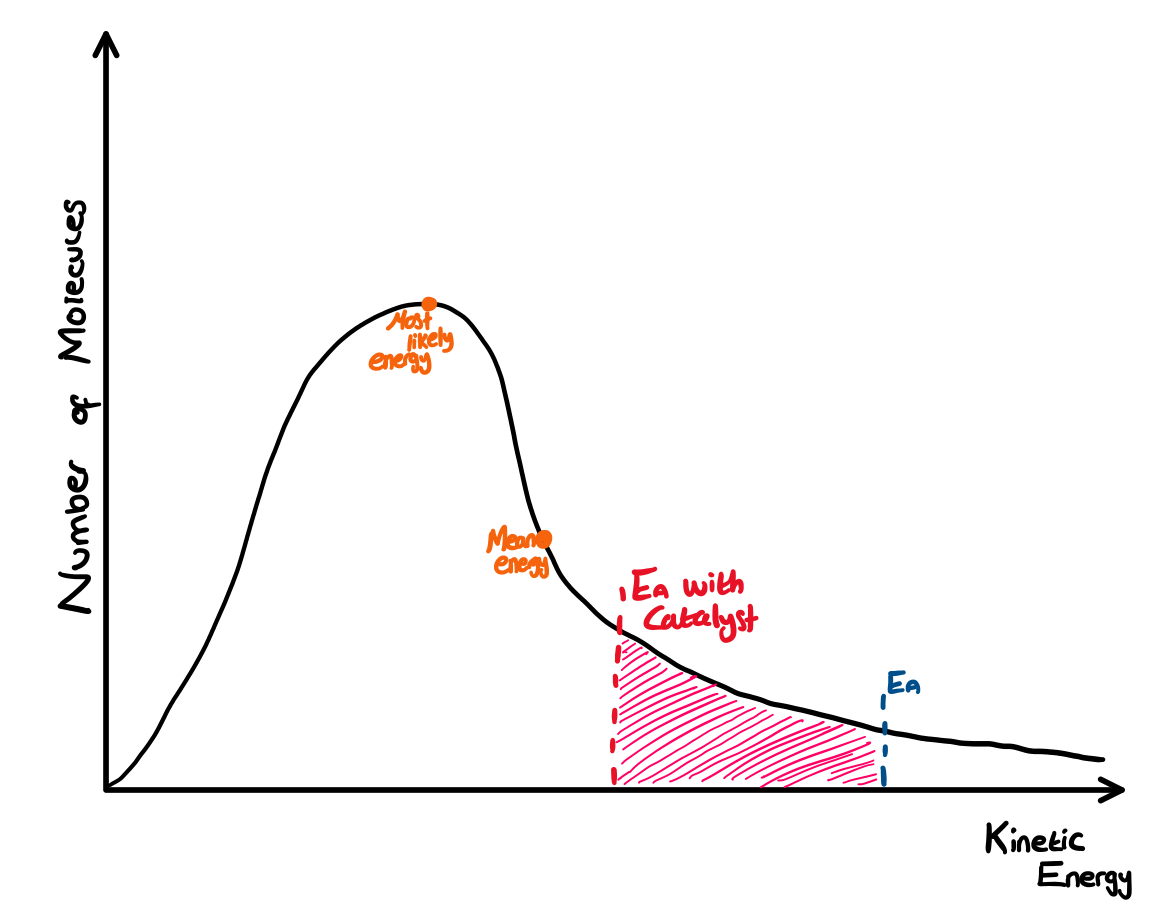
Define a catalyst
• Lowers activation energy of reaction • By providing an alternative route for the reaction • Meaning a greater number of molecules have energy that’s greater than the activation energy
Describe the difference between homogenous and heterogenous catalysts
• Homogenous catalysts are in the same physical state as the reactants • Heterogenous catalysts are in a different physical state to the reactants
When is it difficult to classify if a catalyst is homogenous or heterogenous
When the reactants have different physical states
Describe and explain the importance of catalysts to the enviroment
• Allow reactions to occur at lower temperatures • Reduce energy demand from combustion of fossil fuels • Less CO2 produced
Describe the apparatus and method to investigate rate with volume
• Weigh excess metal using mass balance • Measure volume of acid using measuring cylinder • Mix metal and acid in concial flask • Measure gas volumes from gas syringe at regular intervals • Example: 15s using stopwatch • Continue until no further change in volume
Describe the apparatus and method to investigate rate with mass
• Weigh excess mass of metal using mass balance • Measure volume of acid with measuring cylinder • Mix metal and acid in concial flask • Measure initial mass • Re-weigh at regualr time intervals • Example: 15s using stopwatch • Continue until no further change in mass
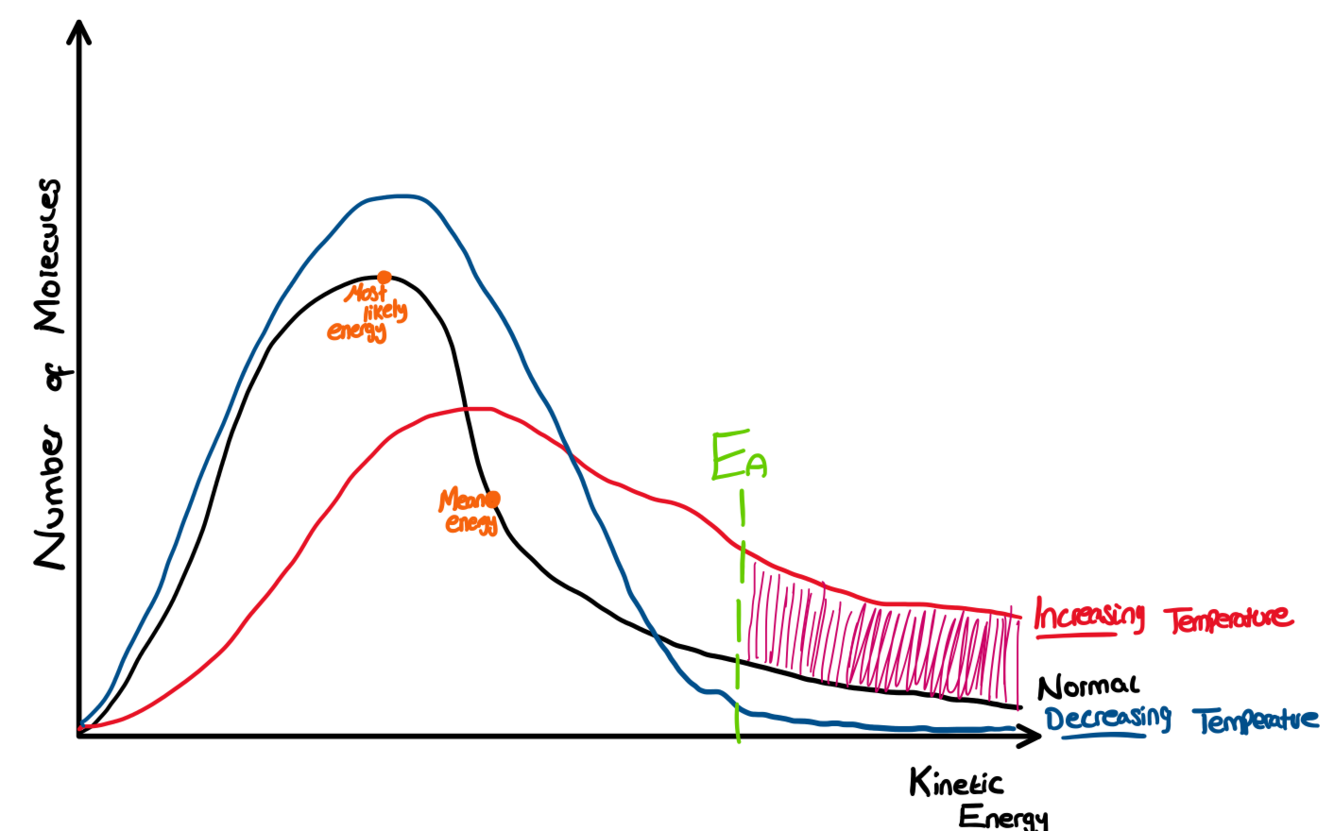
Draw a Maxwell-Boltzmann graph, and show and explain how an increased temperature would affect this
• Increasing temperature means that there is a greater area under the curve above the activation energy • A greater number of molecules have energy greater than the activation energy
Describe and show how a catalyst affects a Maxwell-Boltzmann distribution graph
• Greater area under the curve with energy above the activation energy • A greater number of molecules have energy greater than the activation energy