3.3.10 Aromatic chemistry
暂无描述。系统推荐的高质量记忆内容,适合每天坚持背诵学习。
卡片预览 (7 张)
How did Kekule propose the structure of benzene to be?
cyclohexa-1,3,5-triene six carbon ring of alternating single and double rings
What 3 things prove Kekule’s theory wrong?
• Unlike alkenes, benzene does not undergo electrophilic addition (e.g. it does not decolourise bromine water). • X-ray analysis of solid benzene shows a regular hexagon with all the bonds the same length. This length is intermediate between a typical single and double bond. • DH associated with hydrogenating the three unsaturated C=C bonds would be expected to be 3 x that for hydrogenating the one double bond of cyclohexene (-120 kJ mol-1). However, the experimental value of -208 kJ mol-1 is much smaller than the predicted value of -360 kJ mol-1 .
Is cyclohexa-1,3,5-triene or benzene more stable?
benzene
Why is benzne more stable than cyclohexa-1,3,5-triene? quantitatively
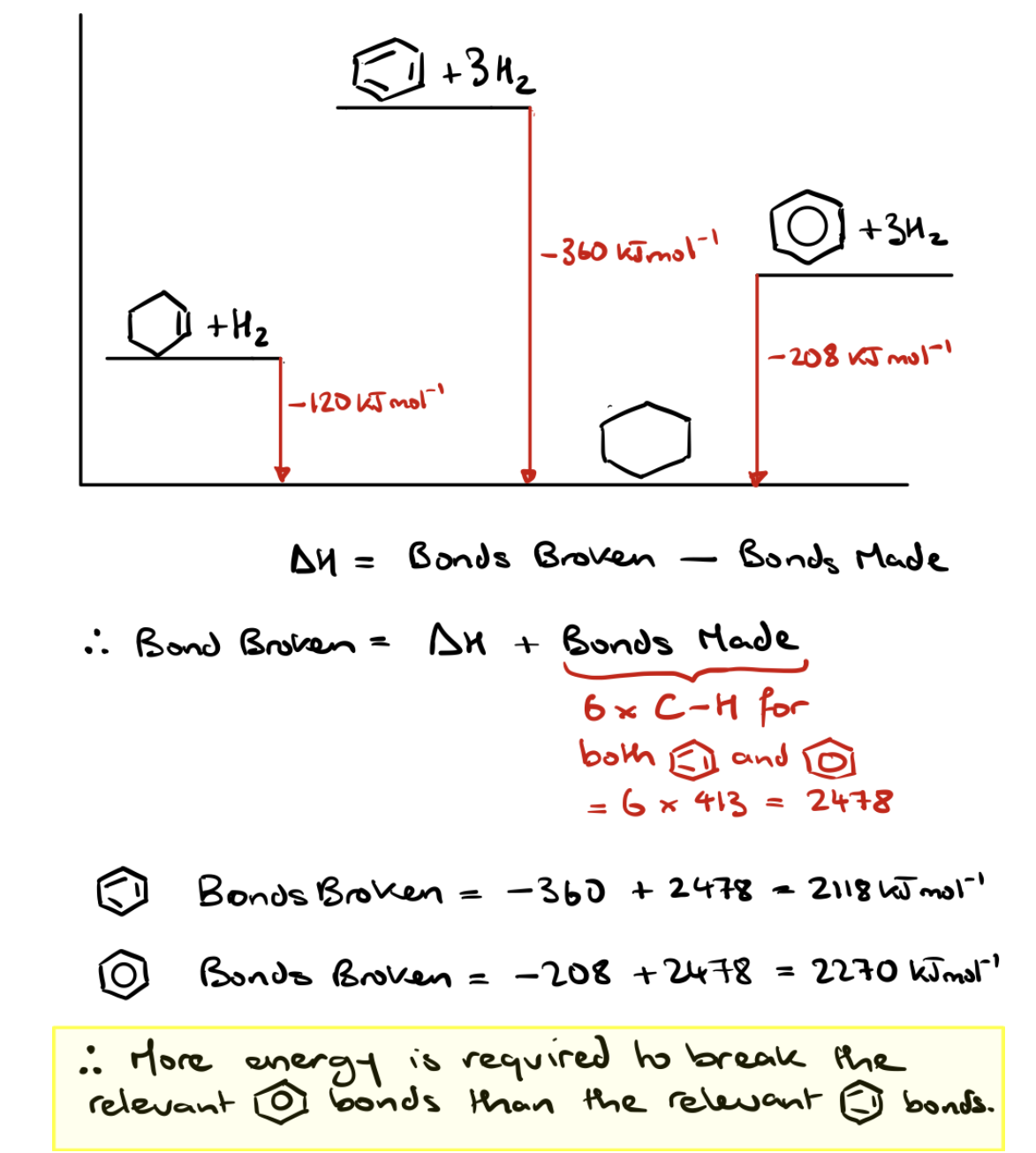
ΔΗ=
Bonds broken - bonds made
Why is benzne more stable than cyclohexa-1,3,5-triene? words
• ΔΗ=bonds broken-bonds made • ΔΗ= enthalpy of hydrogenation for each molecule • **bonds broken (strength)= ΔΗ+ bonds made ** • bonds made = what would be left after hydrogenating = cyclohexane, so 6 x C-H bonds formed = 6 x 413= 2478 • therefore bonds broken in cyclohexa-1,3,5-triene= 2478 + -360 =2,118 kJ mol -1 • therefore bonds broken in benzene= 2478 + -208 =2270 kJ mol -1 • therefore more energy required to break bonds in benzene than cyclohexa-1,3,5-triene