Combined Physics - 6.2
No description yet. This curated deck is ready for daily study.
Card preview (24)
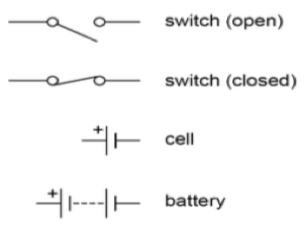
What are the circuit symbols for a switch (open and closed), a cell and a battery?
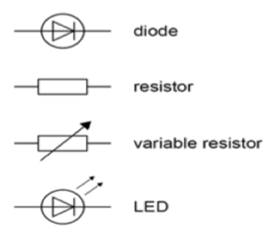
What are the circuit symbols for a diode, resistor, variable resistor and LED?
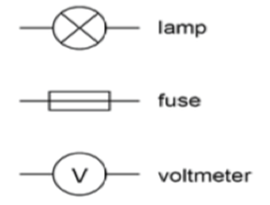
What are the circuit symbols for a lamp, fuse and voltmeter?
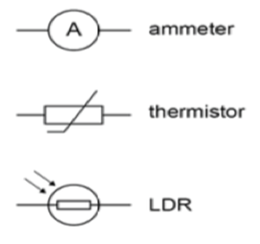
What are the circuit symbols for an ammeter, thermistor and LDR?
For electrical charge to flow through a closed circuit what must be included?
A source of potential difference
What is electrical current and what determines the size of the current?
The flow of electrical charge, determined by the rate of flow
What is the equation for charge flow?
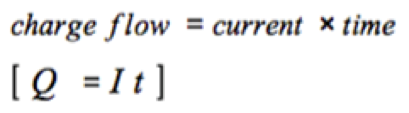
In a single closed loop, what value would the current have at any point?
The same value
What affects the current through a given component?
The resistance of the component and the potential difference across it
For a given potential difference, what happens to the current when the resistance increases?
The current gets smaller
What equation links potential difference, current and voltage?

What happens to the resistance of an ohmic conductor (such as a wire) when the current changes?
The resistance of ohmic conductors doesn’t change with current
What happens to the resistance of a diode or filament lamp when current changes?
Resistance increases with temperature, such as the current increases the resistance increases
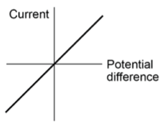
Draw and describe an I-V graph for an ohmic resistor (e.g. a resistor at a constant temperature)
Current (at constant temperature) is directly proportional to potential difference
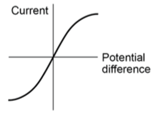
Draw and describe an I-V graph for a filament lamp
As the current increases the temperature of the filament lamp increases (so the resistance increases) meaning less current can flow per unit potential difference
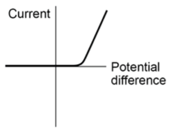
Draw and describe an I-V graph for a diode
Current will only flow in one direction (there is a very high resistance in the other direction)
What happens to the resistance of a thermistor as temperature increases?
As temperature increases a thermistor’s resistance decreases
Where are thermistors commonly found?
Car engine temperature sensors / electronic thermostats (as temperature rises the resistance decreases)
What happens to the resistance of a LDR as light increases?
As light increases a LDR’s resistance decreases
Where are LDRs commonly found?
LDRs are used as automatic night lights / burglar detectors (in bright light the resistance is low)
How are LDRs and thermistors used in sensing circuits?
Sensing circuits can be used to turn on / increase the power to components depending on conditions (e.g. as a room gets hotter the resistance of a thermistor decreases taking a smaller share of the potential difference from a power supply allowing a fan to get more potential difference and spin faster)
What are the two ways of joining an electrical component?
In series or in parallel
In a series circuit, what is the current like through all components?
The same
How is the total potential difference distributed between the components in a series circuit?
It is shared