Exam 2 Reactions
No description yet. This curated deck is ready for daily study.
Card preview (22)
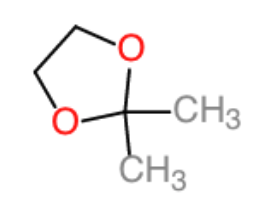
What type of acetal does this reaction create?
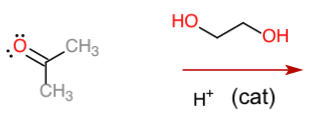
Cyclic Acetal
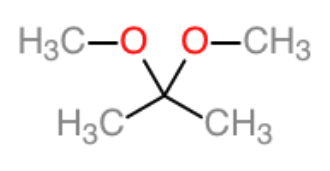
What type of acetal does this reaction create?
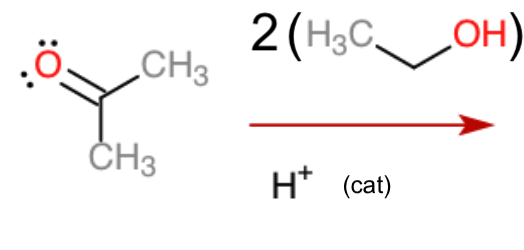
acyclic acetal
What reagent is necessary to make a cyclic acetal?
a carbon chain with OH on either end and an acid catalyst
What reagent is necessary to make an acyclic acetal?
a two sets of carbon chains with OH at the end and an acid catalyst
What are the components of a Grignard reagent?
[carbon chain] [magnesium] [halogen] R-Mg-X
What does a Grignard reagent do? How?
Turns a carbonyl (ketone or aldehyde) into an alcohol. The Grignard Reagent acts like nucleophile and attacks the carbonyl, shifting the double bond to a lone pair on the oxygen. The alkoxide ion is protonated (H added) from water creating an alcohol. A new C-C bond is formed.
What two sets of reagents can be used in a Hydride reduction of a ketone or aldehyde?
LiAlH4 and THF or NaBH4 and an alcohol
What are three ways to prepare an aldehyde?
• Oxidation of Primary alcohols (PCC, CH2Cl2 or DMP, CH2Cl2, or 1. DMSO, (COCl)2, 2. Et3N • ozonolysis of alkenes (1. O3, 2. DMS) • Hydroboration-Oxidation (1. R2B-H, 2. H2)2, NaOH
What are four ways to prepare a ketone?
• Oxidation of Secondary Alcohols (Na2Cr2O7, H2SO4, H2O) • Ozonoloysis of Alkenes (1. O3, 2. DMS) • Acid-Catalyzed Hydration of Terminal Alkynes (H2SO4, H2O, HgSO4 • Friedel-Crafts Acylation (Cl-(C=O)-R, AlCl3)
What are the steps for a nucleophilic addition under basic conditions?
Nucleophilic Attack followed by Proton Transfer • nucleophile attacks the Carbon of the carbonyl. • electrons in double bond migrate to Oxygen becoming a lone pair • Proton transfer: lone pair on Oxygen attacks the hydrogen on water • OH created and nucleophile stays attached to Carbon
Name this reaction. Explain the mechanism steps.

nucleophilic addition under basic conditions • nucleophile attacks the Carbon of the carbonyl. • electrons in double bond migrate to Oxygen becoming a lone pair • Proton transfer: lone pair on Oxygen attacks the hydrogen on water • OH created and nucleophile stays attached to Carbon
Name this reaction and explain the mechanism steps.
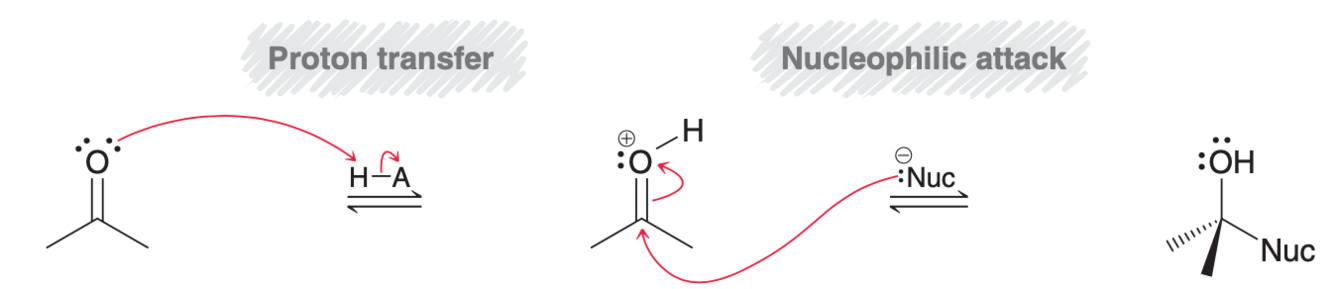
nucleophilic addition under acidic conditions • Proton Transfer: lone pairs on carbonyl oxygen attacks hydrogen on an acid. • Nucleophilic Attack: a nucleophile attacks the Carbon of the carbonyl. • electrons in double bond migrate to Oxygen becoming a lone pair • OH created and nucleophile stays attached to Carbon
What are the steps for a nucleophilic addition under acidic conditions?
Proton Transfer followed by Nucleophilic Attack • Proton Transfer: lone pairs on carbonyl oxygen attacks hydrogen on an acid. • Nucleophilic Attack: a nucleophile attacks the Carbon of the carbonyl. • electrons in double bond migrate to Oxygen becoming a lone pair • OH created and nucleophile stays attached to Carbon
Name this reaction and explain the mechanism steps.

Base-Catalyzed Hydration • Carbon of Carbonyl group attacked by lone pairs on the oxygen of a hydroxide (-OH) • electrons in double bond migrate to Oxygen becoming a lone pair • OH attaches and an anionic intermediate forms • lone pair of negatively charged oxygen (previously carbonyl oxygen) attacks hydrogen in H2O and protonates • two OH groups are now attached to carbonyl carbon
What are the steps for a base-catalyzed hydration?
Nucleophilic Attack followed by Proton Transfer • Carbon of Carbonyl group attacked by lone pairs on the oxygen of a hydroxide (-OH) • electrons in double bond migrate to Oxygen becoming a lone pair • OH attaches and an anionic intermediate forms • lone pair of negatively charged oxygen (previously carbonyl oxygen) attacks hydrogen in H2O and protonates • two OH groups are now attached to carbonyl carbon
Name this reaction and explain the mechanism steps.

Acid-Catalyzed Hydration • Protonation of carbonyl making it more electrophilic • Protonated carbonyl attacked by water forming oxonium intermediate (positively charge H2O) 2b. oxygen of water molecule attaches to carbon making it positively charged • Oxonium intermediate deprotonated by water, forming the hydrate 3b. Lone pairs of another H2O attacks hydrogen on oxonium, removing the hydrogen • Creates two OH groups on carbon
What are the steps for an acid-catalyzed hydration?
Proton Transfer followed by Nucleophilic Attack followed by Proton Transfer • Protonation of carbonyl making it more electrophilic • Protonated carbonyl attacked by water forming oxonium intermediate (positively charge H2O) 2b. oxygen of water molecule attaches to carbon making it positively charged • Oxonium intermediate deprotonated by water, forming the hydrate 3b. Lone pairs of another H2O attacks hydrogen on oxonium, removing the hydrogen • Creates two OH groups on carbon
Name this reaction and explain the mechanism steps.
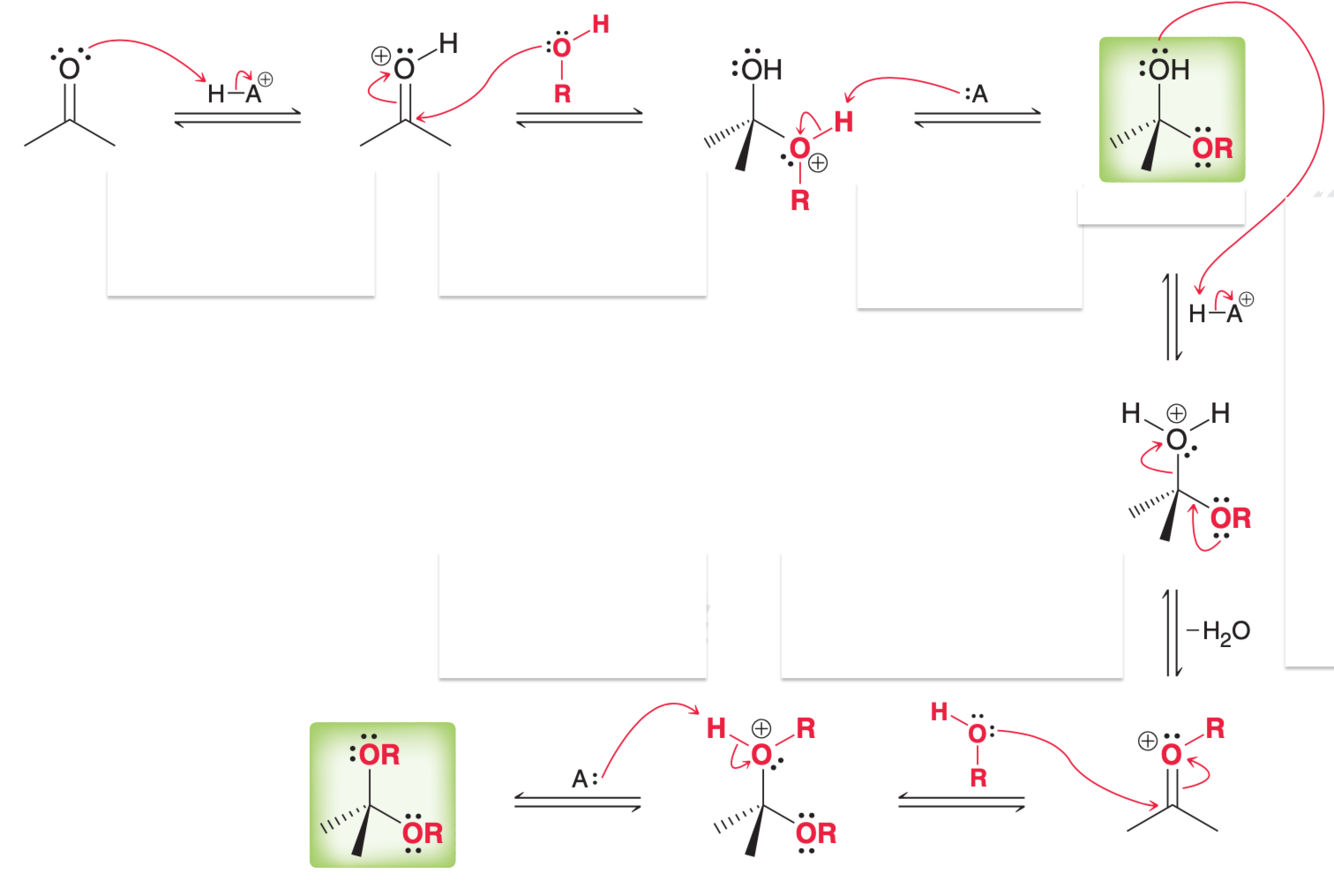
Acetal Formation Proton Transfer»_space; Nucleophilic Attack»_space; Proton Transfer»_space; Proton Transfer»_space; Loss of Leaving Group»_space; Nucleophilic Attack»_space; Proton Transfer • carbonyl protonates making it more electrophilic • First alcohol (from reagent) attacks protonated carbonyl and attaches to the carbon, creating oxonium intermediate (+H2O) • Oxonium deprotonated to form hemiacetal • OH protonated transforming into Good Leaving Group • Leaving Group leaves creating a R–C=O–R double bond • Second alcohol (from reagent) attacks C=O and attaches to carbon creating oxonium intermediate • Oxonium ion deprotonated creating acetal
What are the steps for an Acetal Formation?
Proton Transfer»_space; Nucleophilic Attack»_space; Proton Transfer»_space; Proton Transfer»_space; Loss of Leaving Group»_space; Nucleophilic Attack»_space; Proton Transfer • carbonyl protonates making it more electrophilic • First alcohol (from reagent) attacks protonated carbonyl and attaches to the carbon, creating oxonium intermediate (+H2O) • Oxonium deprotonated to form hemiacetal • OH protonated transforming into Good Leaving Group • Leaving Group leaves creating a R–C=O–R double bond • Second alcohol (from reagent) attacks C=O and attaches to carbon creating oxonium intermediate • Oxonium ion deprotonated creating acetal
Name this reaction and explain the mechanism steps.
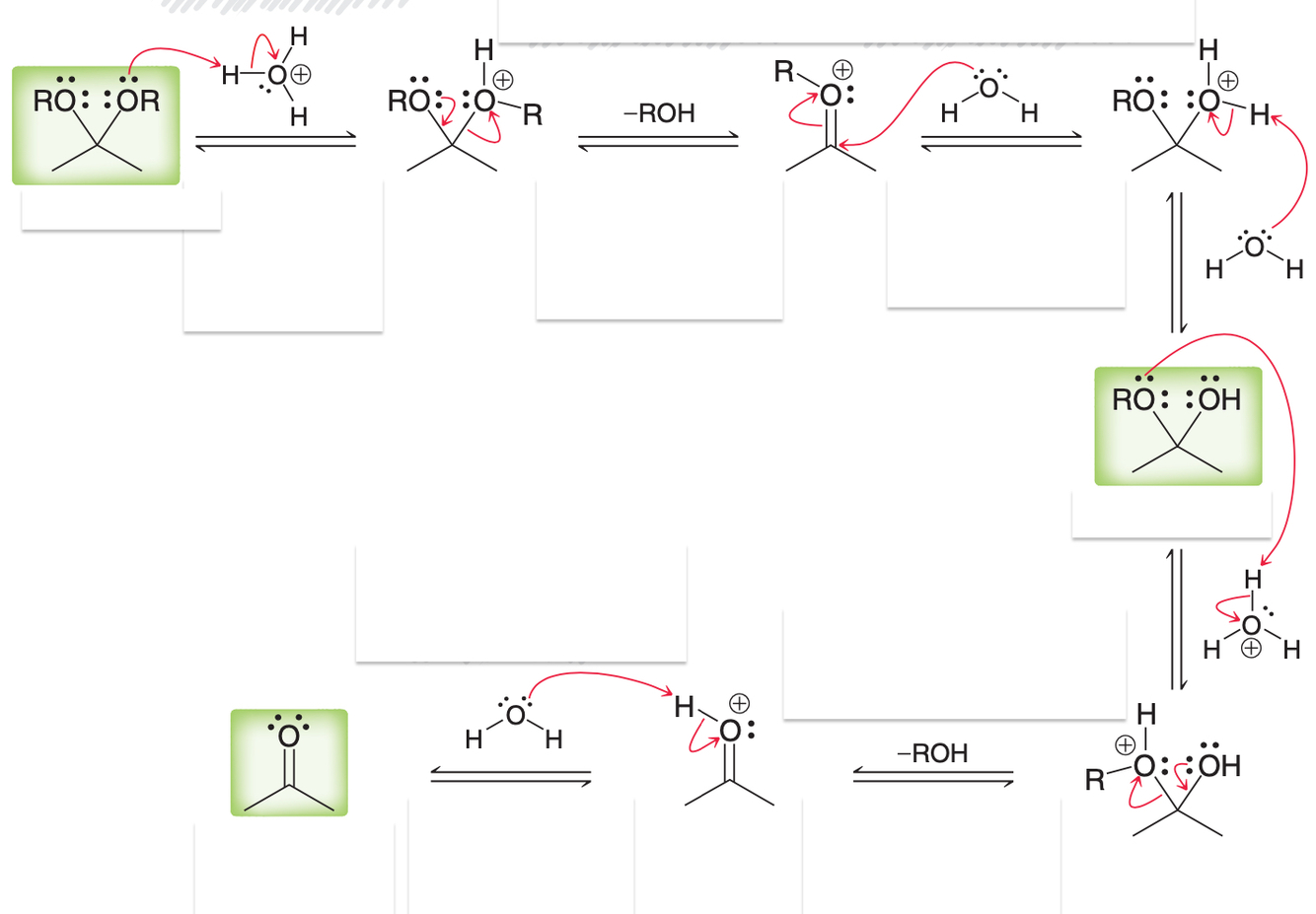
Hydrolysis of Acetals Proton Transfer»_space; Loss of leaving group»_space; nucleaophilic attack»_space; Proton transfer»_space; proton transfer»_space; loss of leaving group»_space; proton transfer
What are the steps for the Hydrolysis of acetals?
• protonation of one carbonyl from H3O • 1 R–OH is ejected, creating C=O with remaining oxygen • Nucleophilic attack of C=O by water, oxonium attaches • Water deprotonates oxonium creating OH • protonation of hemiacetal H3O creating good leaving group • lone pair from OH migrates creating C=O, R–OH is ejected • H-C=O is deprotonated by water creating a ketone
What are the three criteria that must be for a nucleophilic aromatic substitution to occur?
• The ring must contain a powerful electron-withdrawing group (typically a nitro group). • The ring must contain a leaving group (usually a halide). • The leaving group must be either ortho or para to the electron-withdrawing group. If the leaving group is meta to the nitro group, the reaction is not observed.